COLUMBUS, Ohio — Jeremiah Smith has spent the past two seasons making a compelling case that he is the most talented wide receiver in college football. His production is extraordinary. His physical gifts are obvious. His name is already attached to the kind of NFL projections normally reserved for players nearing the end of their college careers.
But some of Smith’s most meaningful work in Columbus never happened inside Ohio Stadium.
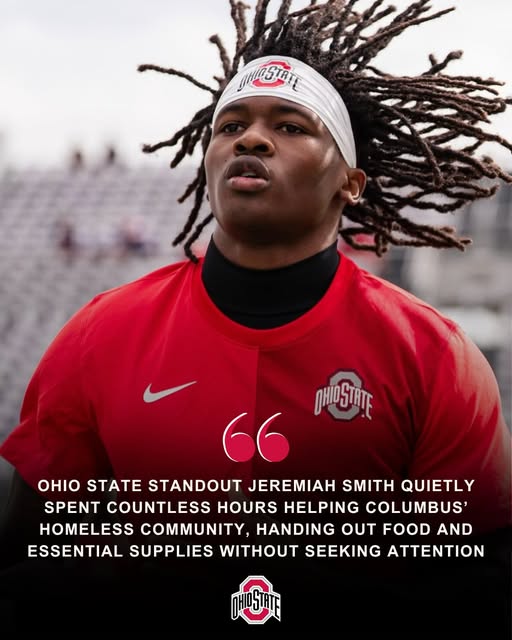
Away from the cameras, the autograph lines and the growing machinery surrounding college football’s most valuable stars, Smith has quietly spent time helping people experiencing homelessness in the Columbus community, providing food and essential supplies and returning even when there was little reason for anyone outside that community to know he was there.
That distinction matters.
College football has entered an era in which the biggest stars are increasingly recognizable brands. Smith is among the clearest examples. Yet the story surrounding him in Columbus is not simply about a player with extraordinary market value choosing to give something back. It is about why he kept returning.
The reason, according to the account surrounding his community work, was simple: Smith wanted people to feel seen.
That is a different kind of impact.
Smith’s football résumé would be enough to make him one of the most recognizable athletes in the country. As a true freshman in 2024, he caught 76 passes for 1,315 yards and 15 touchdowns, becoming the first freshman in Ohio State history to produce those numbers and immediately establishing himself as one of the country’s premier offensive weapons. He followed that with 87 receptions for 1,243 yards and 12 touchdowns in 2025.
Through two seasons, Smith had accumulated 163 catches, 2,558 yards and 27 receiving touchdowns.
Those numbers explain why defensive coordinators have spent two years constructing game plans around him.
They do not explain why he kept showing up for people who had nothing to offer him in return.
That is where the larger story begins.
Columbus has a substantial network of organizations working with people experiencing homelessness and food insecurity. The Open Shelter, for example, reported assisting more than 3,200 homeless and marginally housed people through the first part of 2026 while providing tens of thousands of meals and thousands of clothing and hygiene items.
The work is rarely glamorous. It is repetitive, personal and often invisible.
That makes Smith’s reported involvement notable precisely because it does not fit the usual script for a high-profile college athlete.
Smith could have made his philanthropy part of his brand. Instead, the defining characteristic of the story is that he did not.
That is especially striking given the size of the brand he has built.
The Ohio State receiver enters the 2026 season as one of the most valuable athletes in college sports. On3 currently lists his NIL valuation at $5 million, while other valuation models place his estimated market value in a similar range. Those numbers are estimates rather than disclosed salaries or guaranteed contracts, but they illustrate the commercial territory Smith occupies.
He has also built a portfolio of national partnerships, including deals involving brands such as Red Bull, Nintendo, adidas, KeyBank and American Eagle.
And yet, when Smith has had opportunities to make headlines away from the field, his choices have not always centered on maximizing his financial value.
Earlier this year, Smith revealed that he could have received more than $10 million to leave Ohio State through the transfer portal. He chose to remain in Columbus.
“Over 10 million dollars, easy,” Smith said of what he could have received, according to CBS Sports. “But that’s not how I operate.”
That decision was significant in the new economics of college football.
There is no NFL-style salary cap governing Ohio State’s roster, and college NIL compensation does not function as an NFL contract. But the economic pressure is real. Elite players can command millions of dollars in a market where roster construction, revenue sharing and third-party commercial opportunities increasingly intersect.
Smith nevertheless remained in Columbus.
His reasoning was football-related — he believed Ohio State had the quarterback, offensive line, coaching staff and roster necessary to compete for another national championship.
His community work offers another window into the same decision-making process: not every choice is measured in dollars.
On the field, the stakes for Smith in 2026 are enormous.
He enters his junior season as Ohio State’s established No. 1 receiving threat and as the centerpiece of an offense that has undergone a significant coaching transition. Arthur Smith has taken over as offensive coordinator, replacing Brian Hartline, and the Buckeyes are expected to incorporate more motion, multiple personnel groupings, play-action concepts and formation versatility.
That could create even more opportunities for Smith.
With quarterback Julian Sayin returning after a strong 2025 season, Ohio State has one of the country’s most intriguing quarterback-receiver combinations. Smith’s ability to win vertically, defeat press coverage and create explosive plays after the catch gives the Buckeyes an answer against the increasingly sophisticated man-coverage and split-safety structures used by elite defenses.
The numbers already demonstrate his efficiency as a primary target. Smith averaged 15.7 yards per reception during his first two seasons and scored once every six receptions across his career to date.
His 2027 NFL Draft status only increases the attention.
Because he was not eligible for the 2026 draft, Smith returned to Ohio State for his third season. Under NFL eligibility rules, this is the season after which he can enter the draft, making every snap considerably more important for both his professional evaluation and Ohio State’s championship ambitions.
NFL scouts do not need much convincing about the physical tools.
At roughly 6-foot-3 and more than 220 pounds, Smith combines size, acceleration, body control and ball skills that make him difficult to defend with conventional coverage. His freshman season already broke Ohio State receiving records associated with Cris Carter, and his production as a sophomore confirmed that his first season was not a fluke.
The question now is whether he can turn another dominant season into a legacy-defining one.
Ohio State enters 2026 with national championship expectations. The Buckeyes have talent throughout the roster, but the path to the College Football Playoff is demanding, with major games against opponents such as Texas, USC, Oregon and Michigan.
In that environment, Smith’s availability and efficiency could determine more than individual awards.
He will command safety help. He will see bracket coverage. Defensive coordinators will attempt to force Ohio State to win elsewhere.
That is precisely why his presence changes the geometry of the field.
But there is another kind of geometry at work in Columbus.
A player who can alter a defensive game plan with a single alignment is valuable. A player who can alter how a person experiencing homelessness feels about being forgotten is valuable in a different way.
Smith’s football career may eventually be measured in receptions, touchdowns, draft position and NFL earnings. Those measurements are inevitable. They are also incomplete.
The most powerful part of this story is that the young receiver did not need a national audience to validate the work.
He simply kept coming back.
In an era when college football stars are surrounded by cameras, agents, brands and social-media metrics, there is something striking about an athlete choosing to spend part of his time doing work that produces none of those rewards.
No receiving statistic captures it.
No scouting report can measure it.
And no NFL contract will make it more meaningful.
Jeremiah Smith’s greatest football moments may still be ahead of him. The 2026 season could bring another championship run, another collection of spectacular catches and, eventually, a place near the top of the NFL draft.
But in Columbus, his legacy is already beginning to take shape away from the field.
For all the attention surrounding what Smith can become as a football player, perhaps the more important question is what he chooses to become as a person.
And sometimes, the answer is found not under the lights, but in the quiet moments when nobody is watching.