COLUMBUS, Ohio — Ohio State is preparing to put more money directly into the hands of its athletes in 2026-27, another significant step in the rapid transformation of college sports from an amateur model into a system increasingly shaped by revenue, contracts and player compensation.
The Buckeyes are expected to distribute as much as $21.3 million to athletes during the 2026-27 academic year, an increase of roughly $800,000 from the $20.5 million maximum available to participating schools in 2025-26 under the House settlement. Ohio State athletic director Ross Bjork has indicated the university intends to use the full amount.
The increase is not a traditional “prize” awarded to players for winning games. It is part of the direct revenue-sharing framework created by the settlement of antitrust litigation involving the NCAA and major college conferences. Under the agreement, participating Division I programs can directly compensate their athletes from athletic revenues, with the allowable amount increasing by 4% annually.
For Ohio State, one of the most powerful athletic departments in the country, the significance extends well beyond the additional $800,000.
It represents another piece of the financial arms race that is reshaping the Big Ten and college football.
Ohio State entered the new era with a commitment to fully fund the $20.5 million revenue-sharing maximum in the first year of the system while maintaining its 36 varsity sports and athletic scholarships. The university previously described the new payments as direct compensation to student-athletes through NIL licensing agreements.
Now, that ceiling is moving upward.
The 2026-27 figure of approximately $21.3 million is a relatively modest increase when viewed against Ohio State’s overall athletic operation, but its competitive implications could be substantial. In an environment where elite recruits and transfer-portal targets increasingly evaluate programs according to the total economic opportunity available to them, every additional dollar matters.
And Ohio State has little reason to leave money on the table.
The Buckeyes operate in the Big Ten, where television revenue, stadium attendance, sponsorships and postseason exposure provide some of the strongest financial foundations in college athletics. Their ability to fully utilize the revenue-sharing limit gives coach Ryan Day and his staff another mechanism to compete for players alongside traditional recruiting, facilities, coaching and third-party NIL opportunities.
That distinction is critical.
The $21.3 million figure is not a salary cap for individual players. It is a school-level limit on direct revenue sharing. Athletes can still earn money through permissible third-party NIL arrangements, including endorsements, appearances and promotional agreements. There is no equivalent universal ceiling on those outside earnings, although such arrangements are subject to the new enforcement and reporting structure surrounding the post-House era.
In practical terms, Ohio State’s most valuable football players could therefore have compensation packages extending well beyond their share of the university’s direct revenue allocation.
That is where the economics become especially important for the Buckeyes.
Football remains the financial engine of most major athletic departments, and Ohio State is no exception. Yet the university cannot simply funnel the entire revenue-sharing pool into football. Ohio State has publicly committed to maintaining all 36 of its varsity programs while funding the new direct payments.
The distribution formula therefore becomes a strategic exercise.
Football players are likely to command the largest share because of the sport’s enormous revenue generation, audience and market value. Men’s basketball also operates in a high-value recruiting environment, while other sports have to be considered as Ohio State balances its financial commitments and legal obligations.
That makes the $21.3 million ceiling only part of the story.
The larger issue is how Ohio State allocates that money — and how effectively its athletic department can combine direct payments with outside NIL opportunities to retain established stars and attract future ones.
For Ryan Day, the timing is significant.
College football’s transfer portal has made roster construction increasingly fluid, while the elimination of traditional restrictions on direct athlete compensation has introduced another layer to personnel management. Coaches are no longer operating solely with scholarship limits, recruiting rankings and development projections. They are increasingly working within a financial ecosystem that resembles professional sports in some respects, even though college football has not adopted an NFL-style salary structure.
A quarterback deciding between two programs can now weigh coaching, scheme fit and development against a school’s direct revenue-sharing commitment and its ability to facilitate legitimate NIL opportunities.
The same is true for an elite wide receiver, pass rusher or offensive tackle.
For Ohio State, that can be particularly important because the program routinely competes for players who have NFL-caliber potential before they ever reach college.
The Buckeyes’ ability to put more resources into athlete compensation could help protect against roster erosion, particularly when programs across the SEC and Big Ten are operating with similarly aggressive financial strategies.
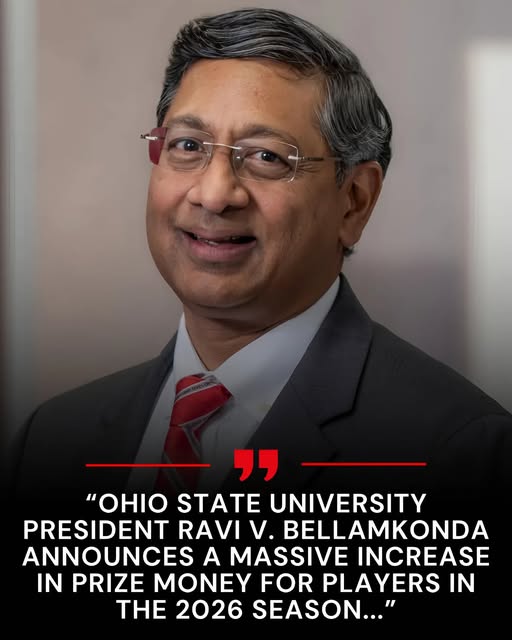
The change also comes during the first full period of President Ravi V. Bellamkonda’s tenure.
Bellamkonda, a biomedical engineer and former provost, was appointed Ohio State’s 18th president on March 12, 2026. His arrival came as the university entered one of the most consequential financial periods in the history of college athletics.
Bellamkonda has publicly emphasized institutional excellence and leadership across academics, athletics, health care and research. In his initial months as president, he described Ohio State as a university prepared to take on difficult challenges rather than retreat from them.
The changing economics of college sports will be one of those challenges.
Ohio State must balance the demands of a nationally competitive football program with its broader academic mission, 36-sport athletic portfolio and financial obligations. The direct revenue-sharing system creates new opportunities for athletes, but it also places greater pressure on athletic departments to generate and manage revenue efficiently.
That pressure will only increase.
The House settlement’s 4% annual increase means the amount schools can distribute is scheduled to rise over time. The $21.3 million figure for 2026-27 is therefore not the endpoint. It is the next step in a system designed to expand as the economics of college athletics evolve.
For Ohio State, that creates both an advantage and a responsibility.
The advantage is obvious: the Buckeyes possess the revenue base, national brand and Big Ten platform necessary to operate at the upper end of the new financial structure.
The responsibility is ensuring that additional spending actually produces competitive value.
In the NFL, teams operate under a formal salary cap and must constantly balance player contracts, roster construction and future flexibility. College football has no identical system. Instead, schools are navigating a hybrid model in which direct revenue sharing, scholarships and third-party NIL deals intersect with recruiting and roster management.
Ohio State’s challenge will be determining how to maximize that system without allowing financial commitments to overwhelm the broader athletic department.
The increase from $20.5 million to approximately $21.3 million may not sound revolutionary by professional sports standards.
In college football, however, it is another marker of a fundamental shift.
The era when athletes were restricted largely to scholarships and limited educational benefits is gone. Ohio State’s own public commitment to direct athlete compensation made that clear when the House settlement took effect.
Now the numbers are moving again.
And as the Buckeyes prepare for another season in which the margin between competing for championships and falling short can be razor thin, an additional $800,000 in direct athlete compensation could prove more consequential than the number suggests.
The real story is not simply that Ohio State has more money to distribute.
It is that the money is becoming an increasingly central part of roster construction, recruiting strategy and championship contention.
For the Buckeyes, the financial race has entered its next phase.