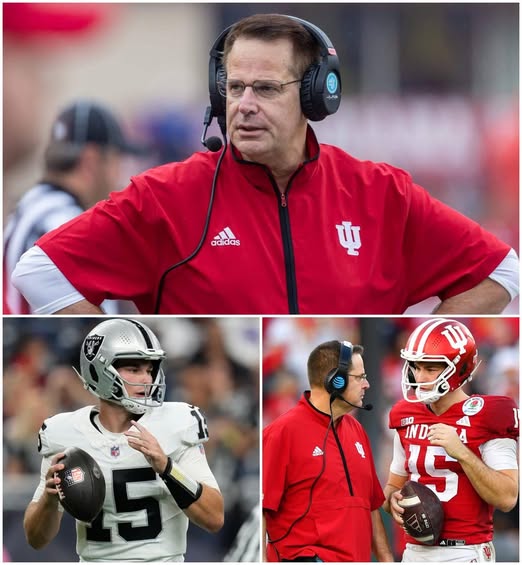
Former Coach Sends Strong Message to Raiders After Fernando Mendoza’s Difficult Performance
One difficult performance should not be enough to erase everything a young quarterback has accomplished.
That is the message coming from someone who has watched Fernando Mendoza develop long before the bright lights of the NFL began following his every move. For those who knew the quarterback before he became a highly scrutinized professional, the recent criticism surrounding Mendoza has raised an uncomfortable question: Have expectations for a young player crossed the line into something counterproductive?
Mendoza’s difficult outing against Houston has generated plenty of discussion, with fans and analysts questioning his decisions, execution and ability to handle the pressure that comes with being an NFL quarterback. Those concerns are understandable. Quarterbacks at this level are judged by results, and poor performances naturally invite criticism.
But according to someone who has seen Mendoza navigate adversity firsthand, there is a major distinction between holding a player accountable and allowing criticism to overwhelm him.
“I’m saying this as a teacher, a coach, and someone who watched Fernando grow, struggle, learn and come back stronger,” the coach said.
That perspective matters because quarterback development rarely follows a straight line.
Young quarterbacks are expected to make difficult decisions at tremendous speed while simultaneously dealing with defensive pressure, complicated schemes, national media attention and the expectations of an entire fan base. Mistakes are inevitable. What separates promising quarterbacks from those who ultimately fail is often how they respond to those mistakes.
Mendoza already understands that his performance against Houston was not good enough.
He does not need anyone to convince him of that.
The quarterback has spent much of his football career being evaluated, challenged and pushed to improve. A difficult afternoon is not something he can simply ignore. Every missed opportunity, questionable decision and inaccurate throw becomes another teaching point.
The concern, however, is what happens when criticism becomes relentless.
Fans have every right to demand better from their quarterback. They invest emotionally in the team, expect victories and want to see their players perform at the highest possible level. Constructive criticism is part of professional sports.
But there is a difference between saying a quarterback needs to improve and repeatedly attacking that quarterback until the criticism begins affecting his confidence.
That distinction becomes particularly important when dealing with a young player.
Quarterback is arguably the most mentally demanding position in football. The position requires confidence, decisiveness and the ability to move past mistakes almost immediately. A quarterback who begins hesitating because he is afraid of making another mistake can quickly find himself trapped in a cycle that becomes difficult to escape.
That is where the Raiders coaching staff becomes especially important.
The responsibility of developing a young quarterback does not end when the game begins. Coaching extends far beyond play calling and game planning. It involves understanding the individual behind the helmet and knowing how to respond when that player is struggling.
“If Fernando makes a bad read, coach him. If he throws an interception, show him what went wrong. If his confidence drops, help him get it back,” the coach said.
That may sound obvious, but quarterback development requires much more than identifying mistakes.
Coaches have to determine why the mistake happened.
Was the quarterback confused by the defensive coverage? Did he fail to recognize a pre-snap adjustment? Was he rushed by pressure? Did he simply make the wrong decision? Or did fear of making a mistake cause him to hesitate?
Those questions matter.
A quarterback cannot improve if every mistake is treated as evidence that he is incapable of playing the position. Instead, mistakes have to become opportunities for instruction.
The best coaching staffs understand when a player needs tough accountability and when he needs reassurance.
There will be moments when Mendoza needs to be challenged. There will be times when coaches have to tell him that a decision was unacceptable. There will be film-room sessions in which every mistake is dissected and corrected.
But there also have to be moments when the quarterback is reminded why the coaching staff believes in him.
That balance can become critical as the season progresses.
Mendoza did not arrive at the professional level by accident. His journey has been defined by preparation, development and an ability to respond when circumstances become difficult. Those qualities did not disappear because of one disappointing game.
In fact, adversity can become one of the most important stages of his development.
Every successful quarterback eventually experiences a period when the game does not go according to plan. Some lose confidence. Others become overly cautious. The best eventually learn how to process failure without allowing it to define them.
That is why the reaction to Mendoza’s struggles should extend beyond the box score.
A quarterback’s development is measured over months and years, not one afternoon.
The Raiders must evaluate what went wrong against Houston, identify the correctable issues and then put Mendoza in a position to improve. That could involve adjustments to his preparation, footwork, reads, protection responsibilities or offensive structure.
But the solution cannot simply be to place more pressure on a player who is already carrying a tremendous amount.
The national spotlight makes that challenge even greater.
Every throw is analyzed. Every interception can become a social-media trend. Every questionable decision is replayed from multiple angles. Every poor performance creates another round of questions about whether a young quarterback is truly capable of becoming the franchise player a team hopes he can be.
That environment can become overwhelming.
It is precisely why the people inside the building have to provide stability.
The coach who spoke out believes he has seen Mendoza face adversity before. More importantly, he has watched the quarterback respond to it.
“I’ve seen Fernando struggle before, and I’ve also seen him respond,” he said. “One bad game does not erase his talent or everything he has done to reach this level.”
That message is ultimately about perspective.
Mendoza should absolutely be held accountable. He should study the film, acknowledge his mistakes and work relentlessly to correct them. There should be no excuses for poor execution.
But accountability and confidence are not mutually exclusive.
A quarterback can be told he must play better while simultaneously being reminded that one performance does not determine his future.
That responsibility falls heavily on the coaching staff.
If Mendoza begins pressing because he believes every mistake will result in another wave of criticism, the Raiders could make his development more difficult than it needs to be. If, however, the coaching staff can turn the Houston performance into a learning experience, the game could eventually become an important chapter in his growth.
The most successful quarterback development programs understand that young players need structure, patience and accountability.
They need coaches willing to correct them without breaking them.
They need teammates who maintain confidence in them when things go wrong.
And they need an organization capable of resisting the temptation to overreact to every difficult performance.
“If the people around him cannot help him handle the pressure and rediscover his best football, then maybe they don’t understand quarterback development — or football — nearly as well as they think they do,” the coach said.
That is a pointed message, and one that some Raiders supporters may not want to hear.
But it is also a message worth considering.
The frustration surrounding Mendoza is understandable. Expectations are high, and professional football does not offer young quarterbacks unlimited time to figure things out. The Raiders need production, consistency and improvement.
At the same time, development requires room to learn.
Mendoza’s response to adversity may ultimately tell the Raiders far more about his long-term potential than one difficult game ever could. If he studies the mistakes, regains his confidence and performs better in the weeks ahead, the Houston game could become less of a warning sign and more of a turning point.
That process begins with the quarterback himself.
But it does not end there.
The coaching staff, teammates and fan base all have a role in creating the environment in which a young quarterback can develop. Criticism will always be part of playing in the NFL. So will pressure.
The key is making sure that pressure produces improvement rather than hesitation.
Mendoza has already demonstrated that he can face adversity.
Now the challenge for the Raiders is to show that they know how to help him overcome it.
One bad game does not erase a quarterback’s talent, potential or journey.
For Mendoza, the next chapter will be determined not by what happened against Houston, but by how he responds when the football is placed back in his hands.