“BENCH HIM… ENOUGH IS ENOUGH!” — Indiana Fans Demand Curt Cignetti Make a Major Lineup Change
BLOOMINGTON, Ind. — The pressure surrounding Indiana’s defending national championship team is arriving before the Hoosiers have even taken their first snap of the 2026 regular season.
That is the reality Curt Cignetti faces as Indiana enters the final stretch before its Sept. 5 opener against North Texas, with an increasingly demanding fan base scrutinizing every position battle, every personnel decision and every indication of who will receive meaningful snaps when the games finally count.
Among the loudest conversations is a simple one: if a player fails to meet the standard expected of a defending national champion, how long should Cignetti allow him to remain in the starting lineup?
Some Indiana supporters have already adopted an uncompromising position — “Bench him. Enough is enough.”
But Cignetti has never built his program around reacting to outside noise.
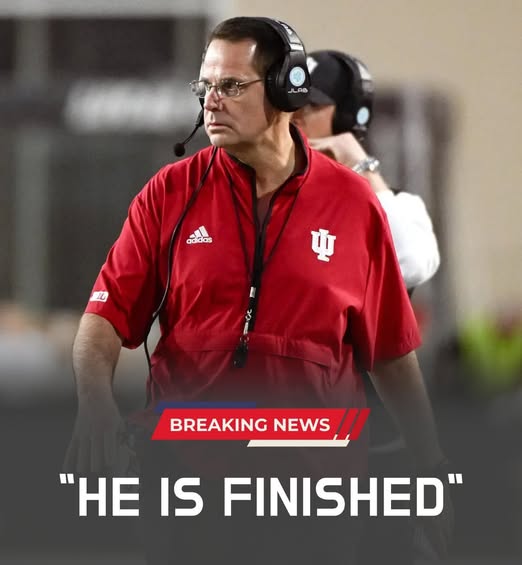
The third-year Indiana coach transformed the program through competition, development and accountability. After taking over a team that had struggled for consistency, Cignetti guided the Hoosiers to an extraordinary 11-1 regular season in his first year. In 2025, Indiana went another level, completing a perfect 16-0 campaign and winning the national championship.
That success has changed the standard in Bloomington.
Last season, simply competing was no longer enough. Now, Indiana is expected to defend a championship.
That creates an unusual dynamic entering 2026. Cignetti must replace several foundational players from the championship roster, including Heisman Trophy-winning quarterback Fernando Mendoza, while integrating a transfer-heavy group into a team that suddenly carries the expectations of a national contender.
Indiana’s official 2026 roster reflects the extent of the transition. Josh Hoover has taken over at quarterback after transferring from TCU, while the coaching staff remains led by Cignetti with Mike Shanahan overseeing the offense and Bryant Haines coordinating the defense.
Hoover is perhaps the most obvious example of the standard facing the new-look Hoosiers.
He is not being asked merely to replace a quarterback.
He is being asked to follow Mendoza.
Mendoza’s departure to the NFL created one of the most significant personnel changes in college football. He finished his Indiana career as the centerpiece of the program’s championship run before becoming the projected No. 1 overall selection in the 2026 NFL draft.
Hoover arrives with extensive experience, but replacing elite production is never a simple statistical exercise. Indiana will have to establish whether its new quarterback can consistently win from the pocket, protect the football and operate efficiently when opponents take away the first read.
That is why Cignetti’s decisions during camp have attracted so much attention.
The coach acknowledged during fall camp that several position battles remained unresolved, including the running-back rotation and the competition for the No. 2 cornerback spot.
The uncertainty is not necessarily a sign of dysfunction.
It may be the opposite.
For a championship program, competition is supposed to create pressure.
Cignetti has repeatedly demonstrated that reputation does not guarantee playing time. His philosophy is built around performance, and the 2026 roster contains enough experienced transfers and returning contributors to make virtually every position vulnerable if a player fails to execute.
That reality is particularly important at positions where one poor decision can dramatically affect an entire game.
A quarterback who repeatedly misses protection checks can expose an offensive line. A cornerback who loses leverage can turn a third-and-long into a touchdown. A running back who misses a blitz pickup can put the quarterback in immediate danger. A receiver who repeatedly fails to separate can force an offense into predictable passing situations.
Modern college football is too competitive for coaches to ignore those mistakes indefinitely.
Still, there is a difference between demanding accountability and making a knee-jerk personnel decision.
That distinction matters for Indiana.
The Hoosiers’ 2026 schedule is considerably more demanding once Big Ten play begins. Indiana will face Nebraska and Rutgers on the road before hosting Ohio State on Oct. 17. Michigan follows one week later in Ann Arbor, while USC and Washington also appear later in the schedule.
Those games will determine whether Indiana can remain in the College Football Playoff conversation.
There is little room for prolonged experimentation.
But there is also little value in abandoning a player after one mistake.
The most successful coaching staffs separate isolated errors from structural problems. A single missed assignment is coachable. A pattern of missed assignments is a personnel issue. Advanced evaluation increasingly revolves around that distinction, using efficiency, success rate, explosive-play prevention, missed tackles, pressure rate and other measures to determine whether a player’s problems are temporary or systemic.
For Cignetti, that evaluation will matter more than social-media outrage.
Indiana’s championship season created a new problem that every successful program eventually encounters: expectations can become more difficult to manage than failure.
A fan base that once celebrated incremental improvement now expects dominance.
That can make every incomplete pass feel like a warning and every defensive breakdown feel like evidence that something is fundamentally wrong.
The coaching staff cannot operate that way.
Cignetti has spent two seasons establishing a culture in which decisions are supposed to be based on preparation and production rather than popularity. His roster-building strategy also reflects that philosophy. Indiana entered the 2026 season with a highly regarded transfer class designed to replenish talent after losing key contributors to the NFL and transfer portal. The program’s approach has been to reload rather than rebuild.
That makes the upcoming quarterback and position battles especially important.
If a starter struggles, Cignetti has options.
If a player consistently fails to execute, there is likely another competitor waiting.
But having options does not mean making changes immediately.
The better question for Indiana is not whether fans are frustrated.
It is whether the player in question is helping Indiana win.
That is the standard Cignetti ultimately has to apply.
The stakes are unusually high because Indiana is no longer operating in obscurity. The Hoosiers enter 2026 as the defending national champions, with expectations that extend beyond winning the Big Ten and into another College Football Playoff run. Their schedule provides little margin for error, particularly during the brutal middle portion of the season.
A lineup decision that looks minor in September could become enormous by October.
The Ohio State game, Michigan trip and later USC and Washington matchups will expose weaknesses that early-season opponents may not be equipped to exploit.
That is why Cignetti’s personnel decisions deserve scrutiny — but not sensationalism.
If a starter cannot protect the football, execute assignments or consistently produce, eventually the coaching staff has to make a change.
If the player is developing, responding to coaching and contributing in ways that do not always appear on a stat sheet, patience may be the correct decision.
Indiana has already shown that Cignetti understands that distinction.
The next test is whether the players do.
And when the Hoosiers finally take the field against North Texas on Sept. 5, the most important response to the “bench him” conversation will not come from social media.
It will come from the depth chart.
Cignetti has made one principle clear throughout his tenure: nobody is entitled to a starting job.
For a defending national champion, that may be the most important rule on the roster.