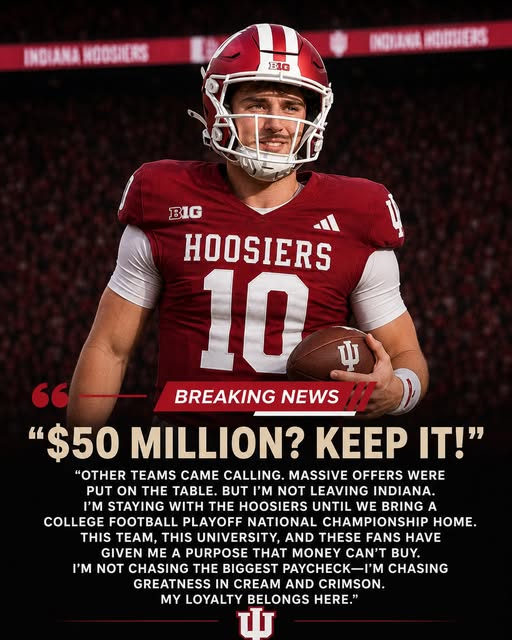
And, reportedly, he has chosen to stay put.
The Indiana Hoosiers quarterback has emerged as one of the most closely watched players in the country entering the 2026 season, and a stunning report that Hoover has rejected opportunities worth as much as $50 million has only intensified the attention surrounding the reigning national champions. According to the storyline circulating around the program, Hoover’s message has been unmistakable: money can wait. The championship cannot.
“I’m staying with the Indiana Hoosiers until we lift the championship trophy,” Hoover reportedly declared.
If that commitment holds, it would represent one of the most consequential decisions of the new era of college football — a period in which elite quarterbacks can command enormous NIL valuations, transfer opportunities and professional-level endorsement packages without ever leaving campus.
For Indiana, it could be the difference between defending a championship and merely trying to remain relevant after the departure of Heisman Trophy winner Fernando Mendoza.
Hoover is not simply being asked to replace Mendoza. He is being asked to follow him.
That distinction matters.
Indiana enters the season carrying expectations that would have been almost unimaginable before coach Curt Cignetti arrived. The Hoosiers went a reported 16-0 during their championship campaign, established themselves as one of the nation’s most complete teams and turned what had once been a rebuilding project into a national powerhouse.
Now the standard has changed.
The goal is no longer simply to win the Big Ten.
It is to repeat.
Hoover is at the center of that pursuit.
The veteran quarterback brings a résumé that makes the transition less daunting than it might appear on paper. He has started 31 games during his career and has accumulated nearly 10,000 passing yards and 79 total touchdowns. Those numbers don’t guarantee that he will duplicate Mendoza’s production, but they provide Indiana with something invaluable: experience.
That experience could become particularly important because Mendoza’s departure leaves more than a statistical void.
It leaves an emotional one.
Mendoza became the face of Indiana’s breakthrough season, eventually winning the Heisman Trophy before moving toward the NFL. His departure created the obvious question entering 2026: Could Cignetti’s program sustain championship-level quarterback play?
Hoover’s answer, at least publicly, has been to embrace the challenge.
The quarterback’s arm talent has drawn comparisons to Mendoza’s, while his familiarity with the offense gives Indiana a foundation upon which to build. Rather than spending the offseason learning the system from scratch, Hoover has been able to focus on the finer points of operating it — protection checks, coverage recognition, progression timing and situational football.
Those details become decisive when a team moves from being a contender to being the hunted.
And Indiana will be hunted.
The Hoosiers were placed at No. 6 in the preseason Associated Press poll, a ranking that some around the program may regard as an insult considering what happened last season. But preseason rankings don’t determine championships. They establish expectations, and Indiana will have little room to surprise anyone this fall.
Opposing defenses will arrive with a specific objective: force Hoover to beat them.
That means disguising coverage, manipulating safety rotations, attacking protections and forcing Indiana into unfavorable down-and-distance situations. The quarterback’s response will determine whether the Hoosiers remain among the nation’s elite.
Hoover’s reported decision to reject enormous financial opportunities adds another dimension to that challenge.
College football’s financial landscape has fundamentally changed. The introduction of direct revenue-sharing arrangements, increasingly sophisticated NIL operations and the transfer portal has made quarterback economics resemble professional football more closely than ever.
But unlike the NFL, college football does not operate under a conventional salary cap or standardized contract system. There is no leaguewide $50 million quarterback contract that can simply be compared with another player’s deal.
Instead, NIL agreements, institutional revenue-sharing structures, endorsements and other compensation mechanisms can create extraordinary valuations.
That makes the reported $50 million figure difficult to evaluate without knowing the precise structure, duration and guarantees of any alleged offer.
Still, the underlying story is significant.
If Hoover truly rejected a package of that magnitude, Indiana would have retained something money cannot easily purchase: continuity at the game’s most important position.
Quarterback continuity has become one of the most valuable commodities in the transfer-portal era. Programs routinely lose starters after successful seasons, while quarterbacks move in search of playing time, larger NIL opportunities or better championship situations.
Indiana appears to have avoided that cycle.
Cignetti’s role in that decision should not be overlooked.
The coach has built his program around development, accountability and competition rather than relying exclusively on star power. His challenge now is managing expectations while preventing the championship from becoming a burden.
Cignetti has repeatedly emphasized the importance of maintaining the habits that produced Indiana’s breakthrough. That philosophy will be tested immediately.
The Hoosiers return a coaching staff that helped construct one of the nation’s best defenses last season. Indiana reportedly led the country with 30 takeaways while allowing only 11.7 points per game, good for second nationally, and 266.0 yards per game, ranking fourth.
That defense provides Hoover with an enormous advantage.
He doesn’t need to throw for 400 yards every Saturday.
If Indiana can continue generating short fields and limiting explosive plays, the offense can operate with greater patience. Hoover’s job becomes converting third downs, protecting the football, creating explosive plays when opportunities appear and executing in the red zone.
Turnover margin could be particularly important.
A quarterback replacing a Heisman winner does not need to become a clone of that player. He needs to avoid turning manageable games into uphill battles.
Indiana’s roster also provides Hoover with legitimate weapons.
Junior wide receiver Charlie Becker enters the season after recording 34 receptions for 679 yards and four touchdowns, giving the quarterback a proven vertical target. The development of Becker and the rest of Indiana’s receiving corps will be critical because defenses will attempt to compress the passing game and force Hoover into contested throws.
The offensive line will also determine how much freedom Hoover has to operate.
Senior left tackle Carter Smith’s return is particularly important. Smith underwent shoulder surgery to repair a torn labrum and missed spring practice, but his return provides experience at a premium position.
For a quarterback, protection isn’t merely about avoiding sacks.
It determines whether the offense can run deeper concepts, whether play-action remains credible and whether the quarterback can progress beyond his first read.
Indiana’s championship defense gives the program a margin for error. Hoover’s job is to preserve it.
That is why the reported decision to remain in Bloomington could ultimately be more valuable than the headline number.
A quarterback can chase the largest offer available.
Hoover, reportedly, is chasing something else.
A second consecutive national championship would place Indiana in rare territory. The College Football Playoff era has produced champions capable of sustaining elite programs, but repeating requires extraordinary depth, health, quarterback play and week-to-week consistency.
The Big Ten makes the challenge even more difficult.
Ohio State, Michigan, Oregon, Penn State and other conference powers have the resources and recruiting infrastructure to punish any decline. Indiana no longer has the luxury of entering conference play as an overlooked challenger.
Every opponent gets the defending national champion’s best shot.
That reality makes Hoover’s decision — if the reports prove accurate — strategically significant beyond one player.
It signals that Indiana’s championship culture may be becoming self-sustaining.
The biggest question, however, isn’t whether Hoover values money less than championships. It’s whether his performance can justify the confidence surrounding him.
Replacing Mendoza is one thing.
Creating a new identity is another.
Hoover doesn’t need to replicate the Heisman winner’s exact statistical profile. He needs to make Indiana’s offense efficient, explosive and difficult to defend. He needs to convert pressure situations into victories. And when the Hoosiers reach the biggest games of the season, he needs to make the throws that separate champions from contenders.
The money will remain part of the conversation.
So will the NFL.
But for now, the message coming out of Bloomington is about unfinished business.
Indiana already climbed the mountain once.
Hoover reportedly wants to climb it again.
And if he can lead the Hoosiers back to the College Football Playoff and ultimately deliver another national championship, the decision to stay could become one of the defining moments of Indiana football’s transformation — not because of the $50 million he supposedly turned down, but because of what he chose to pursue instead.