Ohio State’s Championship Dream Remains Alive Despite Growing Criticism
An optimistic message from an Ohio State supporter highlights the fine line between disappointing results and a team’s potential to compete for the national championship.
Results matter. In college football, they often determine the tone of an entire week, the confidence of a fan base, and the level of scrutiny directed toward a coaching staff. A victory can silence critics, while a defeat can transform optimism into frustration almost overnight.
For Ohio State, that familiar cycle of public reaction has once again become a central part of the conversation surrounding the program.
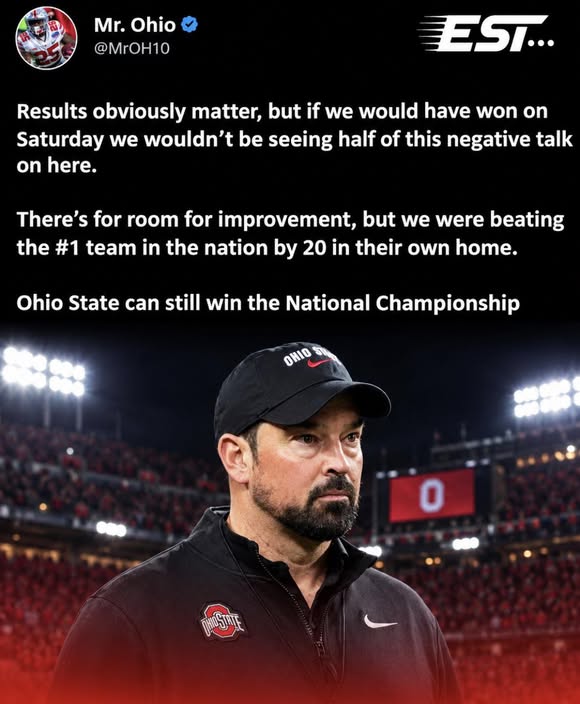
A social media post from an account identified as “Mr. Ohio” offered a measured defense of the Buckeyes, acknowledging that the team has room for improvement while insisting that its championship ambitions remain intact. The message, shared alongside an image of an Ohio State coach on the sideline, argued that the negative discussion surrounding the program would have been considerably less intense had the team won on Saturday.
“Results obviously matter,” the post stated, before suggesting that a victory would have prevented much of the criticism now directed toward the team.
That observation captures a fundamental reality of high-level college football: performance is judged not only by what a team does on the field, but also by whether it produces the result expected of it.
For a program with Ohio State’s national profile, expectations are especially demanding. The Buckeyes are traditionally measured against the highest standards in the sport, and anything short of a convincing performance can trigger questions about execution, consistency, preparation, and the team’s ability to handle pressure.
Yet the post’s broader argument is that one disappointing outcome should not erase the evidence of what Ohio State is capable of achieving.
A Reminder of the Team’s Potential
The most significant claim in the message is that Ohio State was beating the nation’s No. 1-ranked team by 20 points in its own stadium.
That detail is used as evidence that the Buckeyes possess the ability to perform at an elite level, even if their overall performance has not been flawless. The implication is straightforward: a team capable of building such a substantial advantage against the country’s top-ranked opponent should not be dismissed because of one unfavorable result.
The distinction between potential and performance, however, is crucial.
Potential demonstrates what a team can do under the right circumstances. Results determine whether it can reproduce that level of performance consistently. Championship contenders must ultimately bridge that gap.
Ohio State’s challenge, as reflected in the post, is not necessarily a lack of talent or ambition. Rather, it is the need to convert promising stretches of football into complete, dependable performances.
A team can display championship-level ability in one part of a game and still leave questions unanswered if it struggles to maintain its advantage. The most successful programs understand that strong starts must be supported by disciplined execution, effective adjustments, and the ability to finish.
The social media message does not dismiss those concerns. Instead, it concedes that there is “room for improvement,” while arguing that the team’s ceiling remains high.
The Weight of Expectations
The reaction surrounding Ohio State also illustrates the pressure that accompanies national championship expectations.
When a team enters a season with ambitions of competing for the highest honors, supporters often judge individual games through the lens of the larger objective. A narrow victory may be viewed as insufficient, while a defeat can appear to threaten the entire season.
That dynamic creates a difficult environment for coaches and players. Every performance becomes part of a larger narrative, and public criticism can grow quickly when expectations are not met.
The post’s author suggests that the negative conversation is partly a product of the result itself. Had Ohio State won on Saturday, the same stretches of strong play might have been discussed more positively, while the team’s weaknesses would likely have received less attention.
There is an important point in that argument. Results influence perception, but they do not tell the whole story. A win can conceal problems that later become costly, just as a loss can expose weaknesses in an otherwise talented team.
For Ohio State, the task is to evaluate both dimensions honestly: the result and the performance that produced it.
Can the Buckeyes Still Win the National Championship?
The post concludes with an emphatic declaration that Ohio State can still win the national championship.
That statement reflects confidence rather than a guarantee. The message does not claim that the Buckeyes have already solved their problems. Instead, it argues that the team’s demonstrated ability remains sufficient to keep the championship conversation alive.
Whether that confidence is ultimately justified will depend on what happens next. Ohio State must show that the shortcomings acknowledged by the post can be addressed. The team will need to improve its consistency, respond effectively to adversity, and demonstrate that its strongest performances are not isolated moments.
Championship aspirations require more than the ability to compete with elite opponents. They require sustained execution throughout a demanding season.
The post’s optimism is therefore best understood as a call for perspective. It asks supporters to consider the full picture rather than allowing one result to define the program’s identity or future.
A Season Still Defined by Opportunity
The most constructive reading of the message is that Ohio State’s season remains a work in progress.
The criticism surrounding the team may be understandable, particularly when expectations are high and results fall short. At the same time, the evidence cited by the post suggests that the Buckeyes have shown enough quality to remain relevant in the national championship discussion.
Those two realities can exist together.
A team can be talented and still require improvement. It can disappoint in one game and remain capable of achieving significant success. It can face legitimate criticism without losing the confidence of its supporters.
For Ohio State, the next stage of the season will determine whether the optimism expressed in the post becomes a meaningful reflection of the team’s trajectory.
The Buckeyes do not need to eliminate every concern immediately. They do, however, need to demonstrate progress where it matters most: on the field, in the execution of their game plan, and in their ability to deliver when the stakes are highest.
The message from “Mr. Ohio” ultimately offers a reminder that championship football is not defined by one Saturday alone. Results will continue to matter, and criticism will remain part of the landscape. But so will the opportunity to improve.
Ohio State’s championship dream, as the post argues, is not over. The responsibility now rests with the team to turn that belief into consistent performances that can withstand the pressure of the season ahead.