An account of postgame hospitality in Ann Arbor offers a powerful reminder that the greatest traditions in college football extend beyond the scoreboard.
College football has always been about competition. It is about the roar of packed stadiums, the pride of generations of supporters, and the emotional investment that turns a Saturday afternoon into an experience capable of lasting a lifetime.
But the sport’s significance is not measured exclusively by touchdowns, victories, or championship trophies. Sometimes, its most meaningful moments happen away from the field, in conversations between strangers, inside crowded bars, or during the walk out of a stadium after the final whistle.
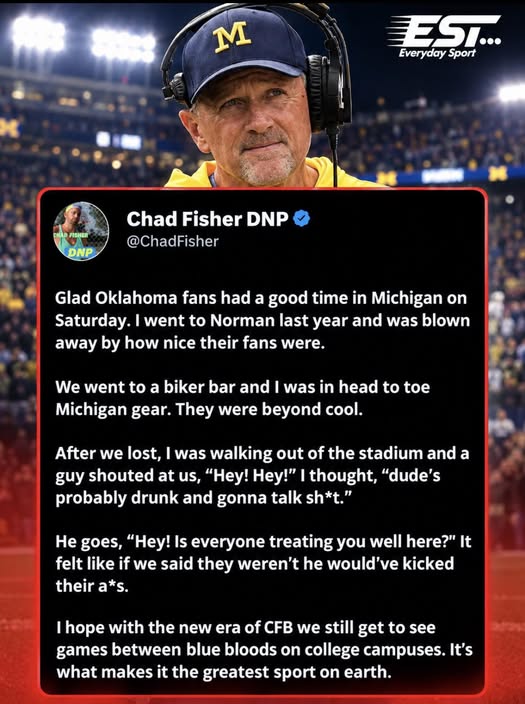
A recent social media post by Chad Fisher DNP highlights precisely that side of the game.
Reflecting on a visit to Norman, Oklahoma, the previous year and a subsequent trip to Michigan, Fisher praised the hospitality he encountered from Michigan supporters. His account offered a personal perspective on the culture surrounding college football and raised a broader question about the future of the sport: Can the traditions of respect, rivalry, and campus-based competition survive in an increasingly changing college football landscape?
His answer was hopeful.
A Rivalry Defined by More Than the Result
Fisher’s story begins with a simple observation. He was pleased that Oklahoma fans had enjoyed their visit to Michigan on Saturday, recalling how impressed he had been by the treatment he received in Norman the previous year.
That comparison is significant because college football rivalries often create an atmosphere of intense competition. Supporters identify strongly with their schools, and the outcome of a game can influence the mood of an entire community.
Yet the most enduring rivalries are not necessarily defined by hostility. They are built on mutual recognition, shared traditions, and an understanding that the opposing team is part of what makes the sport special.
Fisher’s account suggests that Michigan supporters embraced that principle.
He recalled visiting a biker bar with friends while wearing Michigan gear. Rather than encountering hostility, the group was met with a welcoming atmosphere. He described the people there as exceptionally friendly, a detail that stood out because of the obvious rivalry between the schools.
The story illustrates how sports can create opportunities for people with different allegiances to share experiences. A team’s colors may separate supporters inside the stadium, but they do not have to prevent meaningful interactions outside it.
The Moment That Made the Difference
The most memorable part of Fisher’s account occurred after the game.
As he was leaving the stadium, a man approached him and called out. Fisher initially assumed the stranger might be intoxicated and preparing to make an aggressive comment, an expectation shaped by the confrontational behavior sometimes associated with sporting events.
Instead, the man asked a question that completely changed the interaction.
“Is everyone treating you well here?”
According to Fisher, the question was delivered with the understanding that if visiting supporters had not been treated properly, the situation would have been addressed.
That moment forms the emotional center of the post. It was not a discussion about the game’s tactics, the officials, or the final score. It was a direct expression of concern for the experience of visiting fans.
The significance of the interaction lies in its simplicity. The Michigan supporter was not required to agree with Oklahoma fans, support their team, or minimize the importance of the rivalry. He simply recognized that respect should remain part of the experience.
In a sport where emotions can run high, that distinction matters.
Sportsmanship as a College Football Tradition
College football has a unique relationship with tradition. Rivalries are often tied to specific campuses, communities, and generations of family history. Supporters inherit loyalties, travel long distances to attend games, and return to familiar stadiums year after year.
The atmosphere surrounding those traditions can be competitive without becoming destructive.
Fisher’s story reflects a form of sportsmanship that is often overlooked in coverage of college football. Headlines frequently focus on controversy, heated exchanges, disappointing performances, or conflicts between rival fan bases. Those stories attract attention because they create drama.
However, positive interactions between supporters can be just as revealing about the character of a program’s community.
The experience described by Fisher does not establish that every Michigan fan behaves the same way, nor does it suggest that rivalry-related tensions never occur. It does, however, provide an example of how one supporter’s actions can shape a visiting fan’s perception of an entire game-day experience.
A single gesture of hospitality may not appear significant compared with the spectacle of a major college football matchup. But for the person receiving it, the memory can become one of the most lasting parts of the trip.
The Changing Landscape of College Football
Fisher’s post also looks beyond the specific Michigan–Oklahoma experience.
He expressed hope that the new era of college football would continue to feature games between historic programs on their traditional campuses. That concern reflects the broader changes affecting the sport, including conference realignment, expanded schedules, and the increasing commercial pressures surrounding major college athletics.
For decades, the identity of college football has been closely connected to place.
The experience of traveling to a rival’s campus, walking through its surrounding neighborhoods, visiting local establishments, and entering a historic stadium is part of what makes the sport distinct. The game is not simply an event taking place inside a venue. It is an experience involving the entire community.
When traditional matchups are preserved, supporters have opportunities to maintain and develop relationships across generations. Visiting fans can experience unfamiliar campuses, while home supporters can welcome guests who share the same passion for the sport, even when they support opposing teams.
That cultural exchange is one of the reasons college football continues to occupy such an important place in American sports.
The future of the sport will inevitably involve change. But Fisher’s message suggests that preserving the human elements of the college football experience should remain a priority.
A Reminder That Rivalry Does Not Require Disrespect
The Michigan–Oklahoma matchup, as described in the post, produced more than a result. It created an opportunity for Fisher to reflect on the behavior of supporters and the atmosphere surrounding college football.
His experience in Norman had left him impressed by Oklahoma fans. His experience in Michigan reinforced that positive impression.
The contrast between the intensity of the rivalry and the kindness of the interactions is what makes the story compelling. It demonstrates that supporters can be deeply committed to their teams while still treating opposing fans with dignity.
That balance is essential to the long-term health of college football culture.
Rivalries are most meaningful when the teams involved have a shared history and when supporters understand the importance of competition. The goal is to defeat the opponent on the field, not to create an environment in which visiting fans feel unwelcome.
The anecdote shared by Fisher is a reminder that the strongest sporting communities are not defined solely by how loudly they celebrate victories. They are also defined by how they treat others when the game is over.
The Lasting Value of the College Football Experience
Fisher’s closing message is ultimately one of appreciation.
He hopes future generations will continue to experience games between major college football programs on their campuses, where the atmosphere extends beyond the stadium and into the surrounding community.
That vision is rooted in the belief that college football remains special because of its traditions, rivalries, and personal connections.
The sport will continue to evolve. Its conferences, schedules, and financial structures may change, but the importance of the fan experience should not be forgotten.
The story of a visiting Oklahoma supporter being welcomed by Michigan fans offers a small but meaningful example of what that experience can look like.
It reminds supporters that a rivalry can be intense without becoming personal, that competition can coexist with respect, and that the memories created away from the field can be just as valuable as those produced during the game.
In the end, college football is about more than who wins on Saturday. It is also about the communities that gather around the sport, the traditions that connect generations, and the moments of humanity that make the experience worth remembering.
For Fisher, the kindness he encountered in Michigan reinforced a belief that the greatest sport on earth is at its best when rivalry and respect exist side by side.