As criticism grows around the Buckeyes’ kicking game, one supporter argues that the problem may extend beyond missed opportunities to the environment in which kickers are expected to perform.
In college football, few positions demand as much precision under pressure as the kicker. A single swing of the leg can determine the outcome of a game, alter the mood of an entire stadium, and shape the public perception of a player for weeks or even months.
At Ohio State, where expectations are routinely measured against national championship ambitions, those demands become even more intense.
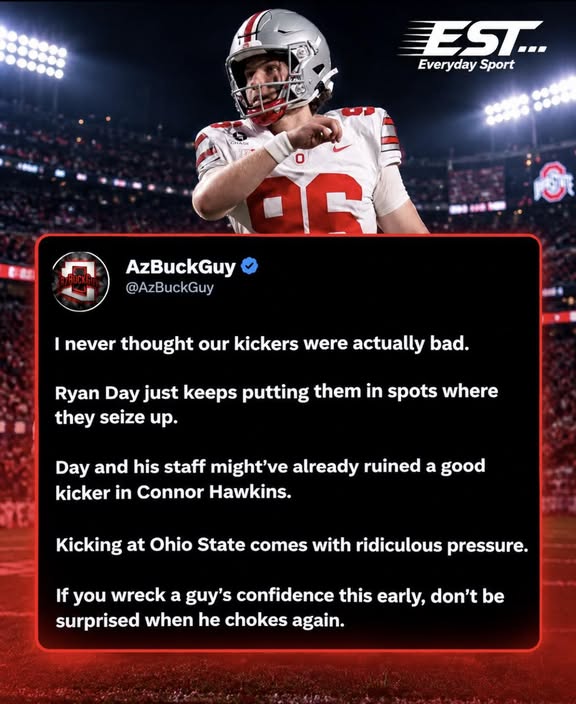
A recent social media post from AzBuckGuy has brought renewed attention to the Buckeyes’ kicking situation, questioning whether the team’s struggles are rooted solely in the players’ performances or whether coaching decisions and the psychological demands of the position are also contributing factors.
The post argues that Ohio State’s kickers may not necessarily be incapable of performing at a high level. Instead, it suggests that head coach Ryan Day and his staff have repeatedly placed them in situations where mistakes carry enormous consequences.
That perspective raises an important issue for any major college football program: How much responsibility belongs to the player, and how much belongs to the environment created by the coaching staff?
The Difference Between Ability and Execution
Kicking is a position where technical ability and mental confidence must work together.
A player may possess the leg strength, accuracy, and preparation required to succeed, yet struggle when the pressure of a particular moment becomes overwhelming. Unlike many other positions, kickers often have only a brief opportunity to influence the outcome of a game.
A missed kick cannot be corrected through another immediate attempt at the same play. Instead, the player must wait for the next opportunity, often while replay footage, public criticism, and personal disappointment remain fresh.
The post by AzBuckGuy emphasizes this distinction by arguing that Ohio State’s kickers may not have been inherently bad. The writer’s criticism is directed toward the situations in which they are being asked to perform.
That is a significant distinction, although the post does not provide kicking statistics, game-by-game records, or coaching explanations to establish the extent of the problem.
Nevertheless, the argument reflects a broader reality in sports: Performance is influenced not only by talent but also by preparation, confidence, decision-making, and the circumstances surrounding competition.
The Pressure of Kicking at Ohio State
Ohio State is one of the most recognizable programs in college football. Its history, fan base, and championship expectations create an environment in which every mistake can receive considerable attention.
For kickers, that pressure can be especially difficult to manage.
A missed extra point, a short field goal, or a late-game attempt can become the defining moment of a player’s performance. Even when a kicker has made successful contributions earlier in a season, a high-profile miss may dominate the conversation.
The social media post suggests that Ohio State’s kickers are being placed in situations where the consequences of failure are particularly severe. The writer believes that repeated exposure to such moments may contribute to a loss of confidence.
That claim should be understood as an opinion expressed by the supporter, rather than a verified diagnosis of the players’ mental state. The post does not establish how the coaching staff prepares its kickers, what conversations have taken place internally, or whether the players themselves believe coaching decisions are responsible for their difficulties.
Still, the issue is worthy of discussion because pressure management is an important part of developing any specialist player.
Connor Hawkins and the Confidence Question
The most pointed section of the post concerns Connor Hawkins.
AzBuckGuy argues that Ryan Day and his staff may have already damaged Hawkins’ confidence. This is a serious criticism because confidence is often central to a kicker’s ability to perform consistently.
However, the post does not provide direct evidence that Hawkins has lost confidence, nor does it establish that coaching decisions caused any difficulties he may be experiencing.
That distinction matters in responsible sports journalism. A player’s performance should not automatically be interpreted as proof of a psychological problem, and a supporter’s criticism should not be treated as confirmation of a coaching failure.
What the post does provide is a question about player development.
How does a coaching staff respond when a young kicker struggles? Does it offer technical adjustments, additional practice opportunities, and support? Does it protect the player from unnecessary pressure while still holding him accountable? And how does it determine when a kicker is ready to return to a high-stakes situation?
Those questions are relevant to any program seeking sustained success.
Coaching Decisions Under the Microscope
Head coaches are responsible for making difficult decisions throughout a football game. Field position, time remaining, score margin, weather, player confidence, and the likelihood of success all influence whether a team attempts a field goal, goes for it on fourth down, or chooses another strategy.
For Ohio State, those decisions carry additional scrutiny because of the program’s ambitions.
The post’s criticism of Ryan Day centers on the belief that the coaching staff repeatedly puts kickers in positions where they struggle. That argument implies that the staff should reconsider how it manages the kicking game.
Yet evaluating that claim requires more than identifying a missed kick. A meaningful assessment would examine the circumstances of each attempt, the distance involved, the score, the game clock, the kicker’s previous performance, and the alternatives available to the coaching staff.
Without that information, it is not possible to determine whether the decisions were unreasonable or whether the results reflect the inherent difficulty of the situations.
The criticism nevertheless highlights the importance of transparency and communication. Supporters want to understand how a program responds when a specialist position becomes a source of concern.
The Mental Challenge of Recovering From Mistakes
One of the most important points in the post is the warning that damaging a kicker’s confidence early can make future mistakes more likely.
The underlying idea is that a player who begins to fear failure may struggle to perform naturally. Instead of focusing entirely on technique and execution, the kicker may become preoccupied with the consequences of another mistake.
That is a challenge familiar to athletes across sports, particularly in positions where individual actions are highly visible and directly connected to outcomes.
The solution, however, is not simply to remove all pressure. Competitive athletes must learn to perform under demanding circumstances. The role of coaching is to help them develop the preparation, routines, and resilience necessary to manage those demands.
For Ohio State, that could mean reviewing the technical aspects of kicking, improving the structure of practice sessions, and ensuring that players receive constructive feedback. It could also involve examining how the team handles mistakes publicly and internally.
The post does not establish whether those measures are already in place. But it raises the question of whether the current approach is producing the desired results.
A Larger Issue for Championship Contenders
Ohio State’s kicking concerns, as presented in the post, illustrate a broader challenge facing championship-level programs.
Teams can possess elite talent at most positions and still struggle because of a weakness in one specialized area. Kicking is particularly important because it can influence games that are otherwise decided by small margins.
A team competing for major honors cannot afford to overlook the importance of reliable special teams play. At the same time, developing dependable kickers requires patience, preparation, and a clear understanding of the pressures involved.
The social media criticism offers one interpretation of the situation: that the problem may be as much about the environment as it is about individual execution.
Whether that interpretation is accurate will require a closer examination of Ohio State’s performances, coaching decisions, and player development practices.
The Road Ahead for the Buckeyes
The immediate challenge for Ohio State is to improve its kicking performance while maintaining the confidence of the players involved.
That responsibility belongs to both the athletes and the coaching staff. Kickers must continue to prepare, refine their technique, and execute when opportunities arise. Coaches must evaluate their decisions, provide support, and ensure that players are placed in situations that reflect their preparation and capabilities.
The criticism from AzBuckGuy should therefore be viewed as part of a larger conversation about accountability and development.
It is not enough for a program with championship aspirations to possess talent. It must also create the conditions in which that talent can perform consistently.
For Connor Hawkins and Ohio State’s other kickers, the coming games will provide opportunities to demonstrate progress. For Ryan Day and his staff, the situation presents an opportunity to examine how they manage one of the most demanding positions in college football.
The scoreboard will ultimately determine the results, but the process behind those results deserves attention as well.
Ohio State’s kicking situation remains a subject of concern for supporters, and the questions raised by the social media post are unlikely to disappear until the Buckeyes demonstrate greater consistency. The path forward will require careful evaluation, improved execution, and an understanding that confidence is not separate from performance—it is one of the factors that can help make reliable performance possible.
For a program pursuing the highest level of success, that balance may prove essential.