The former NFL quarterback’s top 13 list after two weeks highlights emerging talent, fresh storylines, and the difficulty of evaluating college football’s best passers so early in the season.
College football quarterback rankings are among the most closely followed discussions in the sport. The position carries enormous responsibility, and performances behind center often shape the fortunes of entire programs.
After just two weeks of the season, former NFL quarterback and analyst Danny Kanell has entered that conversation with the release of his personal top 13 quarterbacks, a ranking he has branded the “DK13.”
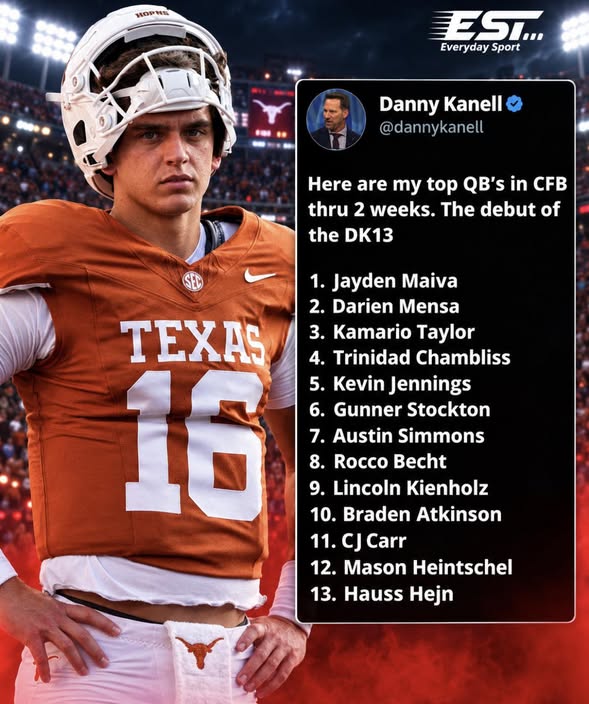
The list, shared through social media, offers an early assessment of the players Kanell believes deserve recognition at the quarterback position. Jayden Maiva leads the ranking, followed by Darien Mensa and Kamario Taylor. The remaining names complete a group that reflects Kanell’s willingness to spotlight players making an impression at the beginning of the campaign.
The graphic has generated interest because quarterback rankings are rarely viewed as simple statistical exercises. They are also discussions about leadership, decision-making, consistency, execution, and a player’s ability to influence games.
However, the timing of the list is equally important. With only two weeks of football completed, the rankings represent an early snapshot rather than a definitive judgment on the entire season.
The Significance of the DK13
Kanell’s decision to publish a top 13 list gives the ranking a distinct identity. Rather than presenting another conventional top 10, the DK13 creates a specific framework for discussing the quarterbacks who have caught his attention.
That format also allows the list to extend beyond the most familiar names in college football.
The ranking places Jayden Maiva at the top, with Darien Mensa second and Kamario Taylor third. Trinidad Chambliss occupies fourth place, followed by Kevin Jennings, Gunner Stockton, and Austin Simmons.
Rocco Becht is ranked eighth, while Lincoln Kienholz, Braden Atkinson, C.J. Carr, Mason Heintschel, and Hauss Hejn complete the list.
The graphic does not provide the statistics, game results, or specific criteria Kanell used to determine the order. Consequently, the ranking should be understood as his personal evaluation of the quarterbacks after two weeks, rather than an independently verified performance table.
That distinction is important because different analysts may place greater emphasis on different qualities. Some prioritize passing efficiency and production, while others focus on decision-making, mobility, leadership, or performance against difficult opponents.
Kanell’s list provides a starting point for that conversation.
Jayden Maiva Leads an Early Group of Quarterback Standouts
The most prominent feature of the ranking is Maiva’s position at No. 1.
Being placed at the top of a national quarterback list carries considerable attention, particularly when the ranking comes from a recognizable football analyst. It signals that Kanell believes Maiva’s early performances have established him as the quarterback to watch.
Yet an early ranking also creates a challenge for the player. Once a quarterback receives national recognition, expectations can increase rapidly.
The next games will provide opportunities to demonstrate whether the qualities that earned the recognition can be sustained. A quarterback’s ability to respond to defensive adjustments, manage pressure, and maintain consistency often becomes more important as opponents gain more information about his tendencies.
Maiva’s place at the top of the DK13 is therefore best viewed as an early indication of Kanell’s assessment, not a conclusion about the entire season.
The ranking creates a storyline, but future performances will determine how that storyline develops.
Darien Mensa and Kamario Taylor Join the Conversation
Mensa and Taylor occupy the second and third positions, respectively.
Their inclusion near the top of the list illustrates how quickly the quarterback conversation can change during the opening weeks of a college football season. Players who begin the year with strong performances can attract national attention, while established expectations may be revised as new evidence emerges.
For quarterbacks ranked near the top, the challenge is to continue producing at a level that justifies the attention.
Early success can come from several factors, including offensive scheme, supporting talent, favorable matchups, and individual execution. A complete evaluation requires consideration of those circumstances rather than relying solely on a ranking position.
The graphic does not provide enough information to determine how each quarterback compares statistically or how difficult his schedule has been. Those details would be necessary for a deeper assessment.
Nevertheless, Mensa and Taylor’s positions in the DK13 make them important names in the early quarterback discussion.
A Broader Look at the Top 13
The remaining quarterbacks on the list demonstrate the range of players Kanell has chosen to recognize.
Trinidad Chambliss is ranked fourth, while Kevin Jennings and Gunner Stockton occupy fifth and sixth. Austin Simmons is seventh, followed by Rocco Becht at eighth.
The final five positions belong to Lincoln Kienholz, Braden Atkinson, C.J. Carr, Mason Heintschel, and Hauss Hejn.
The list’s breadth is notable because it presents a group of 13 quarterbacks rather than focusing exclusively on a smaller number of established stars.
That approach can encourage fans to pay attention to players whose performances might otherwise receive less national coverage. It also creates room for debate, as supporters compare the quarterbacks on the list with players who were not included.
However, the ranking should not be interpreted as evidence that the players outside the DK13 have performed poorly. A personal top 13 is necessarily selective, and the absence of a player does not establish a negative evaluation.
Similarly, a quarterback’s position on the list does not by itself establish a measurable difference in performance between adjacent players.
Why Early Quarterback Rankings Matter
Quarterback rankings influence the national conversation because the position is central to how many teams are evaluated.
A quarterback who performs well can elevate expectations for an entire program. Strong passing decisions, effective movement in the pocket, and the ability to execute in critical situations can help shape a team’s identity.
At the same time, early rankings can be unstable.
Two weeks of football may provide useful information, but it is a relatively small sample for judging a player across an entire season. Injuries, changes in competition, offensive adjustments, and the demands of conference play can all affect performance.
That is why early rankings are best understood as a discussion of current impressions.
Kanell’s DK13 offers his perspective on which quarterbacks have made the strongest early impression. It does not settle the broader debate over who will ultimately emerge as the season’s most successful players.
The Importance of Context in Evaluating Quarterbacks
A meaningful quarterback evaluation should consider more than the number of wins or passing yards.
Accuracy, efficiency, turnover management, third-down execution, red-zone performance, and decision-making under pressure are all relevant factors. The quality of an offensive line and the ability of receivers to create separation can also influence a quarterback’s statistical output.
Additionally, a quarterback’s performance against a strong defense may provide different information from a performance against a less experienced opponent.
The DK13 graphic does not include those details. As a result, readers should treat the list as an analyst’s early assessment rather than a comprehensive statistical comparison.
That does not diminish its value as a conversation starter. Sports analysis often begins with an opinion that invites further examination.
The next step is to compare those opinions with the performances that follow.
What Comes Next for the Quarterbacks?
The players featured in the DK13 now face the challenge that follows every early-season ranking: maintaining their level of performance.
For those near the top, the pressure will be to demonstrate consistency. For those in the middle of the list, strong performances could lead to greater recognition. For those ranked near the bottom, the opportunity remains to improve their position through continued execution.
The season will provide a much larger body of evidence.
As teams face stronger opponents and the stakes increase, quarterback play will be tested in different ways. Some players may thrive under pressure, while others may encounter difficulties that were not apparent during the opening weeks.
Those developments will shape future rankings and determine whether the early assessments remain persuasive.
Conclusion
Danny Kanell’s DK13 provides an early snapshot of the college football quarterback landscape after two weeks of the season.
Jayden Maiva leads the list, with Darien Mensa and Kamario Taylor following closely behind. The remaining quarterbacks represent a group of players Kanell has identified as worthy of national attention at this stage of the campaign.
The ranking is not an official measure of quarterback performance, nor does it establish a final order for the season. It is a personal assessment that invites discussion about talent, execution, and the qualities that define successful quarterback play.
That is precisely what makes early-season rankings compelling.
They create debate, introduce fans to emerging players, and encourage closer attention to the games ahead. As the season develops, the performances of the quarterbacks featured in the DK13 will provide the evidence needed to evaluate how those early impressions hold up.
For now, Kanell’s list has established a new talking point in college football: which quarterbacks are making the strongest impression, and who will continue to rise as the season unfolds?