Indiana coach Curt Cignetti stepped into the growing conversation surrounding quarterback Josh Hoover on Monday, pushing back against what he described as excessive criticism of his starting quarterback after the No. 4 Hoosiers opened the 2026 season 3-0.
Hoover has produced numbers that would ordinarily quiet most early-season concerns. Through three games, the TCU transfer has completed 37 of 51 passes for 649 yards, 10 touchdowns and no interceptions, good for a 72.5% completion rate and a 244.1 passer rating. Yet his performance in Saturday’s 38-0 victory over Western Kentucky generated a different conversation, with several missed opportunities becoming a focal point of the postgame discussion.
Cignetti was not interested in allowing those individual throws to become the defining story of Hoover’s start.
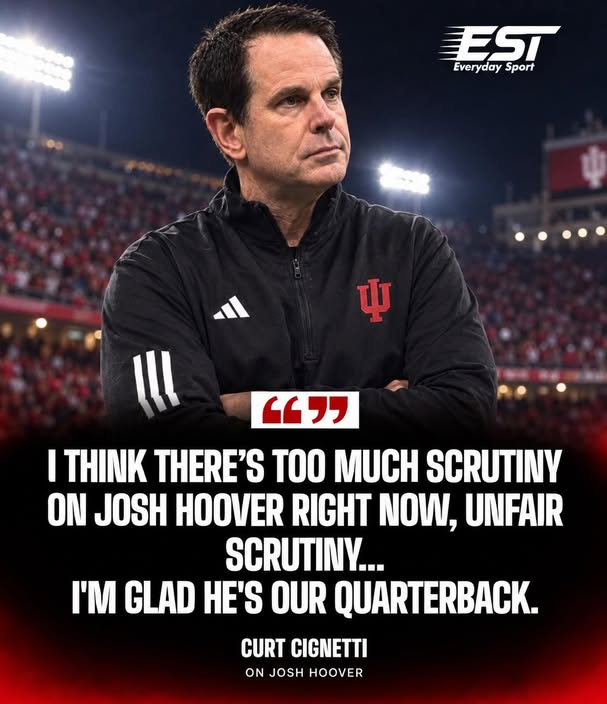
“I think there’s too much scrutiny on Josh Hoover right now, unfair scrutiny,” Cignetti said Monday, according to The Herald-Times. After reviewing the film, Cignetti said he believed Hoover missed only one throw that should clearly have been completed, while other apparent misses involved protection problems, route execution or progression decisions.
The distinction is important for an Indiana offense that is still developing its identity around a new quarterback.
Hoover entered the season with significant expectations after transferring from TCU, where he established himself as an experienced Power Four starter. His first three games in Bloomington have produced immediate statistical production, but Cignetti’s comments illustrate why the evaluation of a quarterback cannot always be reduced to completion percentage, passing yards or touchdown totals.
Against Western Kentucky, Hoover finished 18-of-24 for 273 yards and two touchdowns, according to Indiana’s official statistics. He averaged 11.4 yards per attempt and again avoided an interception. The performance gave him 10 touchdown passes without a turnover through Indiana’s first three games.
That efficiency is particularly significant in Cignetti’s offensive structure, where quarterback decision-making is tied closely to protection, route timing and progression reads. A completion that never appears on a stat sheet can be influenced by whether the receiver reaches the correct landmark, whether the offensive line handles the pressure correctly or whether the quarterback gets through his progressions on schedule.
Cignetti specifically cited those factors when defending Hoover.
On one throw intended for Charlie Becker, the coach said Indiana failed to properly handle a blitz with the running back, leaving Hoover pressure in his face. Another play involving Nick Marsh, Cignetti explained, was affected by the route design and progression. He also identified another throw to Marsh along the sideline where the correct decision, in his view, was to work back toward an open field dig route.
That level of detail matters because Indiana is approaching the point of its schedule when small execution errors will carry considerably greater consequences.
The Hoosiers have overwhelmed their first three opponents. Indiana opened with a 52-16 victory over North Texas, followed it with a 55-0 shutout of Howard and then blanked Western Kentucky 38-0. The three wins have pushed Indiana to 145 points scored and only 16 allowed.
The defensive dominance has allowed the offense room to develop without having to operate in constant high-leverage situations. That luxury will not necessarily exist once Big Ten play begins.
Indiana’s conference schedule starts Friday against Northwestern before the Hoosiers travel to Rutgers and Nebraska. Ohio State then visits Bloomington on Oct. 17, followed by a trip to Michigan one week later.
That stretch provides the context for why Hoover’s development is receiving so much attention.
The Hoosiers are not simply trying to find out whether Hoover can produce against overmatched opponents. They are preparing him to operate against defenses capable of disguising coverages, generating pressure without blitzing and forcing quarterbacks to consistently win on third down and in obvious passing situations.
The early statistics suggest Hoover has handled the responsibility efficiently.
His 10 touchdown passes lead Indiana, while his zero interceptions have protected an offense that has consistently created explosive scoring opportunities. His 12.7 yards per attempt through three games, according to Sports-Reference’s game log, also demonstrates that Indiana has not relied exclusively on short, conservative throws to manufacture production.
At the same time, his completion rate dipped to 75% against Western Kentucky after he completed 81.3% of his attempts against North Texas. He completed only 54.5% against Howard, although he still threw four touchdown passes without an interception in that game.
Those numbers provide a more balanced picture than either extreme.
Hoover has not been flawless. But the evidence also does not suggest that Indiana is dealing with a quarterback crisis.
In fact, Cignetti’s public defense of Hoover reflects a coaching philosophy that has been visible throughout his tenure. Former Indiana quarterback Fernando Mendoza recently discussed the demanding nature of Cignetti’s coaching, explaining that the coach routinely emphasized small technical details even after successful plays. Mendoza said those corrections eventually showed up during games because players understood why seemingly minor details mattered.
That background makes Cignetti’s comments about Hoover particularly revealing. Defending his quarterback publicly does not mean the coaching staff has stopped demanding improvement from him. It means the staff believes the criticism should be evaluated against the complete film rather than isolated throws.
For Hoover, that distinction could become increasingly important as Indiana’s profile rises.
The Hoosiers entered the season ranked No. 6 in the Associated Press preseason poll and have climbed to No. 4 after their unbeaten start.
With that ranking comes a different level of scrutiny. Every missed throw becomes easier to magnify, particularly for a quarterback replacing a player who helped guide Indiana through its recent rise.
The next phase of the season will determine whether Hoover can translate his statistical efficiency against Big Ten competition. His ability to identify disguised coverages, manipulate safeties with his eyes, operate within structure under pressure and consistently win from the pocket will be more consequential than whether he completes every potential explosive pass.
Indiana’s supporting cast should also help determine that trajectory. The Hoosiers have demonstrated a balanced offense, while the defense has allowed Cignetti to avoid putting unnecessary pressure on his quarterback early in the season.
That balance could prove valuable once the schedule becomes more demanding.
For now, Cignetti’s message is straightforward: the film does not support the level of concern surrounding Hoover.
“I’m glad he’s our quarterback,” Cignetti said.
That final sentence may ultimately prove more significant than the criticism that prompted it.
Hoover’s first three games have given Indiana a productive, turnover-free quarterback operating an offense that has scored at least 38 points in every game. The imperfections are real, but so is the production. The question now is not whether Hoover has been perfect. It is whether he can continue turning those early-season numbers into winning quarterback play when the margin for error becomes much smaller.
The answer will begin to emerge Friday night against Northwestern and become considerably clearer during October, when Indiana’s championship aspirations collide with the most demanding portion of its Big Ten schedule.