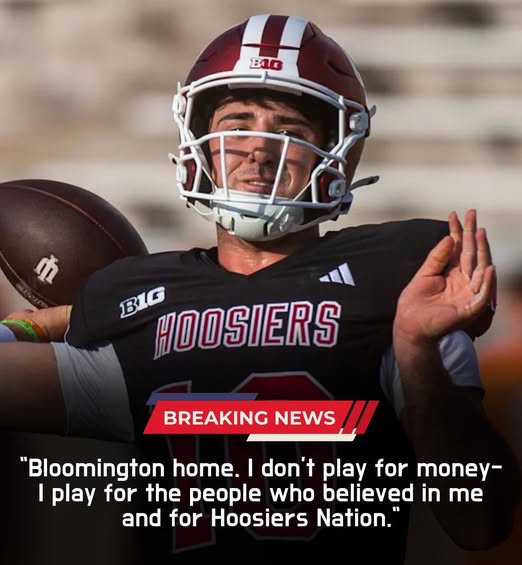
Josh Hoover could have chosen almost anywhere.
Instead, when the former TCU quarterback entered the transfer portal, he chose a place that was already familiar in an unusual way. Bloomington was not simply another destination on a list of opportunities. It was the program Hoover once committed to as a high school prospect before ultimately flipping to TCU.
Nearly five years later, he returned.
Now, with Indiana preparing to defend the first national championship in program history, Hoover is standing at the center of the Hoosiers’ most consequential transition of the 2026 season: replacing a Heisman Trophy winner while attempting to preserve a standard that did not exist in Bloomington until Curt Cignetti arrived.
The decision brought Hoover back to Indiana in January, when he committed to the Hoosiers after four seasons at TCU. At the time, the move was viewed primarily through the lens of football. Indiana needed a proven quarterback after Fernando Mendoza departed for the NFL, and Hoover was arguably the most accomplished returning passer available in the transfer portal.
But months later, the significance of the decision has become clearer.
For Hoover, Indiana represents both an opportunity and a return to unfinished business.
The 6-foot-2, 205-pound quarterback enters his fifth collegiate season having already accumulated 31 starts, 9,629 passing yards and 71 touchdown passes at TCU. He owns 16 career 300-yard passing games and served as a two-time captain for the Horned Frogs.
Those numbers explain why Indiana pursued him.
His connection to Bloomington explains why the fit feels different.
Hoover originally committed to Indiana during Tom Allen’s tenure before changing course and signing with TCU. His path eventually took him to Fort Worth, where he became TCU’s starting quarterback during the 2023 season and developed into one of the Big 12’s most productive passers.
In 2024, Hoover set a TCU single-season record with 3,949 passing yards, adding 27 touchdown passes and 11 interceptions. In 2025, he followed with 3,472 yards, 29 touchdowns and 13 interceptions while completing 65.9% of his passes.
His final TCU résumé was substantial: 9,629 yards, 71 touchdown passes and 33 interceptions across his career.
But Indiana did not recruit Hoover simply because of the statistics.
Cignetti saw a quarterback with experience operating in high-pressure situations, a willingness to compete and, critically, a skill set that could translate to an offense built around efficiency, explosive plays and run-pass option concepts.
“He embraced that challenge when he made the decision to come here,” Cignetti said in the spring. “He’s a process-oriented guy.”
That challenge is enormous.
Mendoza did not merely leave behind a vacancy at quarterback. He left behind an impossible standard.
A year ago, Indiana went 16-0, won the Big Ten championship and captured the national title. Mendoza won the Heisman Trophy and subsequently became the No. 1 overall selection in the NFL draft, joining the Las Vegas Raiders.
That makes Hoover’s situation different from almost any quarterback transition in the country.
He isn’t replacing an ordinary starter.
He is replacing the player who authored the greatest season in Indiana football history.
And yet Hoover has consistently resisted the temptation to make the job about Mendoza.
“I’m trying to be the best version of myself and be who I am every day,” Hoover said. “Fernando is an unbelievable person and player. I have to be myself, do my best for IU, and make guys around me better.”
That mindset may be precisely what Indiana needs.
The Hoosiers’ recent success has been built less on individual stardom than on organizational consistency. Cignetti’s teams have been disciplined, physical and efficient, with complementary football allowing the quarterback to operate within a structure rather than carrying the entire offense.
That distinction matters for Hoover.
At TCU, he was often asked to shoulder a heavy percentage of the offensive burden. His production was impressive, but so were his turnover totals. Indiana’s coaches believe a stronger running game and a defense capable of controlling games can put Hoover in more favorable situations.
The early signs have been encouraging.
Indiana’s coaching staff has emphasized Hoover’s development throughout the offseason, and teammates have noticed his approach. Veteran receiver Charlie Becker described him as one of the hardest workers he has encountered, while Wisconsin transfer offensive lineman Joe Brunner praised Hoover’s confidence and energy in the huddle.
That chemistry could become one of the defining elements of Indiana’s season.
Becker returns after producing 34 catches for 679 yards and four touchdowns last season, while Indiana also added former Michigan State receiver Nick Marsh through the transfer portal. Tyler Morris, another veteran addition, is returning from injury and has already flashed a downfield connection with Hoover during fall camp.
The supporting cast is therefore substantially different from what Hoover had at TCU.
So is the environment.
Indiana is no longer trying to convince the college football world that its breakthrough was real. The Hoosiers are trying to prove it was the beginning of something bigger.
That brings pressure.
The defending national champions enter 2026 with expectations that would have been unimaginable two years ago. Cignetti is 27-2 through his first two seasons at Indiana, including the program’s perfect championship campaign.
Hoover is now the face of the next chapter.
The irony is difficult to miss.
Indiana’s recent quarterback success has been built through the transfer portal. Kurtis Rourke arrived from Ohio University and led the Hoosiers to their first College Football Playoff appearance. Mendoza transferred from California and transformed into a Heisman winner. Now Hoover has become the third consecutive transfer quarterback expected to open the season for Cignetti’s program.
The difference is that Hoover arrives with a résumé that is already larger than either of those quarterbacks had when they first stepped onto the Bloomington campus.
His 9,629 career passing yards lead all active college quarterbacks entering the season, while his 71 touchdown passes rank among the nation’s best.
That experience could prove invaluable once the games become consequential.
Indiana’s 2026 schedule will put Hoover under a microscope from the beginning. The Hoosiers open Sept. 5 against North Texas at Memorial Stadium, beginning a season in which every performance will inevitably be compared with Mendoza’s extraordinary 2025 campaign.
But comparison is not necessarily the right measuring stick.
The more important question is whether Hoover can execute Cignetti’s system at a championship level.
His arm talent is not in question. Neither is his experience. The concern is whether he can limit the mistakes that occasionally followed him at TCU while maximizing the efficiency created by Indiana’s offensive structure.
That will determine far more than individual statistics.
If Hoover protects the football, consistently wins on early downs and converts the explosive opportunities created by Indiana’s play-action and RPO game, the Hoosiers have the personnel to remain a national contender.
And if the defense remains among the nation’s best, Hoover may not need to reproduce Mendoza’s statistical production to lead Indiana back to the College Football Playoff.
That is the larger point behind his return to Bloomington.
Hoover does not need to become Fernando Mendoza.
He needs to become Josh Hoover.
For a quarterback who once chose TCU over Indiana, that journey has now come full circle. He left Texas as a highly regarded recruit, developed into a veteran Big 12 starter and returned to the school he once committed to with something he did not possess the first time around: experience.
Indiana is no longer simply a school Hoover once considered.
It is the place where he now has the opportunity to define the final chapter of his college career.
And as the Hoosiers prepare for their first season as defending national champions, the meaning of his decision reaches beyond one quarterback.
It speaks to what Indiana has become.
Players are no longer coming to Bloomington merely because they believe the program can be good.
They are coming because it already is.
Hoover’s return may be the clearest example yet.
The quarterback who once walked away from Indiana has now chosen to come back.
And this time, he isn’t coming to help build the future.
He is coming to defend it.