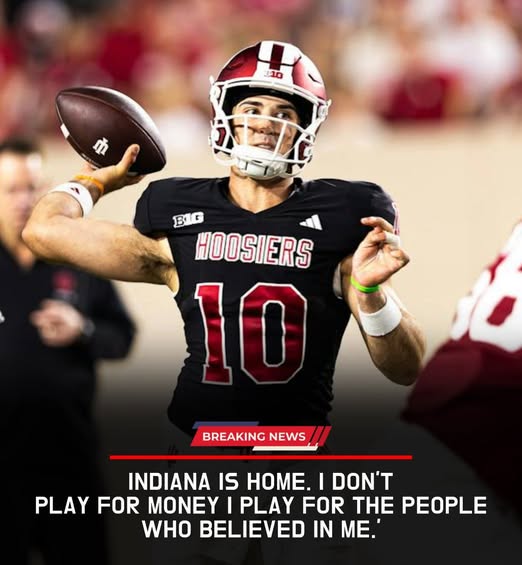
BREAKING: There is a growing belief inside scouting and analytics circles that Indiana may have quietly landed one of the most intriguing quarterback projections in the country, and the betting market might be significantly behind on it. Josh Hoover is beginning to generate internal buzz as a potential breakout Heisman Trophy candidate, with evaluators pointing to a blend of arm talent, decision-making growth, and system fit that could turn him into one of the most productive quarterbacks in the Big Ten.
The early Heisman Trophy odds boards rarely get it right this far out, but they are almost always revealing in one way: they show which players the public is willing to believe in and which ones it is not. Right now, Hoover sits in that uncomfortable middle ground where the production profile is still being digested, the context of his situation is still being evaluated, and the national perception has not yet caught up to the internal projection models. In short, he is being priced like a developmental quarterback rather than a potential award contender. And that is exactly why some evaluators are calling him the most mispriced name on the board.
The foundation of the case starts with arm talent. Hoover has the kind of effortless velocity that doesn’t always show up in highlight packages but jumps out in film study. He can drive the ball outside the numbers without needing a long windup, and he has enough layered touch to attack second-level defenders in zone coverage. What separates him from the average quarterback in his tier is not just arm strength, but how comfortably he can vary pace and trajectory. He does not rely solely on fastball throws. Instead, he shows a developing ability to manipulate defenders with subtle changes in timing, particularly on intermediate dig routes and glance concepts that are critical in modern spread offenses.
But arm talent alone does not move Heisman markets. Decision-making does. And this is where Hoover’s trajectory becomes especially interesting. Early in his career, he showed moments of hesitation under pressure, occasionally drifting from clean reads when defenses disguised post-snap rotations. However, evaluators have pointed to noticeable improvement in his processing speed, particularly in recognizing disguised coverages pre-snap and adjusting protections accordingly. The growth is not just statistical—it is structural. He is beginning to operate with the confidence of a quarterback who trusts the system around him rather than forcing plays outside of structure.
Indiana’s offensive ecosystem is also part of the rising optimism. The Hoosiers have made deliberate investments in modernizing their passing concepts, leaning into spacing principles that prioritize quick reads and defined progression windows. That matters for a quarterback like Hoover, whose ceiling is highest when he is operating within rhythm rather than constantly improvising. The schematic shift is subtle but meaningful: more empty formations, more condensed splits to manipulate leverage, and more designed high-low reads that allow the quarterback to throw with anticipation rather than reaction.
In that environment, efficiency numbers can spike quickly. And efficiency is the currency of Heisman contention.
What makes the “mispriced” argument so compelling is the way early betting markets typically lag behind contextual change. Oddsmakers tend to anchor quarterback evaluations on two things: prior year production and national brand recognition. Hoover, despite flashing high-level traits, does not yet benefit from either in the way that traditional Heisman favorites do. That creates a valuation gap—one that sharp bettors and analysts often try to exploit before the broader public adjusts.
The comparison point being floated internally is not necessarily to established superstar quarterbacks, but to past “leap-year” candidates who went from solid starters to national awards conversation in a single season. The Heisman race is littered with examples of quarterbacks who were not preseason favorites but became unavoidable once their systems clicked and their statistical profiles exploded by midseason. Hoover’s profile, according to some analysts, fits that archetype more than it fits the steady, already-established star category that typically dominates preseason boards.
Still, there are legitimate questions that prevent full consensus. The biggest one is consistency. Hoover has shown stretches where his mechanics can drift under pressure, particularly when interior protection breaks down and he is forced to reset his base mid-throw. Against more athletic defensive fronts, that can lead to off-platform attempts that reduce accuracy on deep throws. At the highest level of college football, those moments are magnified. One bad sequence in a nationally televised game can recalibrate perception faster than an entire month of strong performances can build it.
Turnover avoidance is another critical variable. While Hoover has shown improvement in limiting high-risk throws, evaluators still note occasional aggressiveness into tight windows that are not fully developed. That trait is not necessarily negative in a vacuum—it can be a sign of confidence—but in Heisman conversations, efficiency margins are razor thin. Quarterbacks who win the award typically do not just produce volume; they minimize volatility.
Then there is the question of supporting cast. Indiana’s offensive ceiling will depend heavily on the stability of its skill positions and offensive line play. A quarterback can only be as efficient as the structure allows, and while the scheme may be trending upward, protection consistency and receiver separation rates will ultimately determine whether Hoover’s tools translate into elite production or merely above-average output.
But this is precisely where the optimism begins to take hold again. Because when evaluators talk about Hoover, they do not just talk about what he is now. They talk about what he becomes when the structure around him stabilizes.
The best-case scenario being painted internally is not subtle. It is a quarterback operating in rhythm-heavy concepts, posting high completion rates on early downs, stretching defenses vertically when safeties creep, and turning red-zone opportunities into touchdowns rather than field goals. In that scenario, Indiana does not just become competitive in conference play—it becomes dangerous. And in the modern Heisman landscape, team trajectory matters almost as much as individual performance.
The Big Ten context amplifies that possibility. With defensive talent spread across multiple elite programs, a quarterback who consistently performs against top-tier competition gains credibility quickly. If Hoover were to deliver efficient performances in high-profile conference matchups, particularly in games where Indiana is not expected to dominate, the narrative shift could be immediate. The Heisman race is as much about timing and visibility as it is about raw statistics, and Indiana’s schedule provides multiple potential stages for that kind of breakout moment.
There is also a psychological component that cannot be ignored. Quarterbacks entering a new environment often experience one of two outcomes: stagnation or acceleration. In Hoover’s case, the internal belief is that he is positioned for the latter. Confidence in system familiarity, combined with a coaching staff that has shown willingness to adapt game plans to quarterback strengths, creates a developmental runway that is often missing for players in similar positions.
That is where the “mispriced” label gains traction. It is not just about what Hoover has done. It is about what the environment is now designed to unlock.
Of course, skepticism remains healthy. The Heisman Trophy is notoriously difficult to forecast, and preseason narratives often collapse under the weight of in-season reality. Injuries, defensive adjustments, and simple regression all play significant roles in reshaping what once looked like a clear breakout arc. For every quarterback who ascends into the Heisman conversation, there are several who plateau or are overtaken by more explosive statistical profiles elsewhere in the country.
And Hoover will not be operating in a vacuum. The national quarterback landscape remains crowded, with established names at blue-blood programs commanding attention and volume. To break through, Hoover would need not only strong play but signature moments—games that define perception and force voters and oddsmakers to recalibrate.
That is the true threshold of Heisman legitimacy. Not steady competence, but undeniable impact.
Still, the early signals are enough to generate conversation. And in today’s college football ecosystem, conversation often precedes correction. Once media narratives align with statistical production, odds boards tend to move quickly. The question is whether bettors and analysts identify the gap early enough to capitalize on it.
Right now, Hoover sits in that rare category of quarterback evaluation where projection outweighs perception. The tools are visible. The system is supportive. The trajectory is upward. What remains uncertain is whether all of it converges fast enough to turn a quiet preseason valuation into a national breakout story.
If it does, Indiana may not just have found its quarterback of the future. It may have found one of the most underappreciated Heisman candidates in the country—before the rest of the sport realizes it was there all along.