BLOOMINGTON, Ind. — Indiana football has spent the past two seasons rewriting the boundaries of what was considered possible in Bloomington. Now, Curt Cignetti has produced the recruiting breakthrough that may prove just as significant as anything the Hoosiers have accomplished on the field.
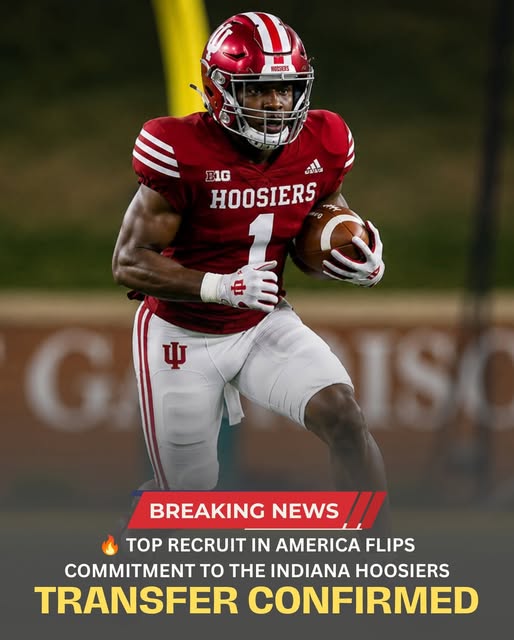
Five-star wide receiver Monshun Sales, one of the highest-rated prospects in the 2027 recruiting class, announced his commitment to Indiana on July 17, choosing the defending national champions over a heavyweight group that included Alabama, Ohio State, Texas and LSU. Sales’ decision marked the first five-star commitment in Indiana football history and immediately changed the conversation surrounding Cignetti’s program.
Sales, a 6-foot-5, roughly 200-pound standout from Lawrence North High School in Indianapolis, is rated among the nation’s elite prospects. Rivals ranks him as its No. 2 wide receiver and No. 7 overall prospect in the 2027 class, while 247Sports’ composite rankings place him among the top overall players in the cycle.
The significance extends beyond one recruiting class.
For decades, Indiana was often a program that had to develop overlooked prospects, find undervalued players in the transfer portal or hope that elite in-state talent chose to remain home. Cignetti has altered that equation. The Hoosiers’ rise from Big Ten afterthought to national champion has now begun producing a different kind of recruiting leverage: elite high school players are choosing Indiana over programs with decades of recruiting dominance.
Sales is the clearest evidence yet.
His commitment came less than a year after Indiana completed an unbeaten national championship season, a run that culminated in a College Football Playoff victory over Miami. The Hoosiers went 16-0 and transformed the perception of the program nationally. That success also helped Indiana attract high-profile transfer talent while sending several players, including Fernando Mendoza, Omar Cooper Jr. and Elijah Sarratt, toward the NFL.
The recruiting implications are potentially enormous.
Sales is not simply another highly ranked name on a commitment list. He represents the type of player programs such as Ohio State, Alabama and Texas traditionally expect to sign. Indiana beating those programs head-to-head demonstrates that Cignetti’s pitch is no longer based solely on development potential.
It is based on winning.
Sales’ own production illustrates why the national programs pursued him. As a junior at Lawrence North, he recorded 37 receptions for 794 yards and nine touchdowns while also contributing 56 tackles defensively. He had 34 catches for 568 yards and seven touchdowns as a sophomore.
At 6-5, Sales gives Indiana the kind of perimeter target that can fundamentally alter defensive structure. His size creates a natural matchup problem for smaller defensive backs, while his production suggests he can function as more than a red-zone specialist. The value of a receiver with his profile becomes particularly important in an increasingly pass-oriented college game in which explosive plays and successful early-down passing can determine possession efficiency.
For Indiana’s offense, the timing matters.
The Hoosiers are entering the 2026 season attempting to defend the first national championship in program history while replacing quarterback Fernando Mendoza, the Heisman Trophy winner who moved on to the NFL. Josh Hoover now assumes the quarterback role, creating a new chapter for an offense that must prove its championship success was sustainable rather than circumstantial.
Landing elite receivers gives Indiana a long-term answer to that transition.
Sales will not arrive in Bloomington immediately, and his commitment remains a verbal pledge until he signs. But his decision gives Cignetti another recruiting asset: proof that a five-star prospect can see Indiana as the destination rather than the developmental stop.
That distinction is critical.
College football recruiting has changed dramatically with the transfer portal, name, image and likeness opportunities and expanded revenue-sharing structures. Programs can now rebuild rosters almost overnight, but sustainable championship contention still requires recruiting high-level high school talent.
Indiana has mastered the first part of that equation.
Now Cignetti is showing signs of mastering the second.
The Hoosiers’ recruiting class was already building momentum before Sales made his decision. Indiana had accumulated a significant group of commitments in the 2027 cycle, and the program’s national recruiting profile had continued to rise. Sales became the centerpiece, giving Indiana its most prestigious recruiting victory to date.
The broader Big Ten implications are difficult to ignore.
Indiana is operating in the same recruiting ecosystem as Ohio State, Michigan, Oregon and Penn State — programs that have historically possessed advantages in facilities, tradition, donor networks and national visibility. A five-star Indianapolis prospect choosing the Hoosiers over Ohio State and other national powers demonstrates how much the competitive landscape has shifted.
It also reinforces the importance of keeping elite Indiana talent in the state.
Sales grew up in Indianapolis, less than an hour and a half from Bloomington. Historically, national powers have routinely entered Indiana and recruited its best players away from the Hoosiers. Cignetti’s challenge was not merely to build a winning team but to make Indiana football relevant enough that elite local players would believe they could stay home without sacrificing their championship ambitions.
Sales’ decision suggests that equation is changing.
There is also a strategic component to the commitment.
A five-star player can become a recruiting ambassador simply by being on the roster. Elite prospects recruit other elite prospects. When a program can show recruits that a player ranked among the best in the country chose Indiana over Alabama, Texas and Ohio State, the recruiting conversation becomes considerably easier.
Cignetti has repeatedly emphasized the importance of relationships in recruiting. Sales echoed that message when explaining his decision, pointing to the relationships he developed with Indiana’s coaches and staff and saying the program ultimately felt like home.
That is perhaps the most revealing element of the commitment.
Indiana did not win this recruitment simply by becoming the newest national champion. It won because Cignetti and his staff convinced one of the country’s most coveted prospects that Bloomington offered the combination of development, winning and personal fit he wanted.
The financial side of modern college football cannot be ignored, either. NIL and revenue-sharing resources have become central components of recruiting, and elite prospects have more leverage than ever. However, there is no publicly verified contract or specific compensation figure attached to Sales’ commitment that can responsibly be reported as fact. Any claims about a specific NIL package would be speculation without documentation.
What can be measured is the value of the commitment itself.
Indiana has gone from a program that had never signed a five-star recruit to one that is attracting prospects coveted by the sport’s traditional powers. That is not simply a recruiting statistic. It is evidence of institutional change.
The next challenge will be keeping Sales committed through the remainder of the recruiting cycle.
Verbal commitments are not binding, and the months leading to the early signing period can bring renewed pushes from national programs. Indiana will have to continue investing in the relationship and maintain the trajectory that convinced Sales to choose the Hoosiers in the first place.
But for now, the message is unmistakable.
Indiana football is no longer asking whether it belongs among the nation’s elite.
Cignetti’s program is beginning to recruit like it does.
And if Sales ultimately signs with Indiana, the significance of his decision could extend well beyond one player. He could become the first major piece of a recruiting pipeline that permanently changes how elite prospects view Bloomington.
For a program that once struggled to make national recruiting headlines, that may be the biggest victory of all.