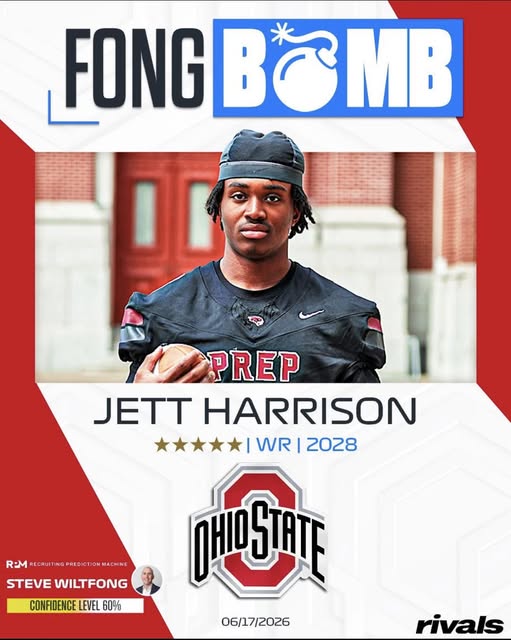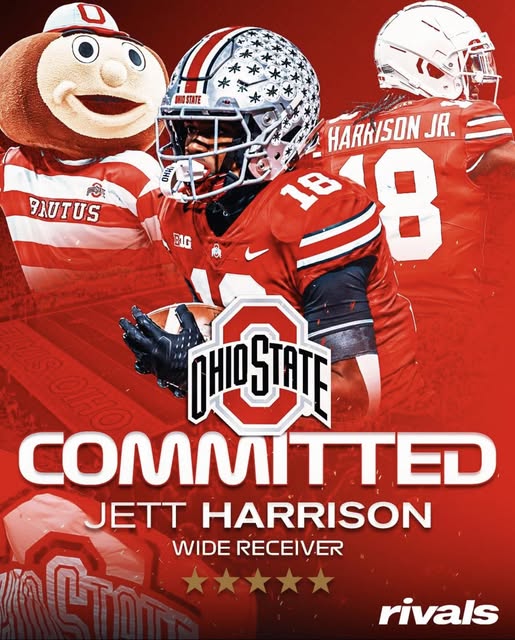
BREAKING — Ohio State has secured one of the most significant recruiting victories of the 2028 cycle, landing a commitment from five-star wide receiver Jett Harrison, the nation’s No. 1 overall prospect and the younger brother of former Buckeyes All-American and current Arizona Cardinals receiver Marvin Harrison Jr.. The announcement delivers another statement win for head coach Ryan Day and further reinforces Ohio State’s reputation as college football’s premier destination for elite wide receiver talent.
Harrison revealed his decision Wednesday through social media, ending months of anticipation surrounding one of the nation’s most closely followed recruitments. The standout from St. Joseph’s Preparatory School in Philadelphia chose the Buckeyes after extensive evaluations and multiple visits to Columbus, continuing a family legacy that has become deeply intertwined with Ohio State football.
While recruiting commitments nearly two years before National Signing Day always carry an element of uncertainty, Harrison’s pledge represents a monumental recruiting victory for Ohio State’s staff. Recruiting analysts have consistently viewed him as one of the most polished prospects in recent memory, with several major services ranking him among the very best players in the country. Rivals currently lists Harrison as the No. 1 overall player in the 2028 class, while other composite rankings also place him among the nation’s elite prospects.
The significance of Harrison’s commitment extends far beyond another blue-chip addition to an already talent-rich program. It symbolizes Ohio State’s continued ability to attract elite receivers despite coaching transitions and the increasingly competitive landscape shaped by NIL opportunities, conference realignment, and aggressive recruiting strategies from programs across the SEC, Big Ten, and ACC.
For Ohio State, Harrison’s decision continues one of college football’s most remarkable position pipelines.
Few programs have produced wide receivers at the level Ohio State has over the past decade. From first-round NFL Draft selections to unanimous All-Americans and Biletnikoff Award winners, the Buckeyes have established themselves as the gold standard for receiver development. Harrison now becomes the latest elite prospect hoping to follow that blueprint.
His older brother, Marvin Harrison Jr., left Columbus as one of the most accomplished receivers in school history. During three seasons with the Buckeyes, Harrison Jr. caught 155 passes for 2,613 yards and 31 touchdowns, earned unanimous All-American honors twice, captured the 2023 Biletnikoff Award, and finished as a finalist for the Heisman Trophy before becoming the fourth overall selection in the 2024 NFL Draft.
That level of success naturally created expectations whenever Jett Harrison’s recruitment began attracting national attention. Rather than shy away from comparisons, the younger Harrison has steadily built his own résumé.
Scouts consistently praise his route-running precision, advanced body control, polished release package, and exceptional hands—traits that closely resemble the technical excellence displayed by both his father and older brother. Standing around 6-foot-1 and approximately 180 pounds, Harrison has already demonstrated the ability to separate against high-level competition while showing maturity uncommon for a player entering only his junior season of high school.
His sophomore campaign further elevated his national profile.
Competing for perennial Pennsylvania powerhouse St. Joseph’s Prep, Harrison emerged as one of the state’s most dangerous offensive weapons, finishing the season with double-digit touchdown receptions while consistently producing explosive plays against nationally respected competition. Recruiting evaluators have repeatedly highlighted not simply his production, but the refinement in his game at such an early stage of development.
Ohio State identified Harrison as a priority long before Wednesday’s announcement.
The Buckeyes extended an early scholarship offer and maintained consistent communication throughout his recruitment. Harrison visited Columbus multiple times over the past year, including recent summer camps where he worked directly with Ohio State’s coaching staff and showcased why many evaluators believe he possesses generational upside.
Those visits ultimately strengthened a relationship built on more than family history.
Ohio State’s offensive philosophy continues to emphasize explosive passing attacks capable of producing NFL-ready receivers. Under Ryan Day, the Buckeyes have consistently ranked among the nation’s most productive offenses, pairing elite quarterback recruiting with dynamic perimeter talent. Even as assistant coaching roles have evolved, Ohio State has maintained its reputation for maximizing receiver development through advanced route concepts, pro-style passing principles, and NFL-caliber preparation.
That stability undoubtedly played a significant role in Harrison’s decision.
Recruiting victories of this magnitude also resonate throughout the locker room and future recruiting classes. Elite quarterbacks frequently seek opportunities to play alongside elite receivers, while offensive linemen and skill-position players often gravitate toward programs capable of competing annually for national championships.
Landing the nation’s top-ranked player sends another powerful message that Ohio State remains one of the country’s premier recruiting destinations despite fierce competition from programs such as Oregon, Miami, Georgia, Alabama, Texas, and others aggressively pursuing elite talent through expanded NIL collectives and enhanced recruiting resources. Reports indicated Harrison seriously considered programs including Oregon and Miami before ultimately choosing the Buckeyes.
From a roster-building perspective, Harrison immediately becomes the centerpiece of Ohio State’s early 2028 recruiting class.
He joins a group that already includes promising commitments such as running back Elijah Newman-Hall and defensive lineman Jameer Whyce, giving Ohio State an impressive foundation more than a year before prospects become eligible to sign.
Although recruiting rankings remain fluid, securing commitments from elite prospects early provides coaching staffs greater flexibility throughout the remainder of each recruiting cycle. Instead of chasing foundational pieces late in the process, staffs can focus resources on complementary positions, relationship maintenance, and identifying emerging prospects nationally.
The Buckeyes have mastered that formula over multiple recruiting cycles.
Equally important is the symbolic value surrounding Harrison’s family ties.
His father, Marvin Harrison Sr., enjoyed one of the greatest receiving careers in NFL history before earning induction into the Pro Football Hall of Fame. His older brother became an Ohio State legend before transitioning to the NFL as a top-five draft selection.
Yet coaches familiar with Jett Harrison emphasize that his recruitment centered on his individual ability rather than his surname.
Evaluators routinely describe him as technically advanced beyond many receivers his age. His releases against press coverage, spatial awareness within zone concepts, contested-catch ability, and acceleration after the catch have separated him from peers nationally.
Perhaps most encouraging for Ohio State is that Harrison continues to show measurable improvement each evaluation period rather than relying solely on natural athletic gifts.
That developmental trajectory explains why recruiting analysts project him as a future impact player capable of contributing early at the collegiate level.
For Ryan Day, the commitment also represents another important recruiting milestone during a period of continued national scrutiny surrounding championship expectations.
Ohio State remains one of college football’s flagship brands, where anything short of competing for conference championships and College Football Playoff appearances generates intense public discussion.
Maintaining elite recruiting classes serves as the foundation for sustaining championship contention.
The Buckeyes have repeatedly demonstrated that philosophy by consistently signing top-five recruiting classes filled with future NFL talent across multiple position groups.
Wide receiver, however, has become something of a signature position.
The success of recent Buckeye receivers at both the collegiate and professional levels has created a self-sustaining recruiting advantage. Elite high school receivers increasingly view Columbus as the fastest pathway toward NFL development.
That perception matters.
Recruits evaluate more than facilities and NIL opportunities. They study draft history, offensive systems, coaching relationships, player development, and opportunities for early playing time.
Ohio State continues to score exceptionally well across every category.
Although Harrison cannot officially sign until the designated signing period for the 2028 class, early commitments often influence dozens of other recruiting decisions.
Highly ranked quarterbacks frequently communicate with elite receivers about playing together.
Offensive recruits build relationships through camps, seven-on-seven tournaments, and national showcases.
One commitment often triggers momentum.
Should Harrison remain firmly committed throughout the process, Ohio State could leverage his pledge to attract additional top-ranked offensive prospects over the next two recruiting cycles.
That possibility explains why Wednesday’s announcement generated excitement well beyond Buckeye fans.
Across the Big Ten, rival programs understand the challenge Ohio State presents whenever another elite receiver commits.
Programs including Michigan, Penn State, Oregon, USC, and Washington continue investing heavily in recruiting infrastructure and NIL initiatives designed to close the talent gap.
Yet Ohio State’s receiver pipeline continues producing results difficult for competitors to match.
Nationally, Harrison’s commitment also highlights the growing importance of recruiting relationships established years before prospects become eligible to sign.
Modern recruiting rarely begins during a player’s junior season.
Elite prospects receive national attention as freshmen, sometimes even earlier.
Ohio State recognized Harrison’s potential early, extended an offer, maintained consistent communication, welcomed him to campus multiple times, and ultimately secured one of the country’s most coveted commitments.
The process illustrates how today’s recruiting landscape rewards sustained relationship-building as much as traditional evaluation.
Financially, college football’s changing environment also shapes every major recruitment.
While specific NIL agreements involving recruits remain private and frequently speculative, top-ranked prospects naturally evaluate each program’s ability to support future endorsement opportunities alongside football development.
No credible reports have detailed any financial arrangements surrounding Harrison’s commitment, making speculation inappropriate. Instead, Ohio State’s longstanding reputation for developing NFL receivers appears to have remained the program’s strongest recruiting asset.
Projecting several years into the future always carries considerable uncertainty.
Injuries, coaching changes, transfers, roster movement, and player development can dramatically reshape recruiting classes before prospects ever arrive on campus.
History is filled with five-star recruits whose careers unfolded differently than expected, just as overlooked prospects frequently developed into NFL stars.
Nevertheless, Harrison enters college football’s recruiting conversation carrying unusually high expectations supported by extensive evaluation rather than hype alone.
His combination of technical refinement, athletic ability, football pedigree, and production has earned widespread respect throughout recruiting circles.
Ohio State now holds the commitment of a player many evaluators believe could eventually become another cornerstone of the Buckeyes’ offense.
Whether Harrison ultimately reaches the extraordinary heights established by his father and brother remains impossible to predict.
What is already clear, however, is that Ohio State once again positioned itself at the center of one of the nation’s biggest recruiting stories.
In an era defined by fierce recruiting battles, NIL competition, conference expansion, and relentless national scrutiny, the Buckeyes secured a commitment capable of shaping not only their 2028 recruiting class but potentially the future direction of their offense for years to come.
For Ryan Day and Ohio State, Wednesday’s announcement was far more than another recruiting victory.
It was another reminder that when the nation’s most coveted wide receiver prospects begin envisioning their future, Columbus remains one of college football’s most compelling destinations.