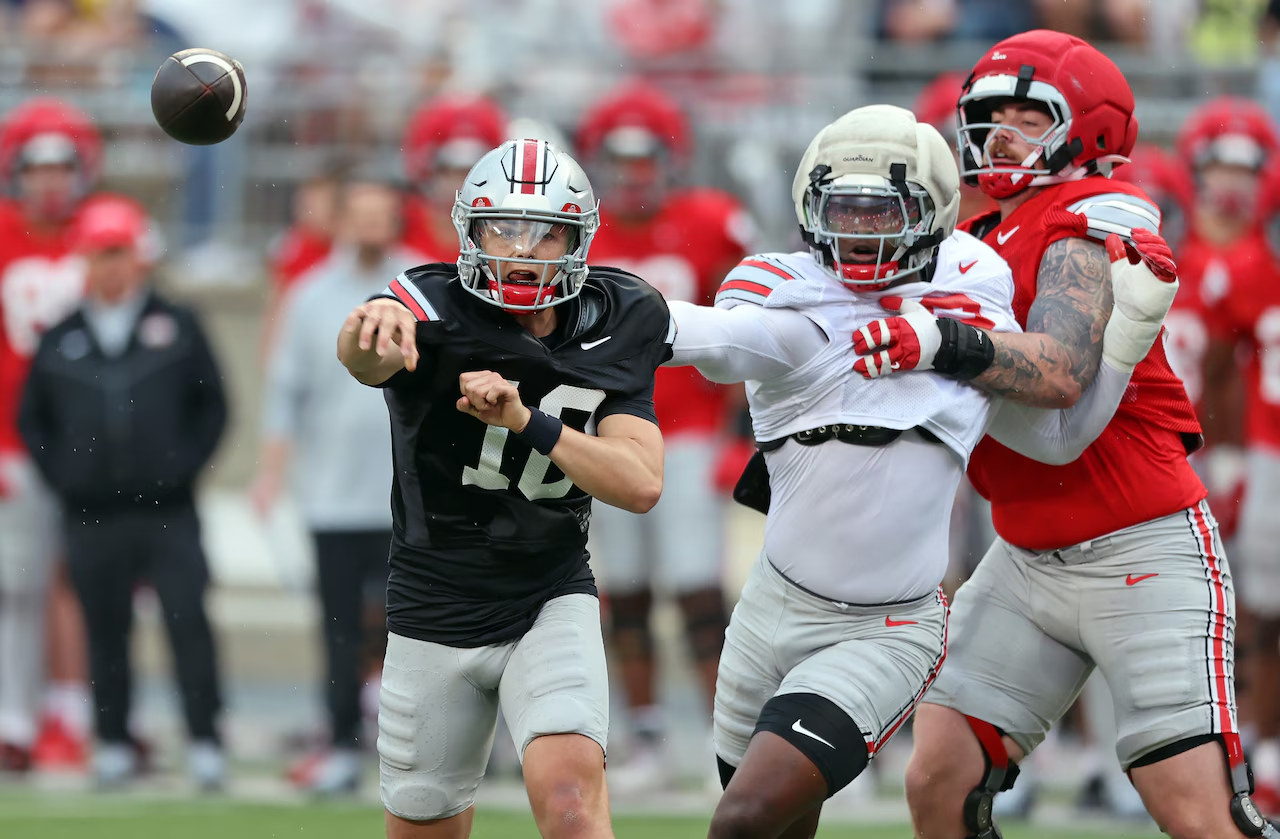
BREAKING: The 2027 NFL Draft quarterback conversation has taken a dramatic new turn, with Ohio State’s Julian Sayin reportedly surging into the same elite tier as Texas star Arch Manning and Oregon quarterback Dante Moore on several early draft boards, according to multiple league sources monitoring the evolving evaluation cycle.
What was once viewed as a two-man headline race between Manning’s generational pedigree and Moore’s high-ceiling arm talent is now being disrupted by Sayin’s rapid development in Columbus, where NFL scouts are increasingly convinced that the former five-star recruit is not just living up to expectations, but actively reshaping them.
The shift has sent ripples through NFL front offices already laying groundwork for a quarterback-heavy future draft class. While it remains early in the evaluation process, the emergence of Sayin as a legitimate challenger at the top of boards underscores how fluid the quarterback hierarchy has become, even among prospects who entered college with vastly different levels of national attention.
Arch Manning, long projected as a potential franchise-altering selection, entered the season carrying the weight of football royalty and immense expectations at Texas. Dante Moore, meanwhile, has been widely praised for his arm strength, pocket poise, and dual-threat adaptability, traits that initially positioned him as one of the most physically gifted quarterbacks in college football. But Julian Sayin’s ascent at Ohio State has complicated what many assumed would be a straightforward ranking at the top of the class.
Sources familiar with multiple NFL scouting departments describe Sayin’s rise as “quiet but undeniable,” noting that while he may not have entered the college spotlight with the same hype as Manning, his tape has steadily closed the gap. Some evaluators now believe he has even surpassed both Manning and Moore in certain schematic fit discussions, particularly for timing-based passing offenses.
Sayin, who transferred into Ohio State with the reputation of a highly accurate and technically refined passer, has reportedly taken significant strides in command of the Buckeyes’ offense. Coaches inside the program have emphasized his processing speed and ability to operate within structure, two traits NFL teams consistently prioritize when projecting quarterback success at the next level.
One AFC scouting director, speaking on condition of anonymity due to ongoing evaluations, described Sayin as “the most mechanically consistent passer in the group right now,” adding that his decision-making under pressure has improved faster than anticipated for a player still early in his college career.
That sentiment is beginning to echo across league circles, where Sayin’s name is increasingly appearing in the same conversations as Manning and Moore—something that would have seemed premature just months ago.
Arch Manning, however, remains firmly entrenched as one of the most scrutinized prospects in the sport. His arm talent, mobility, and lineage continue to make him one of the most marketable and closely watched quarterbacks in recent memory. Scouts continue to praise his ability to extend plays and deliver off-platform throws, but some evaluators have noted that his development curve remains under constant examination, particularly as expectations grow heavier each season at Texas.
NFL personnel departments are believed to be closely tracking Manning’s ability to consistently dominate within structure, an area that separates college production from professional projection. Despite that scrutiny, few question his long-term upside, and many still view him as a potential No. 1 overall pick depending on how his trajectory unfolds.
Dante Moore’s case presents a different kind of evaluation entirely. The Oregon quarterback has impressed scouts with what one NFC executive called “rare arm elasticity,” paired with an ability to generate velocity in tight windows that few college quarterbacks can replicate. Moore’s athleticism and improvisational ability have made him one of the most exciting tape studies in the country, but evaluators remain split on how his aggressive style translates to NFL decision-making consistency.
For Moore, the ceiling remains arguably the highest of the trio, but so too does the variability in outcomes. Some scouts see a future Pro Bowl-caliber quarterback if his processing continues to evolve, while others caution that his risk profile may require the right offensive system to maximize.
What makes Julian Sayin’s emergence particularly significant is that his profile is, in many ways, the most “pro-ready” of the group according to a growing segment of evaluators. At Ohio State, Sayin has operated within a system historically known for producing NFL-caliber quarterbacks, and his ability to execute timing routes, manage protections, and deliver anticipatory throws has drawn consistent praise.
“He doesn’t waste motion,” one veteran NFC scout said. “Everything is compact, efficient, and on time. That matters more than people realize when you’re projecting to Sundays.”
While Sayin may not yet match Manning’s physical stature or Moore’s raw arm explosiveness, his growing reputation centers on efficiency, consistency, and command—traits that often translate quickly at the professional level.
The quarterback landscape in this draft cycle is becoming increasingly difficult to define, and NFL teams are reportedly divided on how to stack the trio. Some front offices reportedly still have Manning as QB1 due to his ceiling and pedigree. Others lean toward Moore for his explosive traits and developmental upside. But a rising contingent is beginning to argue that Sayin’s floor may be higher than both, a factor that carries significant weight in draft evaluations.
The debate reflects a broader philosophical divide in NFL scouting circles: whether to prioritize elite physical tools or refined operational consistency at the quarterback position.
In recent years, teams have oscillated between both approaches with mixed results. The success of quarterbacks who entered the league with strong processing skills and quick decision-making has reinforced the value of “safe” projection profiles, while the continued emergence of high-ceiling, toolsy quarterbacks has kept the upside argument alive.
Sayin’s rise complicates that balance. He does not present the overwhelming physical profile of a generational athlete, but his command of the game has led some evaluators to believe he could rise quickly once he reaches the professional level.
At Ohio State, coaching staff members have reportedly been impressed with how quickly he has adapted to increased defensive complexity. According to internal assessments shared with scouts, Sayin’s ability to diagnose blitz packages and adjust protections has improved significantly, an area that often takes college quarterbacks years to master.
Meanwhile, Manning’s development at Texas continues under the brightest spotlight in college football. Every game, every throw, and every mistake is dissected with NFL-level intensity. That scrutiny is expected to intensify as he progresses through the season, particularly as scouts attempt to separate natural growing pains from long-term concerns.
Moore, on the other hand, remains one of the most intriguing film studies in the nation. His Oregon offense allows him to showcase his arm talent and improvisational skills, but scouts are closely monitoring his ability to reduce turnover-worthy plays and improve consistency within structured reads.
As the draft cycle continues, league executives expect the quarterback order to remain fluid deep into the evaluation process. Pro days, combine performances, and private workouts are expected to play a major role in shaping final boards, especially given how closely matched the top prospects appear at this stage.
For now, Julian Sayin’s emergence has added a new layer of complexity to what was already shaping up to be one of the most competitive quarterback classes in recent memory. His rise has forced evaluators to reconsider assumptions, broaden comparisons, and acknowledge that the gap between college production and NFL projection is often narrower than expected.
One veteran NFL general manager summarized the situation bluntly: “We thought we were looking at Manning and Moore at the top. Now you have to seriously include Sayin in that conversation. And honestly, it’s not a stretch anymore.”
As the season progresses and the draft picture continues to evolve, the battle between Arch Manning’s pedigree, Dante Moore’s raw explosiveness, and Julian Sayin’s precision-based rise will define not just the top of the quarterback board, but potentially the direction of multiple NFL franchises searching for their next long-term leader.
For now, the race is far from settled. But one thing is increasingly clear across NFL war rooms: Julian Sayin is no longer just part of the conversation. He is firmly inside it.