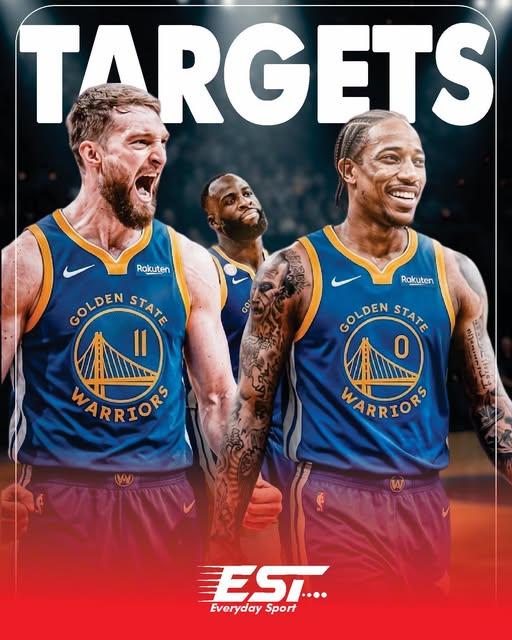
The Golden State Warriors are once again surveying the NBA trade market, and this time their attention appears to be centered on one of their Northern California rivals. League sources indicate Golden State has explored the possibility of pursuing Sacramento Kings stars Domantas Sabonis and DeMar DeRozan as the franchise searches for another championship-caliber roster around Stephen Curry and Draymond Green. The discussions, while still in the exploratory stage, are reportedly tied to the Warriors’ interest in utilizing Jimmy Butler’s $56 million expiring contract as the centerpiece of a potential blockbuster deal.
The reported development signals that Golden State’s front office remains committed to maximizing the remaining championship window of Curry, whose remarkable longevity continues to keep the Warriors among the Western Conference contenders. Even after reshaping the roster over the past two seasons, the organization appears unwilling to stand pat if another opportunity arises to add an established All-Star.
Sacramento, meanwhile, is believed to be evaluating a broader organizational reset after an inconsistent campaign that has left the franchise searching for long-term direction. League executives believe the Kings are open to conversations involving both Sabonis and DeRozan if the return accelerates their retooling process, though no formal agreement or advanced negotiations have been reported.
The possibility of a trade between two Pacific Division rivals would immediately become one of the NBA’s most fascinating storylines.
Golden State’s motivation is easy to understand. While Curry remains one of basketball’s most dangerous offensive players, the Warriors have struggled at times to consistently generate scoring when defenses load up against their franchise icon. Butler brought another elite two-way presence when he arrived in the Bay Area, but his contract also represents one of the league’s largest expiring salary slots, making it an attractive financial mechanism for pursuing another superstar-caliber player under the NBA’s collective bargaining agreement.
That flexibility has fueled speculation that the Warriors could again become aggressive buyers.
Sabonis would arguably represent the more intriguing basketball fit.
One of the NBA’s premier passing centers, Sabonis has developed into an offensive hub capable of orchestrating an entire attack from the elbows and high post. His combination of rebounding, screening, interior scoring and elite playmaking would create countless opportunities alongside Curry’s off-ball movement.
Few big men in today’s NBA can match Sabonis’ ability to initiate offense while simultaneously punishing opponents on the glass. His presence could allow Golden State to return to many of the split-action principles that defined its championship offenses, with Curry darting around screens while Sabonis facilitates from the middle of the floor.
His chemistry with shooters has consistently been one of the strengths of his game throughout his career.
Pairing him with Curry would force defenses into impossible decisions. Collapse on Sabonis inside, and Curry finds daylight beyond the three-point line. Chase Curry aggressively, and Sabonis gains room to attack mismatches near the basket.
The Warriors have long prioritized basketball IQ, passing and unselfishness, and Sabonis embodies all three qualities.
The challenge, however, would be cost.
Sacramento has consistently viewed Sabonis as one of the foundational pieces of the franchise. Any deal involving the Lithuanian All-Star would almost certainly require substantial draft compensation, young talent and salary matching beyond Butler’s expiring contract.
Golden State’s collection of future draft assets has become increasingly valuable as the franchise balances winning now against preparing for life after Curry.
Whether the Warriors would be willing to sacrifice multiple future first-round selections remains one of the biggest questions surrounding any potential blockbuster.
DeRozan presents a different, but equally compelling, possibility.
The six-time All-Star continues to age gracefully, relying on his footwork, mid-range efficiency and elite shot creation rather than overwhelming athleticism. Even entering the later stages of his career, DeRozan has remained one of the NBA’s most dependable late-game scorers, capable of manufacturing offense when possessions slow during the postseason.
That skill set has often been something Golden State lacked outside of Curry.
For years, opposing defenses have trapped Curry high above the three-point line during crunch time, daring other Warriors to create individual offense. DeRozan has built an entire career around precisely that responsibility.
His ability to operate from the elbows, attack mismatches and consistently reach the free-throw line could diversify Golden State’s offense in ways few available players can.
While his perimeter shooting has never been considered elite, DeRozan’s efficiency inside the arc and his decision-making have continued to make him one of the league’s most respected veterans.
His leadership would also fit a Warriors locker room built around experienced championship players.
From Sacramento’s perspective, entertaining offers for DeRozan could make sense if the organization ultimately prioritizes younger players and future assets.
The Kings assembled a veteran-heavy roster with playoff aspirations, but inconsistent results have created questions about whether the current core possesses enough upside to compete with the Western Conference’s elite.
A restructuring centered around draft capital, financial flexibility and younger contributors could prove appealing if Sacramento determines its current timeline has reached its ceiling.
Sabonis, however, represents a much more difficult decision.
Since arriving in Sacramento, he has become one of the NBA’s most productive big men, consistently ranking among league leaders in rebounds while producing near triple-double numbers on many nights. His durability, passing and interior presence have made him the offensive engine of the Kings.
Moving a player of that caliber would signal a significant philosophical shift.
It would also likely require a return substantial enough to justify moving a franchise cornerstone.
Golden State has repeatedly demonstrated throughout the Curry era that it is willing to make bold decisions when championship opportunities arise.
The acquisition of Butler reinforced that mindset, proving the organization remains aggressive despite already possessing one of the NBA’s oldest veteran cores.
General manager Mike Dunleavy Jr. has consistently emphasized maintaining flexibility while remaining competitive.
An expiring contract of Butler’s magnitude provides precisely that flexibility.
Whether it ultimately becomes the foundation for a Sabonis pursuit, a DeRozan deal or another target entirely remains uncertain.
Financially, any blockbuster would require careful navigation under the NBA’s increasingly restrictive collective bargaining rules.
Second-apron penalties have dramatically changed how contenders construct rosters, limiting flexibility for teams carrying multiple maximum contracts.
Golden State would need to balance immediate competitiveness with long-term financial sustainability.
That challenge has become one of the defining realities facing every championship contender.
For Sacramento, the calculus extends beyond talent evaluation.
If the Kings truly decide to reshape their roster, maximizing asset value becomes essential. Waiting too long can diminish returns, while moving established veterans too early risks alienating a fan base eager for sustained playoff success.
Front offices across the league will undoubtedly monitor Sacramento’s intentions closely.
Few teams possess multiple All-Star-caliber veterans who could realistically become available.
Should either Sabonis or DeRozan officially hit the market, interest would likely extend well beyond Golden State.
Several playoff contenders could assemble competitive offers.
That reality could ultimately drive bidding higher.
For the Warriors, timing is everything.
Curry continues to perform at an elite level despite approaching the later stages of his historic career.
Draymond Green remains one of basketball’s smartest defensive players, but the franchise understands opportunities to compete for championships are no longer unlimited.
Every offseason, every trade deadline and every roster decision now carries additional urgency.
The organization has spent more than a decade building one of the NBA’s greatest dynasties.
Its willingness to remain aggressive reflects an understanding that championship windows rarely stay open forever.
Whether Sacramento ultimately decides to part with Sabonis, DeRozan, both players or neither remains unknown.
Trade discussions across the NBA often begin with exploratory conversations before fading quickly.
Others unexpectedly gain momentum and reshape the league.
At this stage, sources continue to characterize Golden State’s interest as exploratory rather than imminent.
Nevertheless, the mere possibility underscores how active the Warriors remain in searching for ways to maximize Curry’s championship pursuit.
If negotiations eventually progress, the basketball implications would be enormous.
Sabonis could transform Golden State’s offensive identity through elite playmaking and rebounding.
DeRozan could provide the late-game shot creation the Warriors have occasionally lacked.
Either acquisition would dramatically alter expectations throughout the Western Conference.
For now, league executives continue watching as two California franchises evaluate very different futures—one attempting to extend a dynasty built around an all-time great, the other considering whether a new direction offers its clearest path back toward sustained contention.
Whether those paths eventually intersect in one of the NBA’s biggest trades of the offseason remains one of basketball’s most compelling questions.