The message landed with the kind of force that can instantly change the trajectory of a young athlete’s career.
One year after arriving in Columbus as one of the most promising young pass-rushing prospects in the program, a rising second-year Ohio State edge defender reportedly saw his Buckeyes career come to an abrupt end after being dismissed from the roster following an absence from every offseason team activity.
According to sources familiar with the situation, the decision came after coaches determined the player missed the entirety of Ohio State’s offseason program while choosing to travel during a period when teammates were participating in mandatory workouts, conditioning sessions, meetings and developmental training.
The reported move has generated significant discussion throughout college football circles, not only because of the player’s potential but also because it highlights the culture and accountability standards that continue to define one of the sport’s premier programs.
At a time when college football is undergoing dramatic changes through NIL opportunities, the transfer portal and increased player freedom, Ohio State’s decision sends a clear message about the expectations attached to wearing the scarlet and gray.
Sources indicate that concerns began to mount early in the offseason when coaches noticed the player’s repeated absence from team activities. What initially appeared to be a temporary situation reportedly evolved into a larger issue as weeks passed without the defender participating in any organized offseason sessions.
The offseason program is widely viewed as one of the most important periods in a college football calendar. While Saturdays in the fall ultimately determine championships and legacies, coaches frequently point to the winter and spring months as the foundation upon which successful seasons are built.
For Ohio State, those months carry even greater significance.
The Buckeyes enter every season with national championship expectations. Every practice rep, every conditioning drill and every film session is treated as an essential step toward competing for Big Ten titles and College Football Playoff appearances.
Players are expected to embrace that standard from the moment they arrive on campus.
According to individuals close to the program, team leaders and coaches repeatedly emphasized the importance of offseason participation this year as Ohio State attempts to build upon recent success and position itself for another championship run.
That environment left little room for exceptions.
The reported absence of a young player viewed as part of the program’s future became increasingly difficult to ignore, particularly as teammates spent months grinding through workouts designed to improve strength, speed and football development.
One source described the situation bluntly.
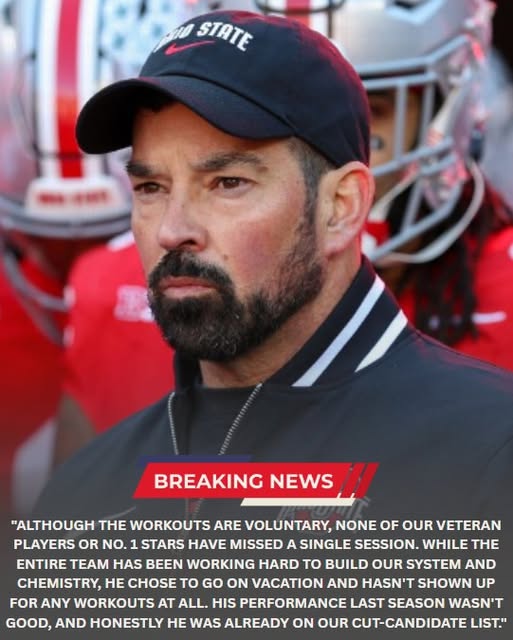
“He chose to travel while the entire team was training.”
That sentiment reportedly resonated throughout the Woody Hayes Athletic Center as coaches evaluated how to handle the situation.
While talent remains one of the most valuable commodities in college football, accountability often determines whether that talent ultimately flourishes.
Programs that consistently compete for championships frequently point to culture as the difference between good teams and elite teams. Coaches often argue that standards must apply equally to everyone, regardless of recruiting rankings, potential or projected future impact.
The Buckeyes have long embraced that philosophy.
Over the years, Ohio State has produced countless NFL stars, but those inside the program often stress that development begins with commitment rather than natural ability.
Former players frequently describe the offseason as the most challenging portion of their collegiate careers. The physical demands can be exhausting. The mental grind can be overwhelming. Yet coaches believe those experiences help build the discipline necessary for success when games begin.
Missing a single workout may be viewed as a minor issue.
Missing an entire offseason presents a much different challenge.
For a young edge defender, the consequences can be particularly significant.
Pass rushers rely heavily on physical development during their first few years in a college strength program. Building explosive power, refining technique and improving conditioning often determine whether talented recruits become productive contributors.
Without those months of preparation, players can quickly find themselves falling behind teammates competing for the same opportunities.
Sources say coaches became increasingly concerned not only about the player’s absence but also about what it represented in terms of commitment and buy-in.
The decision to remove a promising athlete from the roster is never taken lightly.
Scholarship limitations, roster construction and player development all factor into such decisions. Programs invest substantial resources into recruiting and nurturing young talent. Parting ways with a player who still possesses considerable upside can be difficult.
Yet Ohio State’s reported action reflects a belief that culture must remain protected at all costs.
The Buckeyes are hardly alone in that approach.
Across college football, coaches consistently emphasize the importance of establishing expectations and holding players accountable when those expectations are not met.
Some programs address violations internally through suspensions or disciplinary measures. Others take stronger action depending on the circumstances.
In this case, Ohio State reportedly determined that the situation warranted a permanent separation.
The move arrives during a pivotal period for the Buckeyes.
Competition for playing time along the defensive front remains intense. Ohio State continues to recruit at an elite level, bringing in highly regarded prospects nearly every cycle.
That depth provides coaches with options.
It also reinforces a reality facing every player on the roster: no position is guaranteed.
Young athletes entering powerhouse programs often discover that talent alone is insufficient. Daily commitment becomes equally important.
Veteran leaders within the locker room reportedly viewed offseason participation as a non-negotiable expectation.
Players who spend months pushing through conditioning sessions frequently develop a strong sense of collective sacrifice. Every sprint, every weight-room session and every practice contributes to a shared objective.
When one player is absent throughout that process, it can create questions about fairness and accountability.
Sources suggest Ohio State’s leadership group remained firmly aligned with the coaching staff’s position regarding team standards.
That support may have influenced the ultimate outcome.
The dismissed player now faces uncertainty regarding his football future.
Given the modern landscape of college athletics, opportunities may still exist elsewhere. The transfer portal has transformed career paths, allowing athletes to seek fresh starts at new programs.
Potential destinations will undoubtedly evaluate both the player’s talent and the circumstances surrounding his departure.
For many coaches, talent remains attractive.
However, commitment, reliability and availability remain equally important considerations.
The situation also serves as a cautionary tale for young athletes navigating newfound freedom in college sports.
Today’s players possess more opportunities than ever before. NIL deals, personal branding opportunities and expanded transfer options have fundamentally altered the collegiate experience.
Yet football remains a sport built on collective commitment.
Teams spend months preparing for a season that can be defined by a handful of moments. Coaches frequently stress that success requires every player to invest fully in the process long before fans fill stadiums on autumn Saturdays.
Ohio State’s reported decision underscores that principle.
The Buckeyes are attempting to maintain a championship standard in an era filled with unprecedented change. That challenge requires balancing player empowerment with organizational expectations.
According to sources, coaches believed allowing the situation to continue without significant consequences would have undermined the culture they have spent years building.
Whether viewed as a tough but necessary decision or an unfortunate ending to a promising career, the message appears unmistakable.
No player is bigger than the program.
That philosophy has guided some of college football’s most successful teams for decades.
It remains a cornerstone of Ohio State’s identity.
As preparations for the upcoming season continue, the Buckeyes will move forward with a roster committed to the demands of offseason development and championship pursuit.
For the young edge defender, the road ahead likely includes difficult questions and important decisions regarding the next chapter of his career.
For Ohio State, the episode represents another example of the standards required to compete at the highest level of college football.
Championship programs often celebrate their stars on game days.
But insiders will tell you championships are usually built in the months nobody sees.
In weight rooms.
On practice fields.
During conditioning drills.
Inside film rooms.
Those are the moments where trust is established and culture is formed.
According to those familiar with the Buckeyes’ decision, that reality ultimately shaped the outcome.
The player may have possessed immense potential. He may have projected as a future contributor. He may even go on to find success elsewhere.
But at Ohio State, sources say the determining factor became simple: while the rest of the team was working toward a common goal, he wasn’t there.
And for a program whose expectations begin long before kickoff, that proved to be a line that could not be crossed.