For nearly three decades, the ghosts of Madison Square Garden hovered over every spring run, every promising roster, every superstar acquisition and every heartbreaking collapse. The banners inside the world’s most famous arena served as reminders of a franchise that once defined basketball greatness but had slowly become a symbol of instability, impatience and missed opportunity. On Monday night in Cleveland, all of that changed.
The New York Knicks are headed back to the NBA Finals for the first time in 27 years, and the architect of one of the most remarkable turnarounds in modern NBA history is a coach many organizations once believed wasn’t the answer.
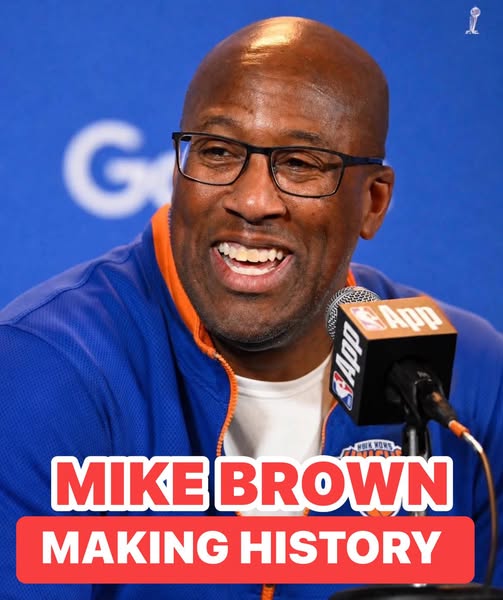
New York Knicks coach Mike Brown completed a stunning sweep of the Cleveland Cavaliers with a dominant 130-93 victory in Game 4 of the Eastern Conference finals, capping off a postseason run that has permanently rewritten the narrative around one of basketball’s most scrutinized coaching careers.
Brown stood near midcourt after the final buzzer with a look that was equal parts exhaustion, vindication and disbelief. The confetti fell. Knicks players embraced one another while thousands of traveling fans inside Rocket Arena roared as though the game had been played in Manhattan instead of Ohio. For the first time since 1999, the Knicks were Eastern Conference champions again.
And for Brown, the moment carried layers far deeper than basketball.
Less than 18 months ago, Brown was fired by the Sacramento Kings despite helping revive a franchise that had wandered through years of irrelevance before his arrival. The decision shocked many around the league, particularly because Brown had transformed Sacramento into one of the NBA’s most entertaining and disciplined teams. Yet the dismissal added another chapter to a career that, fairly or unfairly, had often been framed around exits rather than accomplishments.
The irony became impossible to ignore Monday night.
The Cavaliers franchise that once hired Brown twice — and dismissed him twice — became the latest victim of his resurgence. Cleveland entered the Eastern Conference finals believing this season represented the franchise’s best opportunity since the LeBron James era to return to championship contention. Instead, the series became a showcase for Brown’s tactical brilliance and New York’s relentless identity.
The Knicks didn’t merely beat Cleveland. They overwhelmed them.
Game 4 was supposed to be the Cavaliers’ last stand. Instead, it quickly became another New York avalanche. The Knicks pushed the tempo early, controlled the glass and suffocated Cleveland defensively. By halftime, the tension inside the arena had shifted from hope to resignation. By the fourth quarter, fans were already heading toward the exits while Knicks supporters chanted for Brown and celebrated the franchise’s long-awaited return to basketball’s biggest stage.
New York’s dominance throughout the series reflected the personality Brown has spent years cultivating. Toughness. Defensive accountability. Ball movement. Emotional composure. The Knicks executed every one of those principles with ruthless consistency.
What makes Brown’s achievement even more remarkable is the historical context surrounding the Knicks. Since their Finals appearance in 1999, the organization cycled through coaches, executives and stars in desperate search of stability. There were high-profile disappointments, public controversies and postseason collapses that reinforced the perception that the franchise’s championship days belonged to another era.
Brown changed that culture almost immediately after arriving in New York.
Players repeatedly credited him this season for creating clarity and trust inside the locker room. Veterans embraced clearly defined roles. Younger players developed rapidly under his structure. Most importantly, the Knicks developed a defensive mentality that transformed them from a talented playoff team into a legitimate championship contender.
Throughout the postseason, Brown consistently outmaneuvered opposing coaching staffs. Against Cleveland, his adjustments were devastatingly effective. The Knicks attacked mismatches relentlessly, disrupted the Cavaliers’ offensive rhythm and forced Cleveland’s stars into uncomfortable possessions throughout the series.
The sweep itself became symbolic.
Cleveland had once viewed Brown as expendable. Now Brown delivered one of the most humiliating playoff exits in franchise history against the same organization that twice decided to move on from him.
That reality wasn’t lost on anyone around the league.
NBA coaching careers are often shaped as much by timing and perception as by actual performance. Brown has long been respected internally by executives and players, but public narratives frequently focused on what he supposedly lacked rather than what he consistently accomplished. Before arriving in New York, Brown had already won Coach of the Year honors, reached an NBA Finals with Cleveland and helped restore credibility to Sacramento. Yet criticism followed him at nearly every stop.
Now, he owns perhaps the defining moment of the 2026 postseason.
The significance of the Knicks reaching the Finals extends beyond New York basketball. Madison Square Garden remains one of sports’ most iconic stages, and the NBA is undeniably different when the Knicks are relevant. Generations of fans waited for this moment, enduring decades of frustration and false starts while clinging to memories of the Patrick Ewing era and the gritty teams that once embodied New York basketball.
Those memories now have company.
This Knicks team has forged its own identity through resilience and physicality. Every playoff series seemed to strengthen the group’s belief. By the time they reached Cleveland for Game 4, they looked like a team fully convinced destiny was finally on their side.
The Cavaliers, meanwhile, appeared overwhelmed by the magnitude of the moment and the pressure created by New York’s relentless execution. Cleveland entered the postseason with championship aspirations after a dominant regular season, but the Eastern Conference finals exposed critical weaknesses. The Knicks dictated pace, controlled defensive matchups and repeatedly turned games into physical battles that favored Brown’s roster construction.
For Cleveland, the sweep raises difficult questions about the franchise’s future and whether its current core is capable of surviving the highest-pressure postseason environments. For Brown, however, the series represented personal redemption on the grandest stage imaginable.
After the game, players praised Brown’s leadership and preparation, describing a coach who never allowed outside criticism to define the locker room. That belief became especially important during difficult stretches earlier in the season when injuries and expectations threatened to derail momentum.
Instead, Brown kept the Knicks focused on incremental improvement.
Now they are four wins away from delivering the franchise’s first NBA championship since 1973.
The journey itself almost feels improbable considering where Brown stood not long ago. Coaching careers in professional sports rarely follow linear paths. Success can disappear quickly. Public confidence can evaporate even faster. Brown experienced both realities multiple times, especially after his departures from Cleveland and Sacramento.
Yet the Knicks saw something different.
They saw a coach with championship-level experience, defensive expertise and the emotional intelligence to manage one of the NBA’s most demanding environments. More importantly, Brown embraced the pressure that comes with coaching in New York instead of resisting it.
That confidence spread throughout the organization.
Veteran leaders bought into Brown’s system immediately. Role players flourished because expectations remained clear and consistent. The Knicks became one of the league’s most connected defensive units, rotating with precision and competing with an intensity that mirrored their head coach’s personality.
Against Cleveland, all of those qualities reached their peak.
Every loose ball seemed to belong to New York. Every defensive possession carried urgency. Every Cavaliers mistake turned into transition offense the other way. By the second half of Game 4, the Knicks looked less like an underdog story and more like a fully formed championship machine.
For longtime Knicks fans, the celebration represented the release of nearly three decades of frustration. Since 1999, the franchise endured coaching upheaval, front-office dysfunction and endless debates about whether basketball’s biggest market would ever reclaim relevance. Monday night offered an emphatic answer.
The Knicks are back.
And at the center of it all stands Brown, the coach once dismissed as replaceable by multiple franchises now watching him from home while New York prepares for the NBA Finals.
There is something poetic about the symmetry of Brown’s journey. Fired by Sacramento. Doubted nationally. Let go twice by Cleveland. Then ultimately returning to eliminate the Cavaliers in humiliating fashion while guiding the Knicks to one of the greatest moments in franchise history.
Sports often produce redemption stories, but few unfold with this level of dramatic irony.
Brown’s coaching performance throughout the postseason has already sparked conversations about legacy. If the Knicks complete the final step and capture the championship, his transformation from respected coach to all-time New York sports figure could happen almost instantly.
That possibility no longer feels unrealistic.
The Knicks have momentum, confidence and a coach operating at the height of his profession. Their defensive identity travels. Their composure under pressure has become a defining trait. Most importantly, they appear emotionally unshaken by the enormity of the stage ahead.
For Brown, the Finals appearance validates years of persistence through criticism and uncertainty. Coaching in the NBA often means living one loss away from public doubt. Brown endured that cycle repeatedly, but never abandoned the principles that defined his teams.
Now those principles have brought the Knicks back to basketball’s biggest stage.
As celebrations continued late into the night inside Cleveland’s stunned arena, Brown briefly paused near the tunnel leading back toward the locker room. He looked around at the scene — Knicks fans screaming, players celebrating, cameras flashing — before disappearing into the chaos with the Eastern Conference trophy finally belonging to New York once again.
Twenty-seven years later, the Knicks are going back to the NBA Finals.
And the coach so many teams once gave up on is the reason why.