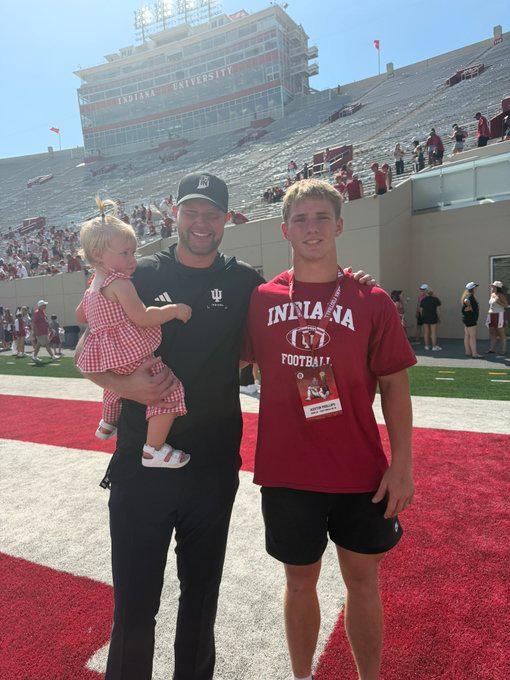
Indiana football’s recruiting momentum extended into the next generation of prospects Saturday, as East Noble standout Austin Phillips left Bloomington with a scholarship offer from the Hoosiers following a visit to the program.
For Phillips, a member of the 2029 recruiting class, the offer represents an early and significant development in his recruitment. For Indiana, it is another indication that Curt Cignetti and his staff are determined to establish a stronger presence inside the state’s borders while building relationships with elite prospects long before the traditional recruiting process reaches its peak.
Phillips, regarded as one of the emerging in-state prospects to monitor in the 2029 class, visited Indiana and came away with more than an opportunity to tour the facilities and meet with members of the coaching staff. He left with a scholarship offer from the Hoosiers, giving Indiana an early position in what could eventually become a highly competitive recruitment.
The timing is notable.
Recruiting the class of 2029 remains in its earliest stages, and player evaluations will inevitably change as prospects mature physically and continue their high school careers. But major programs increasingly understand the value of identifying potential difference-makers early, particularly when those players are located within their own state.
For Indiana, the pursuit of Phillips fits directly into the broader recruiting philosophy that has developed under Cignetti.
The Hoosiers’ rise under Cignetti has changed the perception of Indiana football, both nationally and on the recruiting trail. A program that historically struggled to compete consistently with college football’s established powers has become increasingly aggressive in talent acquisition, using recent success, player development and a growing national profile to expand its recruiting reach.
But while the transfer portal has played a significant role in Indiana’s rapid roster construction, high school recruiting remains essential to sustaining long-term success.
That makes prospects such as Phillips particularly important.
Indiana has historically faced a difficult challenge when recruiting its home state. Indiana’s top prospects often attract attention from programs across the Midwest and beyond, forcing the Hoosiers to compete against schools with deeper recruiting traditions, larger fan bases and decades of sustained success.
Programs such as Ohio State, Michigan, Notre Dame and Purdue have regularly recruited Indiana prospects, while Big Ten and national programs frequently cross state lines in search of talent.
For Cignetti’s staff, however, the objective is straightforward: Indiana’s success must eventually translate into more victories in recruiting battles for the state’s best players.
The offer to Phillips is an early investment in that process.
East Noble has developed a reputation as a program capable of producing competitive football talent, and Indiana’s staff clearly saw enough from Phillips to make an early move. Recruiting evaluations at this stage often extend beyond a player’s current production. Coaches study athletic traits, body development, movement skills, competitiveness and long-term positional projection.
That projection can be especially important with freshmen and sophomores.
A prospect who looks one way physically at 14 or 15 years old can look entirely different by the time he reaches his senior season. College recruiting staffs therefore must balance present-day evaluation with future potential, identifying athletic characteristics that could translate to the college game after several more years of development.
Indiana’s decision to offer Phillips suggests the staff believes his trajectory is worth following closely.
The relationship-building process now becomes equally important.
An early offer does not guarantee an eventual commitment, particularly in modern recruiting. The landscape can change quickly as prospects develop, receive additional offers and establish relationships with new coaching staffs. A player in the 2029 class still has years before reaching a signing decision, creating a long runway for programs across the country to enter the picture.
That makes consistency critical.
Indiana will now have an opportunity to build on the relationship established during Phillips’ visit. Continued communication with the prospect, his family and his high school coaches could prove just as important as the scholarship offer itself.
The Hoosiers also have an advantage that cannot be overlooked: proximity.
For an in-state prospect, the opportunity to visit campus regularly can create a meaningful recruiting edge. Phillips can see the program evolve in real time, attend games, interact with coaches and observe the culture Indiana is attempting to build.
That access can be particularly valuable during the early stages of a recruitment.
The question for Indiana will be whether it can maintain Phillips’ attention as his profile potentially grows.
That challenge has become increasingly complicated across college football. The recruiting process now exists alongside NIL opportunities, the transfer portal, expanded conference footprints and a rapidly changing postseason structure. Players and families are evaluating far more than geography and traditional program prestige.
They are asking questions about development, playing time, coaching stability, NFL preparation and financial opportunities.
For Indiana, recent developments have provided increasingly strong answers.
The Hoosiers have demonstrated that they can construct and develop a competitive roster while operating in one of college football’s most demanding environments. The Big Ten’s continued expansion and the presence of traditional powers make every recruiting battle more difficult, but Indiana’s recent trajectory has given the program a credibility it previously struggled to establish consistently.
Cignetti’s arrival brought an expectation of immediate competitiveness, and his staff has worked aggressively to reshape the roster and raise standards throughout the program.
That transformation is central to recruiting.
High school prospects want to see evidence that a program is moving forward. They want to know whether a coaching staff has a clear identity and whether the system provides a path toward meaningful playing time and professional development.
Indiana’s message to recruits is becoming increasingly connected to what the program has accomplished on the field.
For Phillips, Saturday’s visit offered a firsthand look at that operation.
An offer from the state’s flagship football program carries additional significance for a prospect playing high school football in Indiana. It provides recognition close to home and places the player on the radar of a college staff that will likely continue monitoring his development throughout the coming seasons.
The next step will be determining how quickly Phillips’ recruitment expands.
Early offers often generate additional attention, especially when they come from an in-state Power Conference program. Other schools will evaluate the same film, attend future games and camps and determine whether Phillips fits their recruiting board.
The modern recruiting cycle is rarely linear.
A prospect can go from relatively unknown to nationally recruited in a single offseason after a significant physical transformation or standout performance against high-level competition. Camp settings, combines and increasingly sophisticated film evaluation have also accelerated the process by allowing programs to identify prospects earlier than ever.
Indiana’s staff is clearly attempting to be ahead of that curve.
The Hoosiers do not have the luxury of waiting until every major program has identified an in-state prospect. Programs competing for elite talent must establish relationships early and convince recruits that they are a priority before the national recruiting market becomes crowded.
That is especially true in the Midwest.
The region remains one of college football’s most competitive recruiting territories, producing prospects who routinely attract national attention. While Indiana’s population base does not compare with states such as Texas, Florida or California, the Hoosier State has consistently produced talented offensive linemen, quarterbacks, defensive players and multi-sport athletes capable of playing at the highest levels.
Keeping even a larger percentage of that talent at home would represent a significant step for Indiana.
Phillips’ offer should therefore be viewed as part of a broader strategy rather than an isolated recruiting decision.
Cignetti and his staff are attempting to build a program capable of competing annually in the Big Ten and positioning itself for the College Football Playoff. That goal cannot depend exclusively on one-year transfer additions. The portal can solve immediate roster needs, but sustained success requires recruiting classes that develop together and create depth across multiple seasons.
High school prospects such as Phillips represent the foundation of that long-term model.
The value of an early offer is also tied to relationships with high school programs. By remaining active throughout Indiana and showing a willingness to invest in local talent, the Hoosiers can strengthen connections with coaches who play an important role in future evaluations.
Those relationships often extend beyond individual recruiting cycles.
A positive experience with one prospect can influence how a high school program views a college staff when the next standout player emerges. For Indiana, establishing trust and credibility throughout the state could pay dividends for years.
Phillips’ recruitment is still just beginning, and projecting where he will eventually play college football would be premature. The 2029 class has several seasons of high school football remaining, and the recruiting landscape will undoubtedly change before his decision arrives.
Coaching staffs will change. Rosters will evolve. New programs will enter the conversation.
But Indiana made sure Saturday that it would be part of the story from the beginning.
For Phillips, the offer represents a major milestone and an opportunity to begin building a relationship with a college program located inside his home state.
For the Hoosiers, it represents something larger.
Indiana is no longer content to simply identify the state’s top prospects after the recruiting world has already discovered them. The program is moving early, building relationships and attempting to establish itself as the first call rather than an afterthought when Indiana talent begins attracting national attention.
The recruiting process surrounding Austin Phillips will have plenty of chapters left to write. Other programs could soon enter the picture, and his development at East Noble will ultimately determine how his national profile evolves.
But on this day, Indiana made its intentions clear.
A big-time in-state prospect came to Bloomington.
And he left with an offer from the Hoosiers.
In the increasingly competitive business of college football recruiting, that might only be the first step. But for Indiana and Austin Phillips, it was an important one.