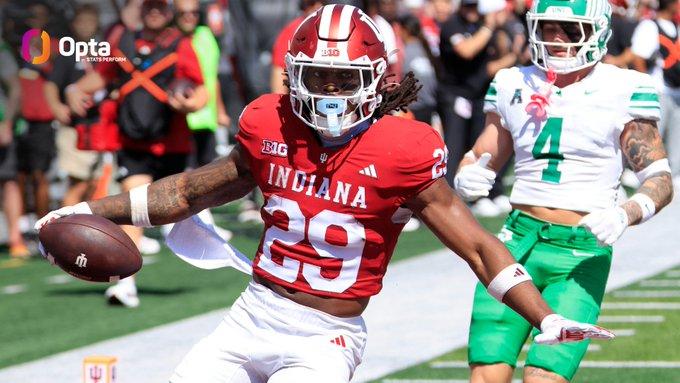
Indiana’s latest run of football has produced plenty of eye-catching numbers, but one statistic quietly separates the Hoosiers from nearly every other team in the Football Bowl Subdivision.
For 27 consecutive games, Indiana has avoided being outplayed in the turnover battle.
The Hoosiers have not committed more turnovers than their opponent in any game during that stretch, a remarkable run of ball security that has extended across multiple seasons and different challenges. According to the statistic, Indiana’s 27-game streak is tied for the longest such streak by any FBS program over the past 30 seasons, matching the mark set by Air Force from 2007 through 2009.
Turnovers are often described as one of football’s most unpredictable elements. A tipped pass can become an interception. A routine exchange between a quarterback and running back can suddenly become a fumble. A defender can make one play that completely changes the momentum of a game.
Indiana, however, has consistently found a way to stay on the right side of that equation.
That consistency has become an important part of the Hoosiers’ identity.
A team can dominate time of possession, pile up yards and control the line of scrimmage, but one mistake with the football can erase much of that work. Indiana’s ability to avoid putting itself in that position has allowed the program to maintain a level of offensive stability that is difficult to sustain over a long stretch of games.
The significance of the number becomes even clearer when viewed through the history of college football.
Twenty-seven consecutive games without being outgained in the turnover margin is not simply a good stretch. It places Indiana alongside one of the most unusual stretches of ball security recorded by an FBS team in the past three decades.
Air Force established the same 27-game mark between 2007 and 2009, giving Indiana a historical comparison that underscores just how difficult this achievement is.
The turnover battle is not always about forcing a large number of takeaways. Just as important is avoiding the mistakes that give opponents extra possessions.
That distinction matters.
When a team finishes a game with zero turnovers while its opponent commits one, Indiana effectively wins the turnover margin without necessarily producing a spectacular defensive performance. If both teams finish without a turnover, the battle remains even. What matters over the course of the streak is that Indiana has consistently avoided the scenario that can quickly put a team behind: giving the opponent more possessions through giveaways.
Over 27 games, that kind of consistency requires more than luck.
It requires quarterbacks making sound decisions, running backs protecting the football, receivers securing passes through contact and ball carriers understanding when to fight for additional yards and when to protect possession.
It also requires an offense that understands situational football.
Third down. Red zone possessions. Two-minute situations. Short-yardage plays. Late-game drives. All of those moments can create opportunities for turnovers, particularly when defenses begin increasing pressure and offenses are forced to make difficult decisions.
Indiana’s streak indicates that, across all of those situations, the Hoosiers have repeatedly managed to keep the football out of danger.
That has value beyond the box score.
A turnover does more than change possession. It can alter field position, swing momentum and place additional pressure on a defense. An interception deep in opposing territory can eliminate a scoring opportunity. A fumble near midfield can give an opponent a short field. A late-game giveaway can turn a comfortable lead into a one-possession game.
Avoiding those mistakes gives a team a chance to control the terms of the game.
For Indiana, that has become one of the defining characteristics of its recent stretch.
The achievement is particularly notable because maintaining such a streak over 27 games means surviving different opponents, different defensive schemes and different game situations. College football seasons are filled with unpredictable moments. Teams encounter hostile environments, injuries, weather changes, unfamiliar opponents and games in which the offense does not operate at its best.
Turnover-free football provides a margin for error in all of those circumstances.
Indiana does not have to play a perfect game to benefit from the streak. It simply has to avoid giving the opponent unnecessary opportunities.
That principle is especially important as the margin for error becomes smaller against quality competition.
The higher the stakes, the more valuable possession becomes.
A team competing for conference championships or postseason opportunities cannot afford to repeatedly lose the turnover battle. Even talented rosters can struggle when an opponent receives extra possessions, particularly against teams capable of converting short fields into touchdowns.
Indiana’s streak represents the opposite approach.
The Hoosiers have consistently protected one of the most valuable resources in football: the ball.
That consistency also speaks to preparation.
Ball security is not something that happens accidentally. Coaches emphasize it throughout practice. Quarterbacks are taught to understand defensive leverage and recognize when a throw is no longer available. Running backs work relentlessly on carrying technique. Receivers are expected to finish catches through contact. Offensive linemen are responsible for maintaining protection that prevents hurried decisions from developing in the first place.
Every position has a role.
The result is a statistic that stretches across 27 games.
For Indiana, the number is now approaching the territory of college football history.
Being tied with Air Force’s 2007-09 run places the Hoosiers in a rare statistical category. The Falcons’ streak became one of the more notable examples of sustained turnover efficiency during that era. Indiana now has matched it.
That does not necessarily mean the Hoosiers have been perfect with the football. Turnovers can still occur during an individual game. What makes the statistic remarkable is the margin relative to the opponent: Indiana has not allowed its turnover total to exceed its opponent’s total in 27 straight games.
That is the key.
It is a measure not simply of offensive execution, but of overall possession discipline.
And as Indiana continues its season, the streak provides another storyline worth monitoring.
Every game now carries historical significance for the statistic.
One more game without being on the wrong side of the turnover margin would give Indiana sole possession of the longest such streak by an FBS team in the past 30 seasons, assuming the stated historical comparison remains accurate.
But even before that threshold is reached, the accomplishment already tells an important story about the Hoosiers.
In an era where one mistake can determine the outcome of an entire game, Indiana has made avoiding those mistakes a consistent part of its formula.
Yards will fluctuate.
Points will fluctuate.
Opponents will change.
Game plans will change.
But the football has remained in Indiana’s hands when it has mattered most.
Twenty-seven consecutive games without losing the turnover battle is more than a statistical footnote. It is evidence of sustained execution in one of football’s most important areas, and it has placed Indiana alongside Air Force in a record that has stood for nearly two decades.
Now, the Hoosiers have a chance to make the streak entirely their own.
The next turnover margin will not simply be another number in the box score. It will determine whether Indiana extends one of the most unusual runs of ball security in recent FBS history — and whether the Hoosiers can move from sharing the record to standing alone at the top.