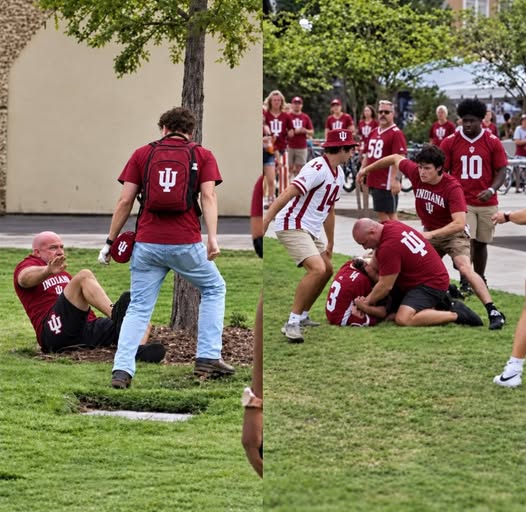
What began as a typical game-day gathering filled with food, music and Indiana Hoosiers pride took a shocking turn when a violent confrontation involving multiple fans erupted during a tailgate celebration.
Male and female supporters were seen exchanging punches during a chaotic brawl that quickly transformed an otherwise festive atmosphere into a scene of confusion and disorder. The incident drew the attention of nearby fans, with some attempting to break up the confrontation while others stepped back as the situation escalated.
Tailgating has long been one of the defining traditions of college football. Hours before kickoff, parking lots surrounding stadiums are typically filled with fans wearing team colors, families gathering around grills and alumni reconnecting over their shared love for the program.
But on this occasion, the excitement surrounding Indiana football was overshadowed by an ugly confrontation that served as a reminder of how quickly emotions can spiral out of control in large game-day environments.
Witnesses watched in disbelief as the argument escalated into a physical altercation. What may have initially appeared to be a disagreement quickly developed into a full-blown brawl, with punches being thrown and multiple individuals becoming involved in the chaos.
The confrontation included both male and female fans, adding to the startling nature of the scene. Nearby spectators reacted in different ways. Some rushed toward the group in an effort to separate those involved, while others kept their distance and watched as the disorder unfolded.
For Indiana supporters who had gathered to celebrate their team and enjoy one of college football’s most popular traditions, the incident created a sharp contrast with the atmosphere normally associated with Hoosiers game days.
College football is built on passion. That passion is visible everywhere on Saturdays, from packed stadiums and student sections to tailgate lots filled with fans hours before kickoff. Rivalries can be intense, emotions can run high and supporters often invest deeply in the success of their teams.
But there is a significant difference between passionate support and physical confrontation.
The scene involving Indiana fans demonstrated what can happen when emotions move beyond celebration and competition. Instead of the attention remaining on the football field, the focus briefly shifted to an incident involving fans whose actions threatened to overshadow the game-day experience.
Indiana football has continued to generate increased excitement around its program, with supporters rallying behind the Hoosiers and the momentum surrounding the team. That growing enthusiasm has helped create an electric atmosphere around games and has brought even greater attention to the fan experience.
For most supporters, tailgating remains an opportunity to celebrate that connection.
Fans arrive early. Friends gather. Families create traditions. Former students return to campus. Conversations center around players, coaches, predictions and the anticipation of kickoff.
Those traditions are part of what makes college football unique.
That is also why incidents involving fan violence stand out so dramatically.
A tailgate is supposed to be an extension of the stadium experience, a place where competition and school pride can be enjoyed before the game begins. When a disagreement turns physical, however, the celebration can quickly become dangerous for everyone involved, including those who had nothing to do with the original confrontation.
The Indiana incident appeared to attract immediate attention from surrounding fans as the altercation intensified. In chaotic situations, the challenge often becomes separating the individuals involved while preventing others from joining the confrontation.
Crowded tailgate environments can make that especially difficult.
With large groups gathered in close proximity, even a relatively small disagreement can become more complicated when bystanders intervene or when the crowd begins to react. What begins as an argument between a few individuals can quickly draw a larger audience and create additional confusion.
That appeared to be part of what made the confrontation so alarming.
The visual of fans exchanging wild punches represented a dramatic departure from the energy that typically surrounds a major college football gathering. Instead of conversations about matchups and expectations, attention shifted toward restoring order and ensuring that the confrontation did not continue.
Game-day security has become an increasingly important part of the college sports experience as attendance figures, tailgate gatherings and fan engagement continue to grow.
Universities and event organizers must manage enormous crowds while balancing the open, celebratory nature of college football traditions with the responsibility of maintaining a safe environment.
Most Saturdays pass without serious incidents.
The overwhelming majority of fans attend games to support their teams, spend time with friends and enjoy the atmosphere. Yet isolated confrontations can still become major stories because of how quickly video and eyewitness accounts can spread.
In the modern sports landscape, a chaotic moment in a parking lot can receive attention far beyond the people who were originally present.
That reality adds another dimension to incidents such as the one involving Indiana fans.
Social media has transformed the way sporting events are experienced. Every major game, tailgate and fan gathering now has the potential to be documented from multiple angles. Moments that once might have remained local can now become national conversation topics within minutes.
For programs and universities, those moments can also create uncomfortable questions about fan behavior and game-day culture.
Supporters are often among the most visible representatives of a school. Their energy contributes to the atmosphere that players, recruits and visiting fans experience. At the same time, highly public confrontations can create an image that few within a fan base want associated with their program.
The incident involving Indiana supporters should not define an entire fan base.
One confrontation does not represent thousands of fans who attend games peacefully and passionately support the Hoosiers. But it does serve as a reminder that individual actions can sometimes attract disproportionate attention when they occur in public settings.
College football thrives on emotion.
Fans celebrate dramatic touchdowns, argue over controversial calls and live through every momentum swing. The emotional investment is part of the appeal. It is what fills stadiums and turns ordinary Saturdays into events that fans remember for years.
But the best of college football is found in the shared experience.
It is found in alumni returning to campus. It is found in parents introducing their children to a team. It is found in students filling the stands and fans celebrating victories together.
Violence has no place in that tradition.
As the Indiana Hoosiers continue to attract attention on the football field, supporters will undoubtedly continue bringing energy and enthusiasm to every game-day gathering. Tailgates will remain an important part of the experience, offering fans the opportunity to connect long before the opening kickoff.
The hope is that the focus remains where it belongs: on the team, the competition and the traditions that make college football special.
The wild confrontation involving male and female Indiana fans may have created a shocking scene during what was supposed to be a celebration, but it should also serve as a reminder for every fan base.
Passion is part of sports.
Pride is part of college football.
Competition is what brings thousands of people together.
But when a tailgate argument turns into punches and chaos, everyone loses sight of the reason they came together in the first place.
For the vast majority of Indiana fans, game day remains about supporting the Hoosiers and sharing an experience with fellow supporters.
One chaotic brawl may capture attention.
A passionate fan base, however, will always be defined by much more than its worst moment.