NEW: Tyler Bowen has quietly already built a wall around Ohio
Ohio State’s 2027 recruiting class is beginning to reveal something more significant than a collection of offensive line commitments: Tyler Bowen is rebuilding the Buckeyes’ relationship with Ohio’s offensive linemen, and he is doing it with a distinctly physical blueprint.
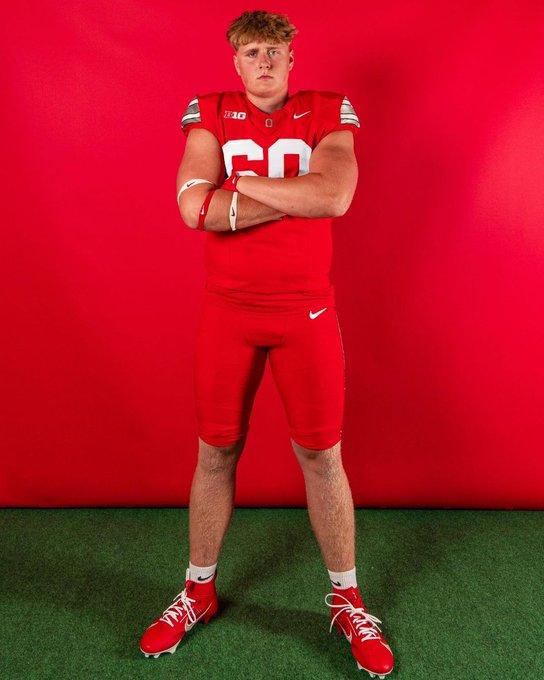
The Buckeyes currently have three in-state offensive line commitments in the 2027 class — Kellen Wymer, Mason Wilt and Davis Seaman — giving Bowen a foundation that reaches from Columbus into some of Ohio’s most productive high school football territories. Recruiting analyst Allen Trieu recently highlighted the trio’s physical profiles and development potential, underscoring a strategy that could become one of the most important pieces of Ohio State’s roster construction over the next several seasons.
For Bowen, the significance goes beyond simply keeping Ohio prospects home.
He is trying to establish a pipeline.
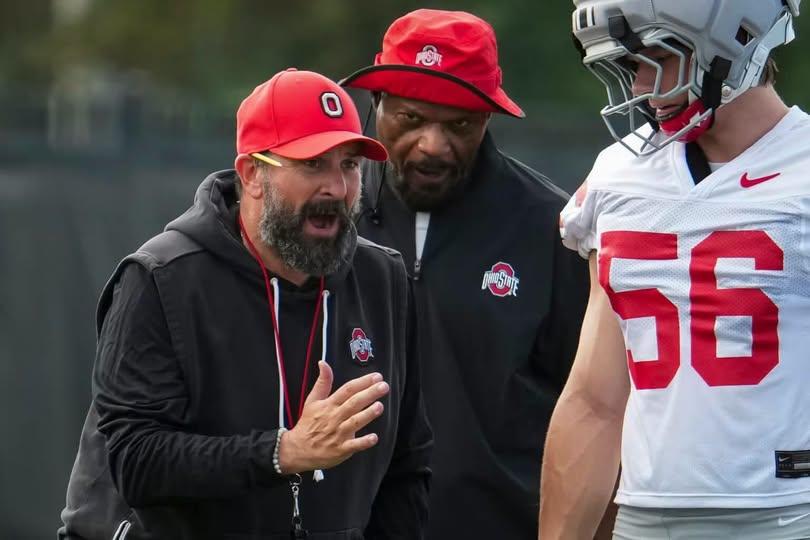
Ohio State hired Bowen as its offensive line coach and run game coordinator in February 2025, replacing Justin Frye. His first season produced tangible results. The Buckeyes returned to the College Football Playoff, defeated Michigan in Ann Arbor and reached the Big Ten championship game. Five starting offensive linemen earned all-conference recognition, while Carson Hinzman earned first-team AFCA All-America honors. Austin Siereveld and Luke Montgomery were named second-team All-Big Ten.
That development has given Bowen credibility with recruits. But recruiting the offensive line is different from recruiting skill positions. Offensive linemen are often projects. Their bodies change dramatically between high school and college, and evaluations frequently depend as much on movement skills, leverage, length and developmental runway as on current production.
That is where Ohio State’s 2027 group becomes particularly interesting.
Wymer, a four-star prospect from Liberty Center, is listed at approximately 6-foot-5 and 270 pounds and has been ranked among the better offensive linemen in Ohio. His recruitment included offers from Michigan, Michigan State and Notre Dame before he chose the Buckeyes.
Wilt represents a different type of evaluation.
The St. Clairsville product entered the cycle with a lower national ranking but possesses the frame Ohio State wants to develop. He has been listed around 6-foot-5 and 295 pounds, with reports emphasizing his feet and willingness to finish blocks. Eleven Warriors described him as an offensive line developmental prospect with physical tools that made him an attractive long-term investment for Bowen.
Then there is Seaman, the latest piece of the in-state puzzle.
The Bishop Watterson product committed to Ohio State in April 2026 after choosing the Buckeyes over Auburn, Penn State and Tennessee. At roughly 6-foot-4 and 275 pounds, Seaman gives Bowen another interior offensive line prospect with the versatility to develop into a valuable piece of the front.
Taken individually, the three commitments are promising.
Taken together, they tell a larger story.
Ohio State has historically recruited nationally at an elite level, but the Buckeyes’ most sustainable roster construction has always depended on identifying elite Ohio talent early and convincing those players that Columbus remains the best place to develop into professionals.
Bowen appears to understand that equation.
His 2027 offensive line class is not limited to Ohio. The Buckeyes have also secured commitments from Brody McNeel, Jimmy Kalis and Caden Moss, giving Ohio State six offensive line commitments in the cycle. Eleven Warriors characterized the position as the strongest and most complete part of the Buckeyes’ 2027 offensive recruiting class.
That depth is important because modern college football roster management has changed dramatically.
There is no NFL-style salary cap in college football, meaning the traditional cap-management discussion does not directly apply to Ohio State. Instead, programs must balance scholarship limits, revenue-sharing obligations, NIL resources, transfer-portal movement and the developmental timeline of high school recruits.
For offensive linemen, that makes high-school recruiting especially valuable.
A program that can develop its own tackles and interior blockers does not have to rely exclusively on the transfer portal every offseason. Ohio State can instead create a pipeline in which freshmen develop behind veterans, redshirt players add functional mass and technique, and eventually those players compete for starting jobs or become valuable rotational pieces.
The NFL Draft provides another layer of credibility.
Ohio State’s official program notes that at least one Buckeyes offensive lineman has been drafted every year since 2016. Ethan Onianwa, a graduate transfer from Rice who worked with Bowen in 2025, was selected by the Atlanta Falcons in the seventh round of the 2026 NFL draft.
That is the pitch recruits understand.
Come to Ohio State. Develop. Compete. Play on a national stage. And, if everything works, position yourself for the NFL.
Bowen’s first season also demonstrated that development is not merely a recruiting slogan. The improvement of the existing offensive line gave the coach a tangible product to sell.
That matters because Ohio State’s offensive line has occasionally been scrutinized during the Ryan Day era, particularly when the Buckeyes have struggled to consistently generate movement against elite defensive fronts. The margin for error is small at Ohio State. A quarterback can be highly rated, the receiver room can be loaded with future NFL talent, and the defense can be championship caliber. If the offensive line cannot consistently win first contact, the entire operation becomes vulnerable.
The answer is not necessarily signing the highest-rated lineman available every year.
It is building a room.
That’s what makes the three Ohio commitments particularly important.
Wymer offers high-end athletic upside. Wilt brings size and developmental potential. Seaman provides interior versatility and another local connection. Their eventual positions could change as their bodies mature, but that flexibility is part of the value. Offensive line prospects frequently move from tackle to guard or from guard to center during their college careers as coaches determine where their traits translate most effectively.
Bowen now has multiple development paths.
And that is precisely what a championship-level offensive line needs.
The broader recruiting implications could be even more important. Ohio State does not need to win every national recruiting battle if it can consistently dominate the state around it while selectively adding elite prospects from outside Ohio.
That is the model.
The Buckeyes’ 2027 class already demonstrates it. Ohio State has combined in-state developmental prospects with higher-ranked national recruits, including Moss, who was ranked among the top offensive linemen nationally and became one of Bowen’s most significant recruiting victories.
The result is an offensive line class that looks less like a collection of individual commitments and more like an organizational plan.
For Ryan Day and offensive coordinator Arthur Smith, that could eventually become one of the most valuable assets on the roster.
Smith’s offense will ultimately be judged by production, efficiency and situational performance — third-down conversion rate, early-down success, explosive-play creation and red-zone efficiency. But none of those metrics can be separated completely from blocking efficiency. Protection determines how long quarterbacks can operate. Run blocking determines whether a defense can dictate down and distance.
And Ohio State’s championship aspirations will continue to run through those variables.
The Buckeyes are not finished recruiting the 2027 offensive line class. But Bowen has already assembled a group that gives Ohio State something it has been seeking: quantity, geographic familiarity and developmental upside at the same position.
The three Ohio commits may not all become immediate stars.
They do not need to.
If even two emerge as long-term starters, the investment becomes significant. If all three develop into Power Four-caliber contributors, Bowen will have done more than protect Ohio State’s borders.
He will have built the beginning of a wall.
And for a program that expects to compete for the Big Ten and national championship every season, controlling the line of scrimmage — and controlling the talent pipeline that feeds it — may be the most important recruiting victory of all.