COLUMBUS, Ohio — The Ohio State Buckeyes’ summer workouts were supposed to be a grind, the kind of voluntary yet fiercely competitive sessions that forge national championship contenders under the relentless Ohio sun. Instead, on a sweltering Thursday afternoon at the Woody Hayes Athletic Center, they became the scene of raw fear and uncertainty.
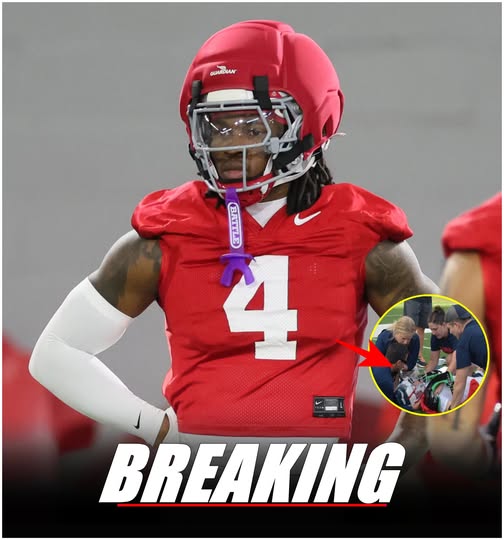
A star player — one of the program’s brightest talents and a projected first-round NFL Draft pick — sprinted through the final rep of a high-intensity speed drill, legs churning with the explosive power that had defined his college career. Witnesses described a sudden stagger, then collapse. Trainers and medical staff rushed to his side as teammates formed a silent circle, the usual trash talk and helmet-slapping replaced by stunned disbelief. Practice halted immediately. An ambulance was called. The player was transported to a local hospital for evaluation.
As of late Thursday, Ohio State had not released an official statement on the player’s condition beyond confirming he was conscious and stable upon arrival at the medical facility. Head coach Ryan Day addressed the media briefly, his voice measured but clearly shaken.
“This is a family,” Day said. “Right now, our focus is entirely on him, his health, and supporting his loved ones. Football is secondary. We’ll have more information when we have it, but these are the moments that remind you what truly matters.”
The incident, which sources described as potentially related to extreme exertion in hot conditions during non-contact conditioning, has sent ripples through the Big Ten and the broader college football world. Ohio State enters the 2026 season as a consensus top contender, ranked No. 1 in ESPN’s Football Power Index and Bill Connelly’s SP+ metrics, with elite returning talent on offense led by quarterback Julian Sayin and wide receiver Jeremiah Smith.
The Player Behind the Moment
While Ohio State has not publicly identified the player amid privacy considerations and ongoing medical evaluation, multiple sources close to the program confirmed it was a high-profile skill-position standout who has been turning heads throughout summer workouts. Described by coaches as a “workout warrior” known for pushing physical limits, the player had been highlighted in recent “Dude of the Week” recognitions for his explosiveness and leadership on the practice field.
This isn’t unfamiliar territory for big-time programs. History is littered with cautionary tales of elite athletes collapsing under the demands of training. Exertional heat illness, cardiac events, or undiagnosed conditions can strike even the most conditioned athletes. Ohio State’s strength and conditioning staff, led by Mickey Marotti, has long emphasized data-driven monitoring — GPS tracking, force plates, and heart-rate variability — but the human body sometimes defies the metrics.
Teammates who spoke on background painted a picture of a player who embodied Buckeye toughness. “He’s the guy who stays late, who competes on every rep like it’s the fourth quarter against Michigan,” one said. “Today just hit different. We’re all praying he’s okay.”
Broader Context for Ohio State in 2026
The Buckeyes are in the midst of a critical offseason. After a 2025 campaign that saw them contend deep into the College Football Playoff before falling short in key moments, expectations remain sky-high for 2026. Sayin returns as a Heisman favorite after a record-setting sophomore year, while the defense reloads with young talent amid significant NFL departures.
Summer workouts are designed to build chemistry and conditioning without pads. Speed drills, position-specific work, and competitive “Oklahoma” sessions test not just physicality but mental resilience. The player in question had reportedly been performing at an elite level, clocking impressive times in 20-yard dashes and showing the burst that made him a nightmare matchup in the Big Ten.
Ohio State’s sports medicine team is among the best in the nation, with protocols refined after past incidents across college athletics. Rapid response, on-site AEDs, and immediate cooling measures are standard. Sources indicated the staff acted swiftly, which could prove crucial.
For the program, this serves as a stark reminder amid the evolving landscape of athlete welfare. The NCAA continues to face scrutiny over training loads, NIL pressures that incentivize peak performance year-round, and the mental toll of being a “superstar” in the modern era. Ryan Day has been vocal about balancing ambition with sustainability, implementing more recovery-focused windows and individualized plans.
Historical Parallels and Lessons Learned
College football has seen its share of frightening on-field medical emergencies. From heat-related collapses to cardiac arrests, programs have adapted with better hydration science, acclimatization guidelines, and emergency action plans. Ohio State itself has navigated high-profile health scares in the past, reinforcing the need for vigilance.
Advanced statistics underscore the physical demands. Players in skill positions can cover 6-8 miles in a full practice session equivalent, with peak speeds exceeding 20 mph on bursts. When layered with heat indices above 90 degrees — common in central Ohio summers — the risk compounds. Metrics like rate of perceived exertion (RPE) and session training load are monitored closely, but as one veteran coach noted anonymously, “You can plan for everything except the moment the body says enough.”
The collapsed player’s projected role was significant. As a dynamic playmaker, he represented a matchup nightmare — speed to stretch the field, vision in the open, and the toughness to work the middle. His absence, even temporary, would force schematic adjustments, elevating younger teammates and testing depth that Ohio State has meticulously built through recruiting.
Impact on Team, Conference, and Playoff Aspirations
For the Buckeyes, this is more than a single practice disruption. It forces a pause in momentum as fall camp approaches. Day and his staff pride themselves on culture; responses to adversity often define seasons. A full recovery could galvanize the group, turning concern into fuel. Lingering uncertainty, however, tests leadership.
In the Big Ten, where physicality and depth reign, Ohio State’s edge has been its talent pipeline and preparation. Rivals like Oregon, Michigan, and Penn State will watch closely. A prolonged absence for a key contributor shifts projections, though the program’s five-star depth — especially at skill positions — provides a buffer.
Broader NFL implications loom. Draft evaluators monitor medical histories intensely. A clean bill of health preserves the player’s stock; complications could prompt questions about durability, even if unrelated to football-specific trauma.
League-wide, this highlights ongoing discussions around player safety. The NFL and NCAA have ramped up protocols post-COVID and amid rising awareness of conditions like rhabdomyolysis or hypertrophic cardiomyopathy. Expert analysis suggests most such incidents resolve positively with prompt care, but the psychological impact on teammates — the “what if” — lingers.
Coaching Perspective and Moving Forward
Ryan Day has built Ohio State into a powerhouse by emphasizing player-first principles. In past pressers, he’s stressed holistic development. Expect the program to lean on sports psychologists, chaplains, and family support networks in the coming days.
Offensive coordinator Chip Kelly and defensive counterparts will recalibrate drills, perhaps dialing back intensity while maintaining competitiveness. Strength staff will review session data for any overlooked signals.
For the player, the road back begins with diagnosis — possibly heat exhaustion, dehydration, or an underlying issue flagged by further tests. Modern medicine, combined with Ohio State’s resources, offers optimism. Many athletes return stronger after such scares, with renewed appreciation for the game’s fragility.
As night fell over Columbus, the Woody Hayes complex stood quieter than usual. Lights dimmed on empty fields where, hours earlier, dreams of another national title chase echoed in every sprint. Teammates dispersed with texts of support and prayers. The Buckeyes, like the player on that stretcher, will rise — but first, they wait.
This is college football at its most human: glory intertwined with vulnerability, superstars reduced to young men in need of care. Ohio State’s response in the days ahead will speak volumes about its championship mettle. For now, the entire program — and its fans nationwide — holds its collective breath for one of its own.
The full extent of the injury and timeline for return remain unknown. ESPN will continue monitoring developments and provide updates as more information becomes available from credible program and medical sources.