Julian Sayin’s Impact Extends Beyond the Football Field
COLUMBUS, Ohio — Julian Sayin arrived at Ohio State carrying the expectations that follow a five-star quarterback. The former elite recruit brought arm talent, anticipation and the kind of pedigree that places every practice throw under a microscope in Columbus.
But a story circulating throughout Buckeye Nation has shifted the focus, at least temporarily, from Sayin’s mechanics and his future under center to the person behind the prospect.
According to reports, Sayin recently gifted his mother a home valued at approximately $650,000 and has quietly provided monthly financial assistance to the family of a childhood coach who supported his football ambitions long before he became one of the most recognizable young quarterbacks in college football.
The details have resonated across social media and among Ohio State supporters, offering a different perspective on a player whose career has largely been defined by recruiting rankings, quarterback competitions and the enormous expectations attached to playing the sport’s most demanding position.
The claims have not been independently verified by Ohio State or publicly detailed by Sayin. But the reaction surrounding the reports has been significant, with fans celebrating the alleged gestures as evidence of a player who has not forgotten the people who helped shape his path.
That distinction matters in an era when the college football ecosystem has changed almost beyond recognition.
Quarterbacks now enter major programs with opportunities that previous generations could scarcely have imagined. Name, image and likeness agreements, revenue-sharing structures and the increasingly aggressive competition for talent have transformed the economics of the sport. The nation’s premier quarterbacks can generate substantial value before they ever take a meaningful collegiate snap.
For Sayin, the financial opportunity accompanying his football career has been substantial enough to make headlines of its own. Yet the story gaining traction around the Ohio State quarterback is not centered on a new NIL partnership, a recruiting victory or an on-field achievement. Instead, it is about what he reportedly chose to do with some of the resources his success has created.
The alleged purchase of a home for his mother carries obvious emotional significance. For many elite athletes, financial success is not measured solely by contracts, endorsements or future NFL earnings. It is often tied to the ability to change the circumstances of the people who made sacrifices during the years when the athlete was simply another talented child with an uncertain future.
The reported assistance to the family of a childhood coach adds another layer.
Long before recruiting services assigned stars beside Sayin’s name, coaches and family members were investing time in his development. Those relationships are rarely reflected in the public record of a prospect’s rise. Fans see the rankings, the scholarship offers and the nationally televised games. They do not always see the early-morning rides to practice, the private quarterback instruction or the adults who continued to encourage a young player before the national attention arrived.
That is why the story has struck a chord in Columbus.
Ohio State has spent decades recruiting and developing quarterbacks capable of operating under extraordinary pressure. The position is different at a program with national championship expectations. Every incompletion can become a debate. Every spring practice can produce a new round of speculation. Every quarterback competition is analyzed through the lens of championships, NFL projections and the history of those who came before.
Sayin entered that environment after a recruiting journey that made him one of the most highly regarded quarterbacks in his class. His transfer to Ohio State intensified the attention, placing him in a program that has consistently assembled elite offensive talent and has remained one of college football’s most prominent producers of NFL players.
The expectations surrounding him have therefore been obvious.
At Ohio State, quarterback play is evaluated not simply by traditional passing yards or touchdown totals. The modern position requires pre-snap recognition, post-snap processing, protection identification, pocket movement and the ability to distribute the football efficiently to elite skill talent. Coaches also place a premium on decision-making against disguised coverages, pressure packages and simulated blitzes designed to force young quarterbacks into mistakes.
Sayin’s physical talent made him an elite recruit. His ability to handle the psychological and technical demands of the position will ultimately determine his place in Ohio State history.
But the recent reports have added a human dimension to the evaluation.
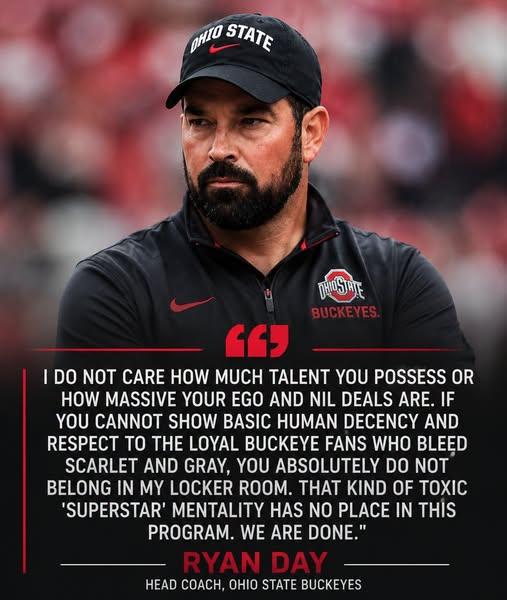
Ryan Day has repeatedly emphasized the importance of leadership and culture within the Ohio State program. Quarterback is particularly central to that equation. The position touches every part of the offense, from communicating protections to managing tempo and responding when momentum shifts.
A quarterback does not need to be the loudest voice in the locker room to become a leader. Some establish themselves through preparation. Others through performance. Others through consistency in their relationships with teammates.
If the reports surrounding Sayin are accurate, they also suggest a form of leadership rooted in loyalty and gratitude.
That does not mean the off-field story will make a third-and-8 conversion or diagnose a disguised Cover 0 pressure. College football remains an unforgiving results business. Ohio State’s championship ambitions will be judged by victories, execution and whether the Buckeyes can navigate a schedule that demands elite performance on both sides of the ball.
But the broader significance of the story lies in the increasingly complicated relationship between money and perception in college athletics.
The NIL era has often produced stories centered on dollar figures. Recruiting battles can become public discussions about compensation. Transfer portal decisions are frequently analyzed through financial incentives. Contracts and revenue opportunities have become part of the language of roster construction.
There is nothing inherently unusual about that evolution. College football has always generated enormous revenue. The difference is that players now have greater opportunities to participate directly in the economic value they help create.
Still, the conversation surrounding Sayin offers a counterpoint to the assumption that financial success automatically changes an athlete’s priorities.
For Ohio State, the quarterback’s development remains the central football question. The Buckeyes have recruited at a level that demands immediate national relevance, and the margin for error is thin. The expanded College Football Playoff has created additional pathways to a championship, but it has also increased the importance of roster depth, quarterback durability and late-season consistency.
A team can survive an imperfect September. It cannot easily survive repeated offensive breakdowns in November or against elite postseason competition.
The Buckeyes’ offensive structure will depend on the quarterback’s ability to make efficient decisions. Completion percentage alone can be misleading; modern evaluation increasingly considers adjusted completion percentage, turnover-worthy plays, pressure-to-sack rate and expected points added.
A quarterback who consistently takes easy completions but fails to create explosive plays may limit an offense. A quarterback capable of generating highlight throws but prone to costly turnovers can create a different set of problems.
The best offenses find the balance.
That is the challenge awaiting Sayin as he continues his development. His recruiting profile offers no guarantee of success. College football history is filled with five-star quarterbacks who struggled with the transition from high school dominance to complex defensive structures.
The same is true in the opposite direction. Some quarterbacks develop rapidly once given the opportunity to operate within a sophisticated system surrounded by elite talent.
Ohio State will eventually receive a clear answer about where Sayin fits on that spectrum. The competition will be settled on the practice field and, ultimately, under the lights.
For now, however, Buckeye Nation has found another reason to discuss its young quarterback.
The reports surrounding the home for his mother and the financial support for his childhood coach’s family have created a narrative that extends beyond the familiar machinery of modern recruiting. It is a reminder that behind the NIL valuations, recruiting rankings and NFL projections are young athletes whose success is often connected to a network of family members, teachers and coaches.
For Sayin, the next chapter will still be written in football terms.
Can he command the huddle? Can he process pressure? Can he deliver the football on time against tight man coverage? Can he protect the ball in the biggest moments and lead Ohio State through the gauntlet of a championship season?
Those questions remain.
But if the reports that have swept through Buckeye Nation are accurate, Sayin has already demonstrated something that will not appear on a stat sheet: an understanding of the people who were there before the stadiums filled, before the recruiting rankings and before the future became worth hundreds of thousands of dollars.
At a time when college football increasingly measures everything in value, Julian Sayin’s most talked-about story may be the one that cannot be calculated by a quarterback rating.