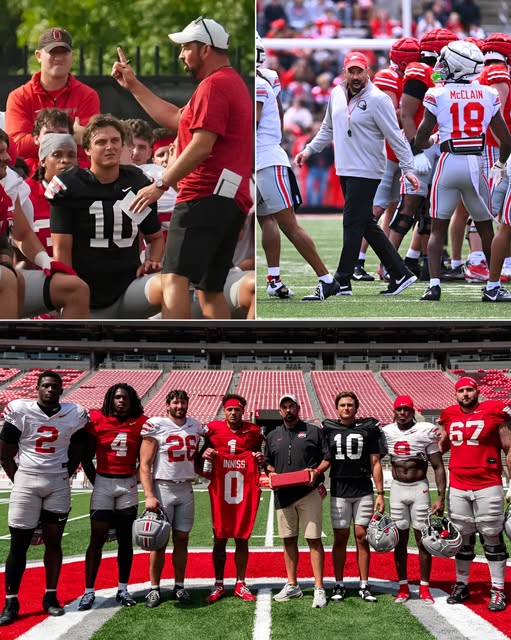
Ohio State’s 2026 season is still ahead, but the preseason spotlight is already getting crowded.
Jeremiah Smith is expected to enter the year as one of the most recognizable players in college football. Julian Sayin, meanwhile, has become one of the most closely watched quarterbacks in the sport as Ohio State continues preparing for life with its next signal-caller at the center of the offense. Together, they provide the Buckeyes with the kind of star power that naturally drives preseason headlines.
But as watch lists, award projections and national preseason coverage continue to roll out, the larger message surrounding Ohio State has become increasingly clear: the Buckeyes are attracting attention at nearly every level of the roster.
That distinction matters.
Preseason recognition does not win games in September, secure a berth in the College Football Playoff or guarantee that a talented roster will navigate the week-to-week demands of the Big Ten. Ohio State knows that better than most programs. Expectations in Columbus are measured against championships, not watch lists.
Still, the breadth of the recognition offers an early indication of how the Buckeyes are being evaluated entering 2026. This is not simply a roster built around one elite wide receiver and a quarterback with enormous potential. It is a team with national-caliber talent spread across multiple position groups, creating the possibility of one of the sport’s most balanced contenders if the pieces develop as expected.
Smith remains the headliner.
The Ohio State receiver has already established himself as one of the defining talents of his generation, combining rare physical traits with the polish to operate as more than a traditional boundary target. His size, catch radius and ability to separate at the top of routes make him a difficult matchup for virtually any coverage structure. Against man coverage, his ability to win vertically and at the catch point creates obvious problems. Against zone, his feel for spacing and ability to uncover in intermediate windows can force defenses to alter their leverage.
For opposing coordinators, the problem begins with allocation.
A defense that commits additional resources toward Smith risks creating favorable matchups elsewhere. A defense that leaves him isolated, particularly on the perimeter, accepts the possibility that Ohio State’s offense can create an explosive play without needing a complicated design.
That kind of player changes the arithmetic of an offense.
And for Sayin, the presence of Smith represents both an opportunity and a responsibility.
Quarterbacks can benefit enormously from elite receivers, particularly when the game speeds up against top competition. A wideout who can create separation, adjust to imperfect throws and generate yards after the catch provides a margin for error. But Smith’s presence also means opposing defenses will spend considerable time developing coverage plans specifically designed to disrupt Ohio State’s primary passing-game threat.
That places a premium on Sayin’s processing.
The next stage of quarterback development is rarely about arm talent alone. Sayin’s ability to identify pre-snap structure, recognize post-snap rotations and deliver the football with anticipation will determine how effectively Ohio State can take advantage of the attention directed toward Smith. If defenses lean toward bracket coverage or safety help, the quarterback must be prepared to find the favorable numbers elsewhere.
That is where the broader composition of the roster becomes significant.
Ohio State’s preseason buzz is not centered exclusively on its quarterback-receiver combination because the Buckeyes have continued to place players across the offense and defense into the national conversation. The program’s ability to recruit and develop NFL-caliber athletes has long been part of its identity, and the 2026 roster once again reflects the depth required to compete through a modern Big Ten schedule.
For coach Ryan Day and his staff, however, talent accumulation is only the starting point.
The Buckeyes have operated under championship-level scrutiny throughout Day’s tenure, with every major season carrying implications beyond the conference standings. At Ohio State, a strong recruiting class or a collection of preseason honors does little to quiet expectations. The standard is established by the program’s history and reinforced by its annual position among college football’s most heavily scrutinized teams.
The pressure is amplified in the expanded playoff era.
The College Football Playoff’s expanded format has changed the path to a national championship, creating more room for a team to recover from a difficult loss while also increasing the importance of roster depth. A contender can now face a longer postseason path, making the ability to withstand injuries and maintain performance across multiple weeks even more valuable.
That is one reason Ohio State’s widespread preseason recognition could carry more significance than individual accolades normally would.
A team built around only two or three elite players can be vulnerable when injuries strike or matchups neutralize its primary strengths. A deeper roster gives a coaching staff more flexibility. It allows an offensive coordinator to adjust when a defense takes away a featured player. It allows a defensive coordinator to rotate personnel without experiencing a dramatic drop in production.
In January, that depth can matter as much as the star power.
The Big Ten presents another layer of difficulty. Ohio State is competing in a conference where the physical demands of the schedule have increased alongside the overall level of competition. The addition of West Coast programs and the continued presence of traditional powers have created a league in which playoff-caliber teams can encounter difficult matchups throughout the season.
Winning the conference is no longer simply about surviving one rivalry game and a handful of ranked opponents. It requires consistency across changing styles of play, travel demands and increasingly deep rosters.
For the Buckeyes, that makes player development especially important.
Preseason watch lists are often based on previous production, recruiting pedigree and projected opportunity. They are not guarantees of future success. Every season produces players who exceed expectations and others whose roles are diminished by injuries, competition or schematic changes.
Ohio State’s staff will ultimately be judged by how effectively it turns that preseason potential into on-field production.
That challenge begins with establishing an identity around Sayin.
The quarterback position will naturally attract the most attention because it dictates much of the offense’s ceiling. Ohio State has built its recent offenses around a mixture of pro-style concepts, vertical passing opportunities and personnel flexibility, but the structure must ultimately fit the quarterback.
If Sayin demonstrates command of the system early, Ohio State could become especially difficult to defend. Smith’s ability to stress coverage would create opportunities for the rest of the receiving corps, while an efficient quarterback could use pre-snap information and tempo to prevent defenses from consistently loading resources toward one matchup.
The key advanced metric may not simply be total passing yards or touchdown production. Ohio State’s offensive ceiling will be reflected in efficiency on early downs, explosive-play rate and success in high-leverage situations. Can the Buckeyes stay ahead of the chains? Can they avoid obvious passing downs? Can Sayin convert third-and-medium opportunities when the defense has the freedom to disguise pressure and coverage?
Those answers will shape the season more than any preseason ranking.
Defensively, the same principle applies.
Ohio State has consistently recruited at a level that gives its coaching staff access to speed at the skill positions and size along the front. The goal entering 2026 will be transforming that talent into a unit capable of controlling games against elite competition.
Modern defensive success is increasingly tied to versatility. A coordinator needs players who can handle run fits without becoming liabilities against the pass, rushers who can generate pressure without requiring constant blitz assistance and defensive backs capable of surviving in space.
A disruptive front can change everything.
If Ohio State can consistently generate pressure with four rushers, it gives the secondary greater flexibility and allows the defense to maintain numbers against the run. That can also force opposing quarterbacks into faster decisions, increasing the likelihood of mistakes and reducing the effectiveness of long-developing concepts.
Those are the details behind the preseason optimism.
Smith and Sayin might command the largest share of the attention, but Ohio State’s 2026 outlook will not be determined by either player alone. The Buckeyes’ championship case depends on whether the players receiving recognition across the roster can fulfill the roles projected for them.
There is also a longer-term implication.
Ohio State remains one of college football’s most important pipelines to the NFL, and another season filled with national recognition strengthens the visibility of the program’s next generation of prospects. NFL evaluators will closely monitor Sayin’s growth, Smith’s continued development and the emergence of players throughout the roster. For draft scouts, the 2026 season will provide another opportunity to evaluate how Ohio State’s players perform against high-level competition in pressure situations.
That connection between Saturdays and Sundays has become part of the program’s recruiting pitch. Elite prospects want to compete for championships, but they also want development that prepares them for the professional game. A roster that repeatedly places players on national watch lists and eventually into NFL draft conversations reinforces that cycle.
For now, though, all of the recognition remains preseason currency.
Ohio State has the stars. It has the depth. It has a quarterback whose development could determine the trajectory of the offense and a receiver capable of changing games with a single matchup.
The Buckeyes also have something more valuable than a collection of individual headlines: a roster attracting attention across multiple positions.
That does not make them champions in August.
But it does explain why the noise around Columbus is getting louder.
Jeremiah Smith and Julian Sayin may be the names driving the biggest headlines, yet the early story of Ohio State’s 2026 season is broader than two players. The Buckeyes are bringing a roster full of nationally recognized talent into a season where expectations will again be measured against the sport’s biggest prizes.
The watch lists will eventually disappear. The projections will be replaced by game tape. And every preseason prediction will face the same test when Ohio State steps onto the field.
For the Buckeyes, that is when the real evaluation begins.