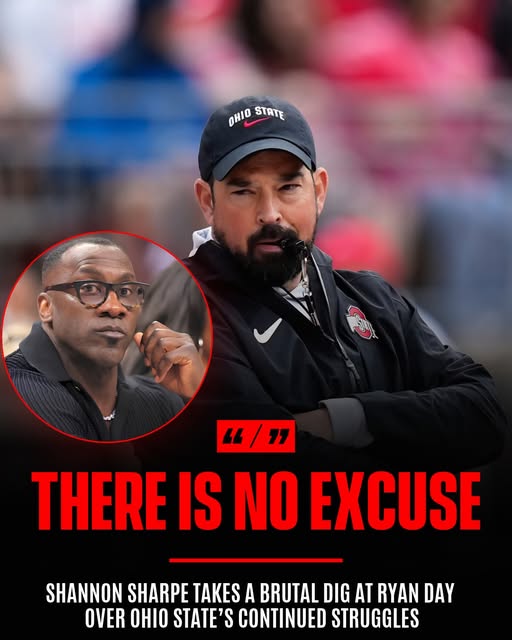
Ohio State’s latest setback has intensified the scrutiny surrounding Ryan Day, and former NFL star Shannon Sharpe is making it clear that he believes the Buckeyes’ championship expectations should come with far greater results.
Following Ohio State’s disappointing loss to Nebraska, questions about Day’s ability to consistently turn elite recruiting classes and NFL-caliber talent into national championships have resurfaced. While the Buckeyes remain one of college football’s most recognizable programs, the growing frustration surrounding their inability to maximize their talent has placed the head coach under another wave of criticism.
Sharpe, who has never been reluctant to challenge prominent figures in the sports world, delivered a particularly pointed assessment of Day’s tenure. His argument centered on one major issue: Ohio State has recruited and developed an extraordinary collection of offensive talent, yet its championship accomplishments have not matched the expectations created by those players.
During his discussion, Sharpe referenced several high-profile names who have played for the Buckeyes, including Chris Olave, Garrett Wilson, Carnell Tate, Emeka Egbuka, Jaxon Smith-Njigba, Marvin Harrison Jr. and Jeremiah Smith.
He also highlighted the quarterback talent that has passed through Columbus, specifically Justin Fields and C.J. Stroud, both of whom entered the NFL with significant expectations.
“I would love to say Ryan Day, but when you had Chris Olave, Garrett Wilson, you had Carnell Tate, you got Egbuka, you got JSN, you got Marvin Harrison Jr., you got Jeremiah Smith, you got one championship to show for that,” Sharpe said. “You got C.J. Stroud, the number two pick in the draft. You got Justin Fields, a top quarterback. There is no excuse.”
The message was unmistakable. Sharpe believes Ohio State’s abundance of elite offensive talent should have translated into considerably more championship success.
For a program with the recruiting resources, national exposure and championship history of Ohio State, that criticism carries considerable weight.
THE TALENT HAS NEVER BEEN THE QUESTION
One of the strongest arguments against Day is the remarkable collection of offensive playmakers who have developed under his leadership.
Olave and Wilson became two of the most productive receivers in Ohio State history before establishing themselves as NFL talents. Smith-Njigba demonstrated his exceptional ability as a receiver, while Harrison developed into one of college football’s most recognizable offensive stars.
Egbuka also became an important part of the Buckeyes’ passing attack, while Tate and Jeremiah Smith represent the type of highly regarded receiving talent that continues to attract national attention to Columbus.
At quarterback, Stroud’s development was another significant achievement for the program. He finished his Ohio State career as one of the most accomplished passers in school history before being selected second overall by the Houston Texans in the 2023 NFL draft.
Fields also demonstrated considerable talent during his time with the Buckeyes, helping maintain Ohio State’s reputation as a destination for elite quarterback prospects.
However, Sharpe’s criticism raises an uncomfortable question for Day: How many championship opportunities should a program receive when it consistently assembles rosters filled with future professional talent?
Recruiting elite players is an important part of building a championship contender. Developing those players, maximizing their abilities and delivering when the stakes are highest are equally important.
Ohio State has demonstrated that it can accomplish the first two objectives. The challenge has been establishing the same level of consistency when championships are on the line.
ONE CHAMPIONSHIP IS NOT ENOUGH FOR OHIO STATE
Day’s supporters can point to the accomplishments that have made his tenure successful. Ohio State has remained a nationally competitive program, recruited at an elite level and consistently placed talented players into the NFL.
The Buckeyes also captured the 2024 College Football Playoff national championship, defeating Notre Dame 34-23 in the title game. That accomplishment was a significant milestone for Day and provided Ohio State with its first national championship since the 2014 season.
Nevertheless, Sharpe’s argument is that one championship does not necessarily satisfy the expectations associated with a program that routinely recruits some of the nation’s best players.
Ohio State does not measure success by simply qualifying for major postseason games. Its history, resources and passionate fan base create expectations that extend beyond competing for championships.
The Buckeyes are expected to win them.
That distinction explains why Day continues to face criticism despite maintaining Ohio State’s position among the country’s prominent programs.
When a roster includes highly regarded quarterbacks, first-round NFL selections and elite receivers, the expectation is that those advantages should translate into postseason dominance.
Sharpe believes the gap between Ohio State’s talent and its championship return is too significant to ignore.
THE NEBRASKA LOSS ADDS TO THE PRESSURE
The defeat against Nebraska has provided another opportunity for critics to examine the direction of Day’s program.
Losing games against conference opponents can happen to even the most talented teams. However, the circumstances surrounding a defeat often determine how heavily it influences the public perception of a coaching staff.
For Ohio State, the Nebraska result has added another layer of pressure at a time when expectations remain exceptionally high.
The concern is not simply about one disappointing afternoon. It is about whether the Buckeyes are consistently performing at the level their roster suggests they should.
Day understands the environment in which he operates. Ohio State is not a program where a successful recruiting cycle or a collection of regular-season victories automatically guarantees long-term job security.
Every season brings championship expectations, and every significant setback creates questions about whether the coaching staff is getting the most out of its players.
That scrutiny becomes even more intense when the team possesses the kind of talent Sharpe highlighted.
DAY’S DEFENDERS HAVE AN ARGUMENT, TOO
Despite the criticism, evaluating Day’s tenure requires acknowledging the accomplishments that have kept Ohio State among the nation’s elite programs.
His ability to recruit top prospects, develop offensive talent and maintain a competitive roster should not be dismissed.
College football has become increasingly difficult, with the transfer portal, name, image and likeness opportunities, conference realignment and the expanded playoff creating new challenges for coaches.
Winning a national championship requires more than assembling talented players. Teams must remain healthy, execute under pressure, make effective adjustments and navigate an increasingly competitive postseason.
Day’s championship victory demonstrated that he can lead Ohio State to the highest level of the sport.
The bigger question is whether he can establish the sustained championship consistency that the program demands.
One successful championship run is an important achievement. Building a team capable of competing for that same prize year after year is an entirely different challenge.
THE QUESTION FACING OHIO STATE
Ultimately, Sharpe’s comments reflect a broader debate surrounding Day’s legacy in Columbus.
Is he the coach capable of delivering the consistent championship success Ohio State expects, or has the program reached a point where its extraordinary recruiting success must produce more tangible postseason results?
The Buckeyes have consistently attracted elite talent. They have developed NFL quarterbacks and some of the country’s most dangerous offensive playmakers. They have also demonstrated that they possess the resources to compete for the national championship.
But expectations are determined by more than potential.
For Day, the challenge is turning that potential into results that silence the growing criticism.
Sharpe’s assessment may be harsh, but it touches on an issue that Ohio State cannot afford to ignore: elite recruiting classes and NFL-caliber players ultimately mean little if they do not translate into championships.
The Nebraska defeat has reignited the conversation, and Day now faces another opportunity to demonstrate that his program can respond to adversity.
For Buckeyes supporters, the standard remains clear. Competing for championships is expected. Winning them is the ultimate objective.
And as Sharpe’s criticism makes clear, Ohio State’s collection of elite talent has made anything less increasingly difficult to defend.