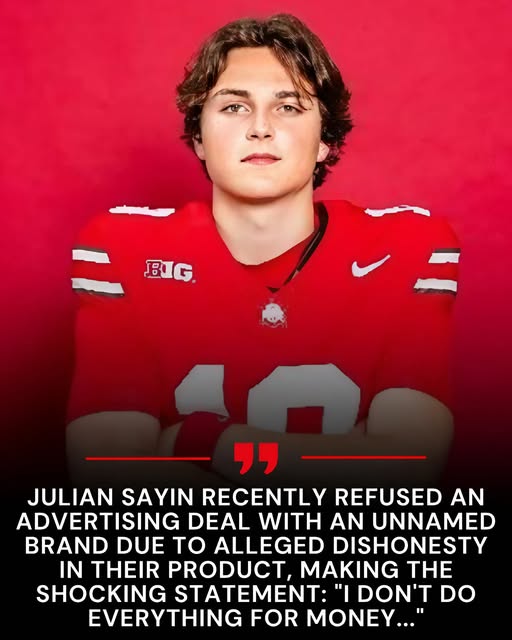
Julian Sayin’s Reported NIL Decision Puts a Different Spotlight on Ohio State’s Star Quarterback
Julian Sayin has spent the past year becoming one of the most valuable quarterbacks in college football. Now, an alleged decision away from the field is drawing attention to the Ohio State quarterback for an entirely different reason.
A report circulating around Sayin claims the Buckeyes quarterback recently declined an advertising opportunity with an unnamed brand because of concerns about the honesty of the company’s product. The same account attributes a striking line to Sayin: “I don’t do everything for money.”
The claim has not been independently substantiated by major national outlets, Ohio State or Sayin’s representatives, and the identity of the company involved has not been disclosed. But the story has nevertheless resonated because it touches one of the defining questions of the new college football economy: How much should an elite player be willing to compromise when millions of dollars in name, image and likeness opportunities are available?
In Sayin’s case, that question carries unusual weight.
The Ohio State quarterback enters the 2026 season as one of the most recognizable players in the sport after a breakthrough 2025 campaign that established him as a legitimate national star. He completed 301 of 391 passes for 3,610 yards, 32 touchdowns and eight interceptions while posting a 177.5 passer rating. His 77% completion rate led the nation and established a Big Ten record, according to Ohio State’s official records.
Those numbers changed the conversation around Sayin.
He was no longer simply the former five-star quarterback who transferred from Alabama to Ohio State in January 2024. He was a proven Power Four starter, a Heisman Trophy finalist and the operator of one of the country’s most efficient passing attacks.
Ohio State’s own records underscore the significance of his season. Sayin’s 3,610 passing yards ranked fifth in program history for a single season, while his 32 touchdown passes ranked eighth. His 177.5 passer efficiency rating also placed him fourth on Ohio State’s single-season list, behind only some of the most accomplished quarterbacks in program history.
That production has translated directly into commercial value.
On3’s NIL profile currently lists Sayin with a confirmed-deal valuation of $2.5 million and ranks him No. 53 nationally in the NIL100. Another recent Yahoo Sports ranking placed him 18th among the highest-valued college football players for 2026, also assigning him a $2.5 million NIL valuation.
Those figures are valuations rather than guaranteed salaries. They do not mean Sayin is receiving $2.5 million in cash from one source, nor do they represent an NFL-style contract. They reflect the estimated economic value of an athlete’s name, image, likeness, performance, audience and commercial market.
That distinction matters.
The college football marketplace has changed dramatically since athletes gained broader rights to monetize their NIL. Following the House settlement and the emergence of direct revenue-sharing mechanisms, major programs are operating in an environment where elite players can command compensation that would have been unthinkable just a few years ago.
Quarterbacks sit at the center of that market.
The position carries disproportionate commercial value because quarterbacks are typically the public face of their programs. At Ohio State, that visibility is amplified by the size of the fan base, the national television footprint and the expectations surrounding a program that enters 2026 ranked No. 1 in the preseason Associated Press poll.
Sayin therefore has considerable leverage.
He also has considerably more to lose.
For an athlete with a seven-figure NIL valuation, accepting every available endorsement is not necessarily the best business decision. Reputation, audience trust and long-term brand positioning can be just as important as the immediate payment.
That is where the alleged advertising decision becomes relevant.
If the report about Sayin is accurate, his refusal would represent a calculated decision to protect the credibility of his personal brand rather than maximize short-term income. But because the company has not been identified and the allegations about its product have not been independently verified, it would be premature to characterize the decision as anything more than an unconfirmed report.
Still, the broader principle is increasingly important in college sports.
Players are no longer simply athletes being offered occasional appearances or local sponsorships. They are becoming independent commercial properties. Their social media accounts, public statements, performance and personal reputations all influence their market value.
A quarterback who promotes a product is effectively lending that product his credibility.
If consumers later question the product, the athlete’s reputation can become part of the story.
Sayin’s current market position makes that especially significant. Opendorse, which tracks athlete marketing opportunities, lists estimated ranges for social media promotions involving Sayin that can reach into five figures depending on the service, platform and deliverables.
That does not establish that Sayin rejected any particular offer. It does, however, illustrate the financial ecosystem surrounding a player of his stature.
And Ohio State has built an environment in which that commercial value can flourish.
The Buckeyes return Sayin, star wide receiver Jeremiah Smith and much of an offense that has already demonstrated elite efficiency. Ohio State also enters 2026 with new offensive coordinator Arthur Smith, whose system is expected to incorporate more motion, multiple personnel groupings, play-action concepts and a stronger commitment to manipulating defensive structure before and after the snap.
For Sayin, the football implications are substantial.
His 2025 performance demonstrated exceptional accuracy and decision-making. His 77% completion rate was not simply a product of short-area passing; he averaged 9.2 yards per attempt and produced 32 touchdown passes against eight interceptions.
The next challenge is translating that efficiency into another championship-caliber season against a considerably demanding schedule.
Ohio State is scheduled to face Texas, USC, Oregon and Michigan, among other major opponents, meaning Sayin’s performance will be central to the Buckeyes’ College Football Playoff ambitions.
The transition to Arthur Smith’s offense could also test a different dimension of Sayin’s game.
The new system is expected to ask the quarterback to process defensive leverage, identify pressure indicators and use play-action to exploit space created by the running game. Sayin’s accuracy and football intelligence should make him a natural fit, but the offense’s ultimate success will depend on how effectively he handles defenses that have spent an entire offseason studying his 2025 tape.
That is the real business confronting Sayin.
The advertising market may provide additional money, but his biggest financial opportunity remains his football trajectory.
A dominant 2026 season could significantly increase his professional prospects and strengthen his position in the NFL draft conversation. Conversely, a major regression could affect both his draft stock and his commercial value.
That makes the alleged statement about money particularly interesting, even if it remains unverified.
For an elite college quarterback, money and football are no longer separate worlds. They increasingly intersect.
Every endorsement affects a player’s public identity. Every public decision can influence his market. Every season can alter his draft projection.
Sayin has already demonstrated that he can handle the pressure of being Ohio State’s quarterback.
Now, if the reported endorsement decision is accurate, he may also be demonstrating another form of maturity: understanding that not every dollar is necessarily worth taking.
But the most important test remains on the field.
Ohio State enters the 2026 season with national championship expectations, and Sayin is at the center of them. The Buckeyes have the talent, the depth and the schedule to make another run at the College Football Playoff.
The quarterback who helped establish those expectations last season now has to meet them again.
And if Sayin truly believes that his name is worth more than a paycheck, the coming season will provide the ultimate proof of what that name is worth.

That’s a really interesting stance from him, it’s refreshing to hear someone prioritize their values over a lucrative deal.