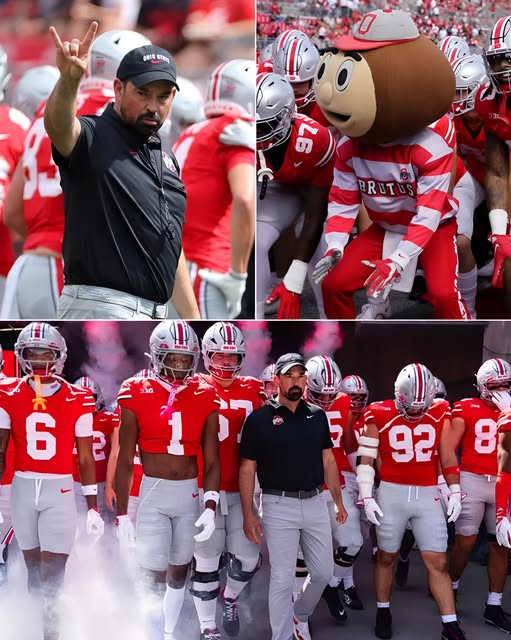
The scoreboard told one story. The television numbers told another.
When Texas erased a 20-point fourth-quarter deficit against Ohio State on Saturday night, the Longhorns did more than produce one of the most dramatic comebacks of the young 2026 college football season. They delivered a national television audience rarely seen during the regular season.
An average of 14 million viewers watched Texas rally from a 23-3 deficit to defeat Ohio State 24-23 on ABC, according to figures released by ESPN. The audience peaked at 16.4 million viewers, making it ESPN’s most-watched regular-season college football game in a decade.
The magnitude of the audience reflects both the significance of the matchup and the extraordinary way the game unfolded.
Texas entered the night ranked No. 4 while Ohio State was No. 1, creating an early-season meeting between two programs with national championship expectations. Instead of producing a routine top-five game, the matchup became a fourth-quarter survival test that changed the national championship picture in a matter of minutes.
Ohio State appeared to have control for most of the night. The Buckeyes built a 23-3 advantage before Texas quarterback Arch Manning and the Longhorns offense finally found another gear. Texas scored three touchdowns in the fourth quarter, turning a seemingly decided game into a one-possession thriller before completing the comeback with 37 seconds remaining.
Manning finished with 196 passing yards and a touchdown, while Texas’ fourth-quarter surge included a touchdown pass to Ryan Wingo and two short touchdown runs by Hollywood Smothers. The Longhorns’ final touchdown came with 25 seconds remaining, followed by Gianni Spetic’s extra point to put Texas ahead.
The audience stayed with the game until the end, and that matters.
The 14 million average is not simply a reflection of two nationally recognizable programs sharing a broadcast window. It demonstrates the television value created when elite brands, playoff implications and a compelling game script converge.
ESPN said the audience was its largest for a regular-season college football game since Ohio State-Michigan in 2016, when that rivalry meeting attracted 16.8 million viewers. The Texas-Ohio State matchup also became the most-watched Week 2 college football game on record, according to Sports Media Watch.
There is an important distinction, however, between the 2026 number and last year’s meeting between these programs.
Ohio State and Texas also met in 2025, when the Buckeyes defeated the Longhorns 14-7 in Columbus. That game averaged 16.6 million viewers on FOX, making it the most-watched Week 1 game on record at the time. Ohio State’s subsequent rivalry victory over Michigan drew 18.4 million viewers and finished as the most-watched regular-season game of the 2025 season.
So while the 2026 matchup did not surpass the previous year’s audience, it reached a different milestone: it became the biggest regular-season audience for an ESPN platform in 10 years.
That distinction also illustrates the changing television landscape of college football.
The sport’s media economy has become increasingly dependent on marquee inventory. Conference realignment has placed traditional Big Ten and SEC powers in more frequent high-profile intersections, while expanded access to the College Football Playoff has made early-season games between contenders increasingly consequential.
Ohio State-Texas checked every box.
Ohio State carried the weight of being the nation’s No. 1 team. Texas had the home-field advantage and an emerging national storyline around Manning. Both programs entered the game with championship aspirations, and the result immediately altered the national hierarchy.
Texas moved to No. 1 after the victory, while Ohio State dropped to No. 6 in the latest rankings.
That creates a fascinating contrast for the two programs.
For Texas coach Steve Sarkisian, the comeback provides an early signature victory in a season in which the Longhorns are operating under enormous expectations. Texas is now tasked with avoiding the emotional hangover that often follows a nationally significant victory. The Longhorns host undefeated UTSA next, a game that carries considerably less national attention but significant importance for maintaining momentum before SEC play.
Ohio State faces a different challenge.
The Buckeyes were in position to secure a defining road victory before allowing Texas to score 21 unanswered points in the fourth quarter. The collapse will inevitably become part of the team’s early-season evaluation, particularly on defense and in late-game execution.
For a program competing for the Big Ten title and a College Football Playoff berth, the loss does not eliminate Ohio State from the national championship race. But it increases the importance of what comes next. The Buckeyes now have to demonstrate that the fourth-quarter breakdown was an isolated failure rather than a structural problem.
That dynamic is part of what makes television audiences so valuable to the sport. A game such as Ohio State-Texas does not merely generate ratings for one night. It creates storylines that can carry through the remainder of the season.
The 14 million viewers also underline the continued strength of college football as a live television product.
Streaming has fragmented the broader sports audience, while entertainment options have multiplied. Yet a major college football game can still command an audience approaching the size of a major national television event when the matchup and stakes align.
The number becomes even more striking when compared with other Week 2 games.
Alabama’s victory over Kentucky averaged 7.3 million viewers on ABC, while Oklahoma-Michigan averaged 8.22 million on FOX. Arizona State-Texas A&M averaged 2.5 million, Oregon-Oklahoma State drew 2.1 million, and Tennessee-Georgia Tech averaged 1.8 million.
Ohio State-Texas therefore stood apart from the rest of the weekend’s national television inventory.
There is also a methodological caveat worth noting. Nielsen’s audience measurement has evolved, including expanded out-of-home measurement and newer approaches incorporating big-data sources. Sports Media Watch noted that out-of-home viewing was not fully incorporated across all markets until recently, meaning comparisons across eras should be interpreted with some caution.
Still, the broader conclusion is unmistakable: Ohio State-Texas was a massive television event.
The game also provided another reminder that the value of college football’s biggest programs extends beyond their individual fan bases. Ohio State and Texas have national followings, but the audience included viewers who had no direct allegiance to either school and simply wanted to watch a matchup with championship implications.
That is precisely the kind of inventory broadcasters and conference executives are trying to create in the modern college football economy.
For ESPN and ABC, the audience is a significant validation of placing such a game in a prime-time window. For the Big Ten and SEC, it is another example of the commercial value created when their flagship programs meet. And for the College Football Playoff selection committee, the result ensures that both teams will remain central to the national conversation even as their seasons move forward.
Most importantly, the 14 million viewers were not watching because the game was supposed to be close.
They watched because Ohio State and Texas represented the upper tier of the sport — and then the game delivered something even better than the matchup promised.
A 23-3 lead became a 24-23 defeat. Manning authored the comeback. Texas took the No. 1 ranking. Ohio State was forced to regroup.
And millions of viewers stayed until the final possession.
In an era when college football’s biggest question often centers on whether the sport can continue attracting massive national audiences amid constant change, Saturday night offered a compelling answer.
When the stakes are high and the ending is unpredictable, the audience is still there.