The financial gap between college football’s biggest brands and the rest of the Power Four has taken another dramatic step forward, and Ohio State is sitting at the center of it.
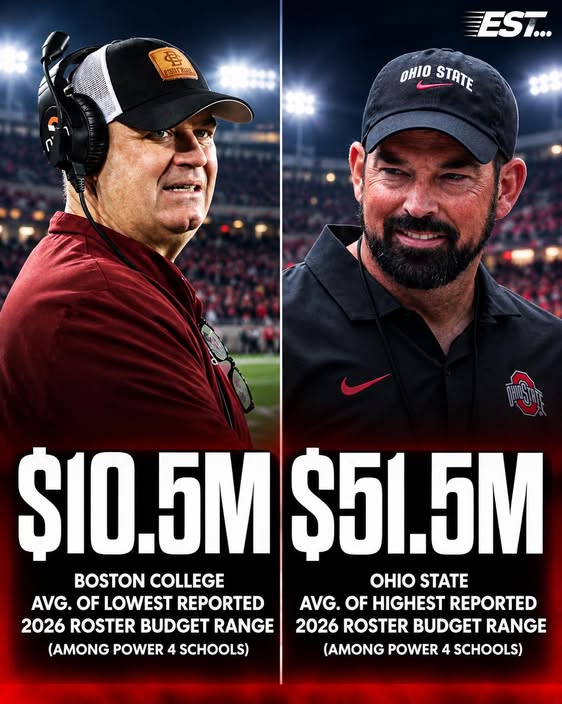
The Buckeyes are projected to have a 2026 roster budget of $49 million to $54 million, according to a new survey of the college football marketplace, while Boston College’s estimated roster budget sits between $8 million and $13 million. Using the midpoint of each range, Ohio State’s spending level is roughly five times that of the Eagles.
The figures are estimates rather than publicly disclosed payrolls. They were assembled from information gathered from more than 70 sources across the sport and are intended to measure the resources available to construct each 2026 roster, including athletic department revenue, booster support and program-controlled funds. Outside endorsement income that is not controlled by the school is excluded.
That distinction matters because the number being discussed is not an NFL-style salary cap. College football has no hard roster payroll ceiling comparable to the NFL’s system. Instead, the current model combines direct school payments under the House settlement, scholarships and other benefits with third-party NIL arrangements, collectives and other resources.
The result is a market in which the most powerful programs can operate well beyond the direct revenue-sharing limit.
Ohio State is one of the clearest examples.
The Buckeyes entered the new era of college athletics after winning the 2024 national championship with a roster whose reported cost was around $20 million. ESPN reported this offseason that several national championship contenders were now expected to operate with football rosters costing somewhere between $40 million and $50 million for 2026.
The latest estimate puts Ohio State even higher.
At the midpoint of the reported range, the Buckeyes’ projected roster budget is approximately $51.5 million. Boston College’s midpoint is approximately $10.5 million. That produces a difference of about $41 million in roster-building resources.
That is not simply a reflection of two athletic departments choosing different spending strategies. It is also a reflection of the economic structures surrounding their programs.
Ohio State operates in the Big Ten, one of the most lucrative conferences in college sports, and plays before massive crowds at Ohio Stadium while benefiting from national television exposure, substantial donor support and a football program that consistently generates significant athletic revenue. Ohio State’s FY2026 financial plan lists athletics among the university’s major auxiliary operations, with athletics projected at $274 million in sources before transfers and capital.
Boston College, meanwhile, operates in the ACC and is attempting to build a competitive roster while working within a considerably smaller financial ecosystem.
That difference has become increasingly visible in roster construction.
Boston College coach Bill O’Brien acknowledged that the Eagles are participating in revenue sharing and said the program is receiving more resources in 2026 than in previous years. But O’Brien declined to disclose the football program’s specific allocation, saying those details were better addressed by athletic director Blake James and university leadership.
The Eagles also underwent substantial roster turnover. After a 2-10 season in 2025, including a 1-7 ACC record, O’Brien’s program added 35 players during the offseason — 27 transfers and eight freshmen — as it attempted to reshape the roster.
Ohio State’s approach has been different.
The Buckeyes have continued to retain elite talent while aggressively supplementing the roster through recruiting and the transfer portal. Their 2026 roster includes quarterback Julian Sayin, wide receiver Jeremiah Smith and defensive lineman Kenyatta Jackson Jr., among a group of players with high NFL projections. The official Ohio State roster lists Smith, Jackson and a deep collection of veterans and young prospects across the roster.
Smith is perhaps the clearest illustration of how the market has changed.
Multiple industry sources have estimated that his 2026 compensation is in the neighborhood of eight figures, while Smith has publicly said he turned down a transfer offer exceeding $10 million.
Those numbers help explain why roster budgets can now climb far beyond the direct revenue-sharing framework.
When the House settlement took effect, the initial benefits pool allowed participating schools to provide up to $20.5 million in direct financial benefits to athletes. Ohio State subsequently said it would fully participate in the model, with $18 million available for direct athlete payments in its first implementation because of the treatment of additional scholarships.
For 2026-27, the maximum increased to $21.3 million. Ohio State athletic director Ross Bjork said the university intended to maximize the available amount.
But that $21.3 million figure should not be confused with Ohio State’s football roster budget.
The two numbers measure different things.
The revenue-sharing pool is an institutional benefits mechanism. The reported $49 million-to-$54 million roster figure encompasses the broader resources being used to assemble the football team, including money outside the direct school-to-athlete distribution system.
That distinction is central to understanding the new competitive landscape.
The old argument in college football was that the richest programs had better facilities, larger staffs, stronger recruiting operations and deeper donor networks. The modern version adds another layer: those advantages can now be converted much more directly into roster retention and acquisition.
And that is where the disparity becomes particularly consequential.
A program with $50 million-plus available to construct its roster can absorb departures differently from a program operating around $10 million. If a starting-caliber player enters the transfer portal, a wealthy program can potentially pursue a replacement without dismantling its existing structure. A smaller-budget program has fewer opportunities to replace production at the same rate.
The transfer portal has therefore turned financial flexibility into a roster-management tool.
Ohio State’s advantage is not merely that it can pay more for one superstar. Its larger budget can be distributed across quarterback depth, offensive line insurance, pass-rush rotation, secondary depth and experienced transfer additions.
That is especially important in a sport where injuries and attrition routinely determine postseason outcomes.
The Buckeyes’ 2026 roster reflects that philosophy. Ohio State’s official roster includes significant experience along the offensive line, including veterans such as Tegra Tshabola, Ethan Onianwa, Carson Hinzman and Austin Siereveld, while also carrying younger players such as Ian Moore and Carter Lowe.
The financial story, however, should not be interpreted as proof that roster spending automatically produces championships.
College football remains dependent on coaching, player development, scheme fit, health and execution. A large budget can acquire talent, but it cannot guarantee that talent becomes a cohesive team.
That is an important distinction for Ryan Day and Ohio State.
The Buckeyes are paying to maintain championship-level depth, but the burden now shifts to the coaching staff to convert that investment into efficient football. In practical terms, that means maximizing explosive-play efficiency on offense, limiting defensive busts, developing rotational depth and ensuring that expensive veterans and younger recruits coexist within the same program.
Boston College faces a different challenge.
O’Brien has acknowledged that resources matter, but his comments have also emphasized that roster construction cannot be reduced to compensation alone. The Eagles have to identify undervalued players, develop them and use the transfer portal strategically.
That dynamic could become increasingly important throughout the ACC.
The latest estimates suggest Miami is operating near the top of the conference financially, with an estimated advantage of $15 million to $20 million over every other ACC program. Boston College’s reported $8 million-to-$13 million range sits at the opposite end of that spectrum.
The implications extend beyond individual teams.
If the spending gap persists, college football could increasingly resemble a two-speed marketplace. The largest programs will have the financial capacity to retain elite players, attack the transfer portal and build depth simultaneously, while smaller programs will be forced to find competitive advantages elsewhere.
That does not make the outcome predetermined. It does, however, change the margin for error.
Ohio State’s reported $49 million-to-$54 million budget is a striking number on its own. The more revealing figure may be the comparison with Boston College.
At roughly five times the Eagles’ estimated roster budget, the Buckeyes illustrate how dramatically the economics of college football have changed in just two years.
The $20 million roster that helped Ohio State win the national championship in 2024 once looked extraordinary. In the 2026 marketplace, it is no longer enough to describe the upper tier.
The arms race has moved again.
And Ohio State, with one of the largest football budgets in the country, is operating at the leading edge of it.