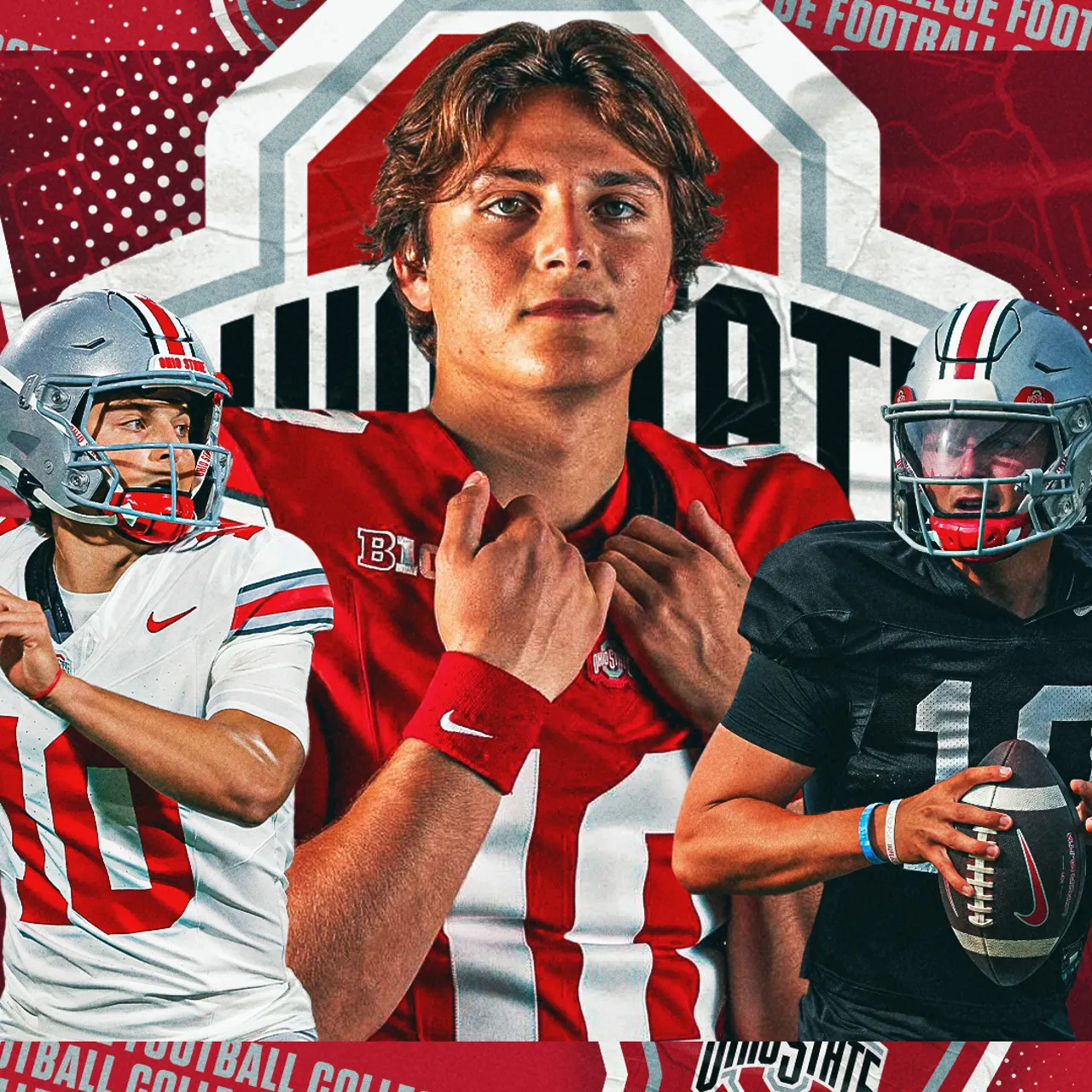
Let’s be clear at the start of this discussion: For a redshirt freshman, Ohio State quarterback Julian Sayin had a pretty good season. Freshmen and sophomores are supposed to struggle to a certain degree. They aren’t supposed to have everything figured out. Sayin completed a high percentage of his passes and ran the Ohio State offense very capably. On balance, he had a good year … for a player going through his first full season as a college starter. Yet, the reality of being a younger player, with all its limitations, prevented the Buckeyes from doing more. The 2026 NFL draft pounded home this basic point.
Carnell Tate at No. 4
Ohio State receiver Carnell Tate being the first Buckeye off the board at No. 4 showed very clearly why Julian Sayin held back the Buckeyes. Ohio State used a short, high-percentage passing game, which didn’t maximize Tate’s production. Ohio State — not unreasonably, it should be said — wanted to make the game simpler and safer for Sayin as a comparatively less experienced player. Nevertheless, the passing game was not as dynamic as it was in the CFP the season before with Will Howard. Tate rising to the top five showed Sayin wasn’t ready to maximize Ohio State’s high-end weapons last season.
Arvell Reese, Sonny Styles, Caleb Downs
Ohio State had three defensive players go off the board in the first 11 picks of the 2026 NFL Draft. Julian Sayin had a great defense behind him and still couldn’t win a playoff game or the Big Ten title.
Historic Ohio State NFL draft class
Ohio State did something no Big Ten team had done since Michigan State way back in 1967: It put four players in the first 11 picks. Not winning the Big Ten title or a playoff game with all those resources puts the focus squarely on the quarterback.
Miami disaster
Let’s not sugarcoat this: Julian Sayin got exposed in the CFP quarterfinals against Miami. His pick-six was a game-altering play. Sayin lost the game on a night when his defense played very well.
Indiana
Ohio State’s defense similarly did its job, holding Indiana and No. 1 NFL draft pick Fernando Mendoza to just 13 points in the Big Ten Championship Game. Sayin and the OSU offense managed only 10 points.
The narrative surrounding Julian Sayin took a dramatic and, in some corners, unforgiving turn as the 2026 NFL Draft unfolded, with a wave of selections that seemed to validate a growing sentiment: that Ohio State Buckeyes football may have been held back offensively during the 2025 season. It is a conclusion that, while perhaps overly simplistic at first glance, has gained traction in the aftermath of a draft class loaded with former Buckeyes skill players who are now being heralded as elite professional prospects.
In the weeks leading up to the draft, scouts and executives consistently praised the pro-readiness of Ohio State’s offensive weapons. Wide receivers, running backs, and offensive linemen who had shared the field in Columbus were described as polished, explosive, and, perhaps most notably, underutilized. As those same players began to hear their names called early and often, a retrospective lens quickly formed over the Buckeyes’ 2025 campaign—one that has placed Sayin squarely at the center of a complicated debate.
Sayin, once viewed as a cornerstone recruit and a future star under center, entered the 2025 season with considerable expectations. A former five-star prospect, he arrived in Columbus amid comparisons to some of the program’s recent quarterback successes. The lineage at Ohio State is not a forgiving one; the program has consistently produced high-level quarterback play, and anything short of elite production is often magnified. For Sayin, the challenge was not just meeting expectations—it was navigating an offense brimming with NFL-caliber talent.
That context has become crucial in understanding the criticism that has emerged. During the 2025 season, Ohio State’s offense was efficient in stretches but rarely dominant in the way many anticipated. There were flashes of brilliance—explosive plays, commanding drives, and moments where the unit looked every bit like a national title contender. But there were also inconsistencies, stalled drives, and games where the offense appeared constrained rather than dynamic.
Fast forward to April 2026, and the narrative has shifted dramatically. Multiple Ohio State offensive players were selected within the early rounds of the draft, with analysts repeatedly highlighting their college tape as evidence of untapped potential. It is here that the criticism of Sayin has sharpened. Evaluators have pointed to route combinations that were open but not targeted, mismatches that went unexploited, and a general sense that the Buckeyes’ offensive ceiling was never fully realized.
To be clear, assigning blame in football is rarely straightforward. Quarterback play is influenced by coaching schemes, protection, play-calling tendencies, and the broader rhythm of the game. Yet the quarterback remains the focal point of any offense, fairly or unfairly. In Sayin’s case, the juxtaposition of his 2025 performance with the immediate NFL value of his former teammates has created a perception problem that is difficult to ignore.
Several league executives, speaking anonymously during the draft process, noted that Ohio State’s film required a nuanced evaluation. On one hand, the system showcased pro-style concepts and demanded full-field reads. On the other, there were questions about execution. One scout remarked that “the talent was obvious, but the ball didn’t always get there on time,” a subtle but telling critique that has echoed throughout draft coverage.
For the receivers in particular, the draft served as a platform to reframe their collegiate production. Players who posted strong but not record-breaking numbers were suddenly being described as elite separators and advanced route runners. Teams emphasized their ability to create space at the next level, suggesting that their statistical output in college may not have fully reflected their capabilities. Inevitably, that conversation circled back to quarterback play.
Sayin’s defenders argue that such critiques ignore the complexities of a first-year starter navigating one of college football’s most demanding environments. They point out that decision-making at the quarterback position is a learned skill, one that often develops with experience. They also note that Ohio State’s offensive structure, while sophisticated, placed significant mental and physical demands on its signal-caller.
Moreover, there is the matter of expectations. At a program like Ohio State, success is not measured solely by wins but by dominance. The Buckeyes won games in 2025, remained competitive in the national landscape, and fielded one of the more balanced teams in the country. Yet the absence of a truly explosive offensive identity left room for criticism, particularly when viewed through the prism of what followed in the draft.
The coaching staff, led by Ryan Day, has also come under scrutiny in light of these developments. Day’s reputation as an offensive architect is well established, and his track record with quarterbacks has been a cornerstone of Ohio State’s recruiting success. The question now being asked is whether the 2025 scheme adequately maximized the talent at its disposal or whether it inadvertently limited the offense’s potential.
It is a delicate balance. Coaches must tailor their systems to the strengths of their personnel, and in Sayin’s case, that may have meant simplifying certain reads or emphasizing ball security over aggression. Such decisions, while understandable in the moment, can have long-term implications for how an offense is perceived. In retrospect, some analysts believe Ohio State could have been more aggressive, particularly given the caliber of its skill players.
The draft has a way of reshaping narratives, often in ways that feel disproportionate. A player’s stock rises, another’s falls, and suddenly entire seasons are reinterpreted through a new lens. For Sayin, the 2026 draft has become a referendum of sorts on his 2025 performance. It is a harsh reality, but one that comes with the territory of playing quarterback at a program of Ohio State’s stature.
There is also an element of projection at play. NFL teams are not drafting players solely based on past production; they are investing in future potential. When they identify traits—speed, route-running precision, football IQ—that translate to the professional level, they are effectively making a statement about how those traits were utilized in college. In the case of Ohio State’s offensive players, the consensus appears to be that there was more left on the table.
Still, it would be reductive to frame the entire conversation as an indictment of Sayin. Football is the ultimate team sport, and outcomes are rarely attributable to a single individual. Offensive line protection, defensive adjustments, game scripts—all of these factors shape how an offense functions. Sayin operated within that ecosystem, and his performance must be evaluated accordingly.
What the draft has done, however, is amplify certain perceptions. Fair or not, the idea that Ohio State’s offense underachieved in 2025 has gained momentum, and Sayin, as the quarterback, has become the face of that narrative. It is a position that invites scrutiny, particularly when juxtaposed with the success of his former teammates at the next level.
Looking ahead, Sayin’s own future will be shaped by how he responds to this moment. Quarterbacks are often defined not just by their successes but by how they handle adversity. The criticism stemming from the draft could serve as motivation, a catalyst for growth and development. Alternatively, it could linger as a question mark, a narrative that follows him into the next phase of his career.
For Ohio State, the implications are equally significant. The program prides itself on developing NFL talent, and the 2026 draft reinforced that reputation. But it also raised questions about offensive optimization and quarterback play, areas that will undoubtedly be scrutinized moving forward. Recruiting, development, and scheme will all be evaluated through the lens of what transpired in 2025 and how it was perceived in 2026.
In many ways, this is the cyclical nature of football discourse. One season informs the next, one draft reshapes the narrative of the previous year. Players become symbols of broader trends, and individual performances are woven into collective judgments. For Sayin, the 2026 NFL Draft has become a defining chapter in that cycle, one that has cast his 2025 season in a new and more critical light.
Whether that judgment ultimately proves fair is a question that may take years to answer. Careers evolve, players develop, and narratives shift. What feels definitive in the immediate aftermath of a draft can look very different with the benefit of hindsight. For now, though, the perception is clear: a talented Ohio State roster has entered the NFL with considerable acclaim, and in doing so, has sparked a reevaluation of the quarterback who once led them.
And in the high-stakes, ever-evolving world of college football, perception often carries as much weight as reality.