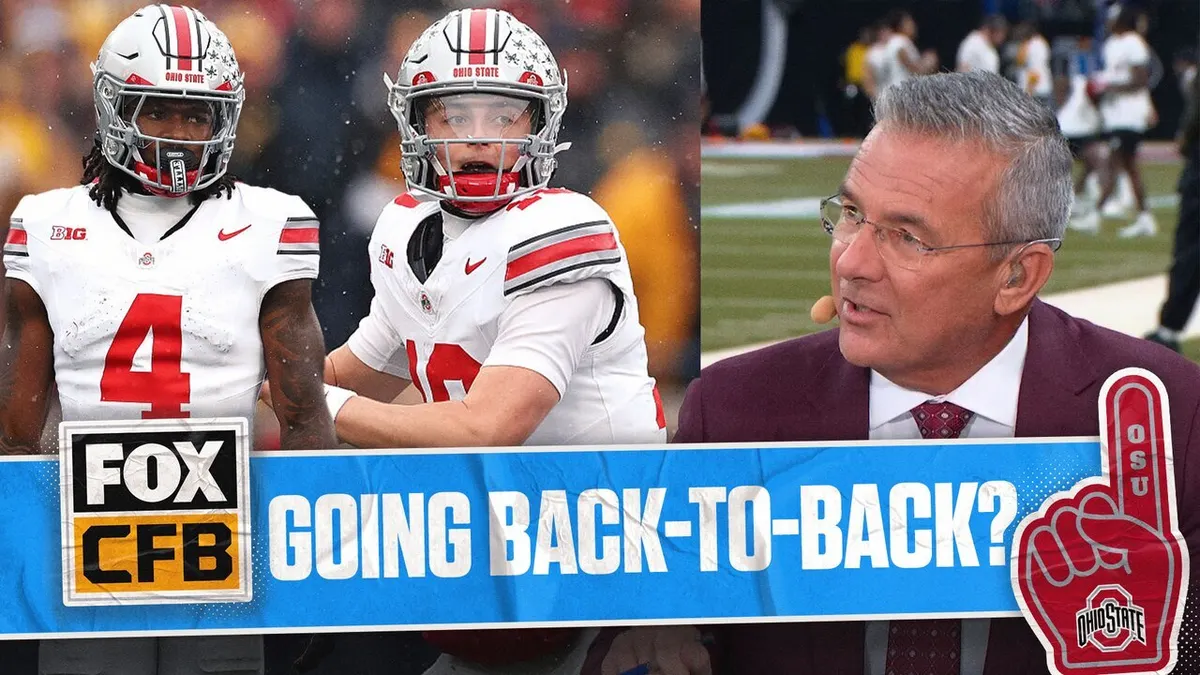
Urban Meyer has never been one to revisit the past without conviction, and his latest reflections on the Ohio State Buckeyes football’s College Football Playoff shortcomings have reignited one of the sport’s most debated “what-if” scenarios. Speaking candidly about the 2018 postseason, Meyer maintained that a pivotal injury within his squad ultimately derailed what he firmly believes would have been a championship run—one that, in his view, would have ended with Ohio State atop the sport instead of the Clemson Tigers football, who went on to secure the national title in dominant fashion.
For Meyer, the claim is not rooted in hindsight bias alone but in what he describes as a clear competitive edge his team possessed at the time. The 2018 Ohio State roster, led by a high-powered offense and anchored by experienced leadership, had surged through the regular season with moments of brilliance that suggested it could match any opponent in the country. Yet, as Meyer recounts it, the Buckeyes’ trajectory shifted dramatically when a crucial injury struck at the worst possible moment, disrupting rhythm, depth, and ultimately their championship aspirations.
The injury in question, though often discussed in broad terms rather than isolated to a single name in Meyer’s retelling, symbolized more than just the loss of a player. It represented the unraveling of a carefully constructed system—one that relied heavily on continuity, execution, and depth at key positions. Meyer has long emphasized that championship teams are not only defined by talent but by timing, health, and the ability to peak in late December and early January. In 2018, he insists, Ohio State was trending toward that peak before circumstances intervened.
Context is essential when evaluating Meyer’s assertion. The 2018 college football season culminated in the College Football Playoff National Championship 2019, where Clemson dismantled Alabama in one of the most decisive title game performances in recent memory. That Clemson team, led by freshman quarterback Trevor Lawrence and a generational defensive line, is widely regarded as one of the most complete teams of the modern era. Their dominance has often been used to dismiss hypothetical challenges from teams left out of the playoff, including Ohio State.
But Meyer’s perspective challenges that narrative. He argues that stylistically, Ohio State posed a different kind of threat—one that Clemson might not have been as comfortable handling. The Buckeyes’ offensive versatility, combined with their ability to stretch the field vertically and attack defenses with tempo, created matchup problems that Meyer believes could have neutralized Clemson’s strengths. Moreover, he points to the psychological component: Ohio State, under his leadership, had developed a reputation for rising to the occasion in high-stakes games.
This is not an abstract claim. Meyer’s track record in postseason play lends weight to his argument. During his tenure at Ohio State, he guided the program to a national championship in the inaugural College Football Playoff in the 2014 season, defeating both Alabama and Oregon in consecutive games. That run established a blueprint for how his teams could navigate elite competition, relying on adaptability, preparation, and a relentless competitive edge. Meyer sees parallels between that championship squad and the 2018 team, suggesting that, had circumstances aligned differently, history might have repeated itself.
The Buckeyes’ exclusion from the playoff that year remains a contentious topic among analysts and fans alike. Despite winning the Big Ten Championship, Ohio State was left out in favor of other one-loss teams, with concerns about defensive inconsistencies and a lopsided loss earlier in the season weighing heavily on the selection committee’s decision. Meyer has never fully embraced that rationale, and his recent comments suggest that he views the injury setback as compounding an already controversial outcome.
From his standpoint, the injury didn’t just affect Ohio State’s on-field performance—it altered the perception of the team at a critical juncture. Late-season evaluations, rankings, and playoff considerations often hinge on momentum and visual dominance. A diminished roster, even slightly, can shift those perceptions, influencing how decision-makers assess a team’s championship viability. Meyer believes that without that disruption, Ohio State would have presented a more compelling case, potentially changing the playoff landscape entirely.
What makes Meyer’s argument particularly compelling is the broader discussion it invites about the role of injuries in shaping championship narratives. College football, unlike its professional counterpart, does not offer the same margin for recovery. A single loss, a single poor performance, or a single injury can derail an entire season’s worth of work. Depth is critical, but even the deepest rosters can struggle to compensate for the loss of key contributors at pivotal moments.
Clemson’s championship run, by contrast, was marked by remarkable health and continuity. The Tigers entered the playoff with their core intact, executing at a level that left little doubt about their supremacy. Their victory over Alabama in the title game was not just a win—it was a statement, reinforcing their status as the sport’s gold standard at the time. Yet Meyer’s comments suggest that the margins between dominance and vulnerability may have been thinner than the final score indicated.
There is also an element of competitive psychology at play. Coaches, particularly those with Meyer’s pedigree, often carry an unshakable belief in their teams’ potential. That belief is not merely motivational—it is grounded in countless hours of preparation, film study, and firsthand observation. When Meyer says his team had the advantage, he is drawing from an intimate understanding of both his own roster and the opponents he studied throughout the season.
Critics, of course, will argue that such claims are inherently speculative. The absence of a direct matchup between Ohio State and Clemson in the 2018 playoff leaves the debate unresolved, confined to hypothetical scenarios and retrospective analysis. Clemson’s dominance, they contend, speaks for itself, and any suggestion that another team could have unseated them must be tempered by the reality of what actually transpired on the field.
Yet college football has always thrived on these debates. The sport’s structure, with its limited playoff field and emphasis on subjective rankings, naturally creates scenarios where deserving teams are left out, and questions linger long after the season ends. Meyer’s remarks tap into that enduring dynamic, offering a perspective that challenges the finality of Clemson’s championship narrative without diminishing their achievement.
For Ohio State fans, Meyer’s comments are both validating and bittersweet. They reinforce the belief that the 2018 team was capable of more, that its legacy is defined as much by what might have been as by what was achieved. The idea that an injury—not just performance—played a decisive role in shaping that outcome adds another layer of complexity to an already emotional chapter in the program’s history.
For Clemson supporters, the response is likely to be one of confidence. Championships are won on the field, not in hypotheticals, and the Tigers’ 2018 run remains one of the most impressive in recent memory. Meyer’s claims, while intriguing, do not alter the record books or the dominance Clemson displayed against the nation’s best.
Still, the conversation sparked by Meyer’s reflections underscores a fundamental truth about sports: outcomes are rarely as simple as they appear. Behind every championship lies a series of variables—health, timing, matchups, and moments—that collectively determine the final result. Change one of those variables, and the entire narrative can shift.
As college football continues to evolve, with an expanded playoff format on the horizon, scenarios like the one Meyer describes may become less common. More teams will have the opportunity to compete for a national title, reducing the likelihood that a single injury or selection decision will define a season’s legacy. But in 2018, under the existing system, the margins were razor-thin, and the consequences of misfortune were magnified.
Meyer’s willingness to revisit that season speaks to his enduring connection to the game and to the players he coached. It also reflects a broader desire among competitors to seek clarity, to understand how and why certain opportunities slipped away. Whether one agrees with his assessment or not, his perspective adds depth to the ongoing dialogue about one of college football’s most memorable seasons.
In the end, the 2018 championship belongs to Clemson, their dominance etched into the sport’s history. But Meyer’s argument ensures that the conversation does not end there. It invites fans, analysts, and historians to consider the fragile nature of success, the impact of unseen variables, and the ever-present possibility that, under slightly different circumstances, the story might have unfolded in a completely different way.