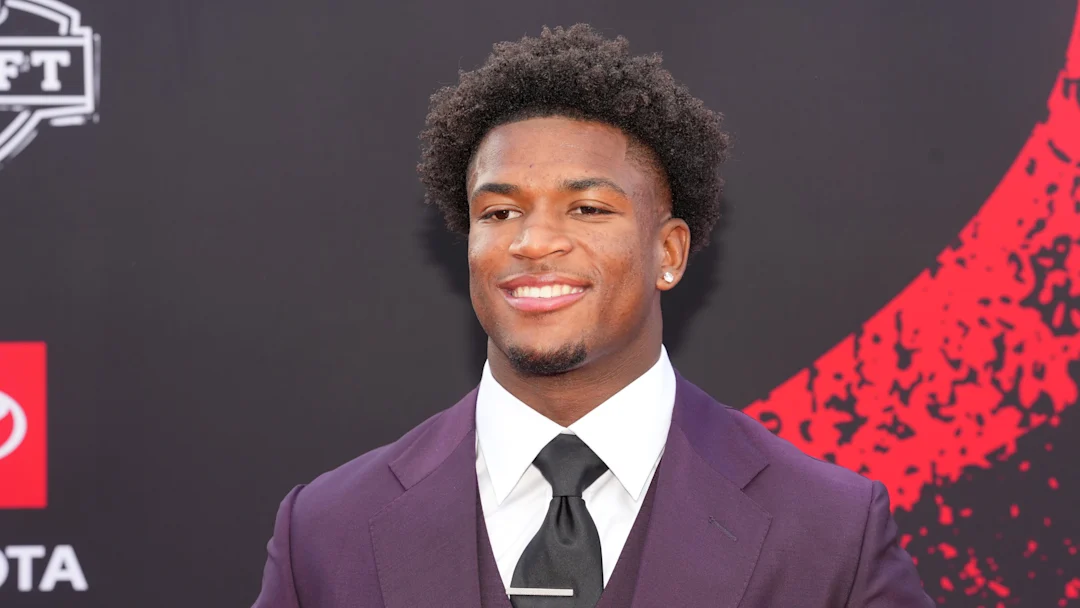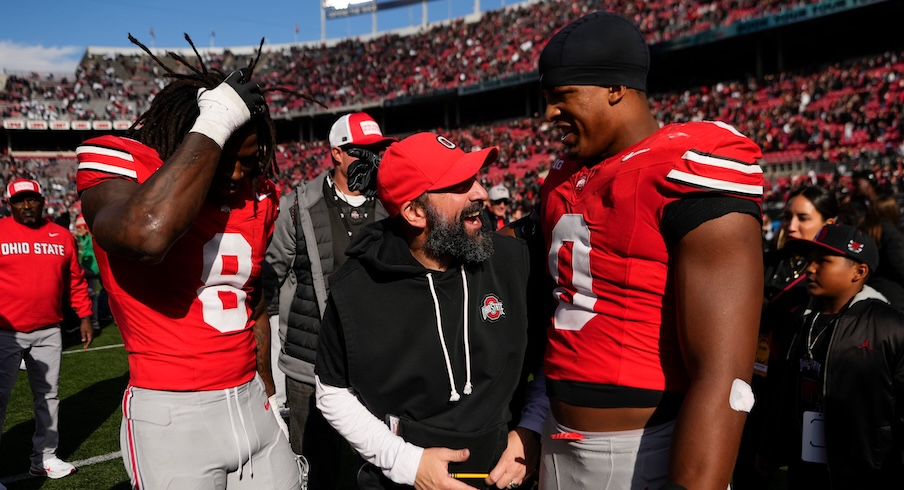
Ohio State’s standing as the most consistent pipeline of NFL talent in college football has long been part of its identity, but the 2026 NFL Draft has pushed that reputation into territory the sport has rarely seen. In a historic opening round stretch on Thursday night, the Ohio State Buckeyes produced four top-11 selections, becoming the first program in 59 years to accomplish the feat and only the third in recorded draft history.
With wide receiver Carnell Tate going No. 4 overall to the Tennessee Titans, linebacker Arvell Reese selected No. 5 by the New York Jets, defensive back Sonny Styles taken No. 7 by the Washington Commanders, and safety Caleb Downs picked No. 11 by the Dallas Cowboys, Ohio State not only dominated the early portion of the draft but also reshaped the modern understanding of roster development at the collegiate level. The Buckeyes are now the first program in the common draft era to place three defensive players inside the first 11 picks of a single draft, underscoring a defensive dominance that matched their offensive firepower.
The only comparable moments in history trace back generations. Michigan State accomplished the feat in 1967, and Notre Dame did it in 1946, in an entirely different era of football evaluation, scouting, and player development. In a modern draft environment defined by exhaustive scouting departments, analytics, and year-round evaluation cycles, Ohio State’s achievement stands apart not just for its rarity but for the level of consensus required among NFL franchises to select multiple players from the same program at the very top of the board.
What makes the moment even more striking is the youth of the group. Only one of the four selections was technically a senior, and even Sonny Styles reached that designation only because of an accelerated academic path after reclassifying from the 2023 recruiting cycle to 2022. The rest of the group arrived in Columbus as part of a wave of elite talent that spent just three seasons in the program before becoming top-11 NFL draft selections.
Ohio State head coach Ryan Day has repeatedly emphasized the developmental structure within the program as a central reason for its NFL success, and following the Buckeyes’ Pro Day on March 25, he pointed directly to the rapid ascension of his players as validation of the system.
“That to me speaks a lot about the development here,” said Ryan Day. “Sonny reclassified, but you talk about Carnell, you talk about Caleb, you talk about Arvell, you talk about Kayden McDonald, but those guys are all juniors. So for them to be ready the way they are right now in three years, again, says a lot about what we do. And this is a big part of what we sell.”
Day’s comments reflected a program philosophy built around early readiness rather than prolonged college careers. Ohio State has increasingly positioned itself not just as a national championship contender, but as a direct preparation ground for the NFL, where scheme familiarity, physical development, and exposure to high-pressure environments are baked into every season.
“I mean, you talk about the expectation of being in Ohio State, what comes with this, playing in front of the big guys,” Day continued. “The fact that we’re held to a very high standard for how we do things. We’re the face of the university. That translates really well to the end result. We have just under 12 million fans here. And so there’s a lot that comes with that. These guys understand that. And again, held to a high standard. So they understand what that’s like, being in an NFL-type city. So I think it’s easy for organizations to look at our guys and project what they’re going to look like going on to their teams. But it’s also the schemes. You know, we’re both on offense and defense NFL schemes.”
That alignment between college and professional systems has become one of Ohio State’s strongest recruiting pitches, and the 2026 draft results provided perhaps the clearest proof yet. The Buckeyes are no longer simply producing NFL athletes; they are producing immediate NFL-ready starters who can step into complex defensive and offensive systems with minimal transition.
The four players selected in the top 11 each represent a different dimension of that development model.
Carnell Tate, selected fourth overall by the Tennessee Titans, entered Ohio State as one of the most refined route runners in his recruiting class and left the program as a polished, versatile receiver capable of operating across multiple alignments. His combination of technical precision and contested catch ability made him one of the most coveted offensive prospects in the draft, and Tennessee’s decision to invest a top-five pick reflects their belief in his ability to become a foundational offensive weapon.
Arvell Reese, chosen fifth overall by the New York Jets, is the embodiment of modern defensive versatility. A hybrid linebacker with sideline-to-sideline range, Reese’s ability to defend both the run and pass made him one of the most complete defensive prospects in the class. NFL evaluators praised his football IQ and adaptability, traits that allowed him to function in multiple roles within Ohio State’s defensive structure.
At No. 7, Sonny Styles landed with the Washington Commanders, continuing Ohio State’s recent trend of producing defensive backs who combine size, physicality, and coverage versatility. Styles’ reclassification and accelerated development trajectory made his rise even more remarkable, but his production on the field quickly silenced any questions about readiness. His ability to play near the line of scrimmage while also handling deep coverage responsibilities made him one of the most unique defensive prospects in the class.
Caleb Downs, selected 11th overall by the Dallas Cowboys, rounded out the Buckeyes’ historic top-tier run. Widely regarded as one of the most instinctive defensive backs in college football during his time at Ohio State, Downs brought elite anticipation, tackling consistency, and leadership to the secondary. His selection ensured that Ohio State accounted for three of the top 11 picks on the defensive side of the ball, an unprecedented achievement in the common draft era.
That defensive dominance is particularly significant when viewed in historical context. No program has ever placed three defensive players inside the first 11 picks of a single NFL draft since the merger of professional scouting systems. It reflects not only individual talent but systemic excellence in coaching, preparation, and schematic teaching.
Even more impressive is the fact that Ohio State achieved this while simultaneously maintaining one of the nation’s most productive offenses. The balance between elite offensive and defensive output has become a defining feature of the program, further distinguishing it from other perennial college football powerhouses.
The phrase “Developed Here” has become a slogan associated with Ohio State’s identity under Day, but the results of the 2026 draft have given that phrase measurable weight. Still, within the program, another phrase has begun circulating with equal frequency: “Reload, not rebuild.” The Buckeyes have consistently demonstrated an ability to replace elite talent with equally elite talent, often without a noticeable drop in performance.
This year’s draft cycle reinforced that reputation more than any in recent memory. Despite losing multiple early-round picks from the previous season, Ohio State responded by producing an even more historically significant draft class. One year earlier, the Buckeyes tied their school record with 14 total selections in a single draft, including four first-round picks. The 2026 group, however, elevated the standard by concentrating elite talent at the very top of the draft board.
NFL front offices have increasingly taken notice of Ohio State’s ability to prepare players for immediate contribution. The consistency of schematic alignment between the Buckeyes’ system and professional schemes has made transitions smoother for incoming rookies, reducing the learning curve that often accompanies early draft selections.
For the four players selected Thursday night, that familiarity is expected to play a key role in their development trajectories. Each arrives in the NFL with experience in complex defensive or offensive structures, high-pressure environments, and national spotlight games that mirror the intensity of professional football.
Beyond the first round, Ohio State still has a significant number of players projected to be selected throughout the remainder of the draft weekend. The program’s depth ensures that its presence will continue to be felt across multiple rounds, reinforcing its reputation as the most prolific producer of NFL talent in college football.
As the draft continues, attention will inevitably turn to how this class is evaluated in the years ahead. Early draft success is one measure, but long-term NFL production will ultimately define the historical significance of the 2026 Buckeyes group. Still, few programs in modern football history have ever entered a draft weekend with this level of top-end talent concentration.
For Ohio State, the message is clear and now backed by historical precedent. Elite talent does not simply pass through Columbus; it is refined, accelerated, and prepared for the highest level of the sport at a pace unmatched by almost any program in college football.
The 2026 NFL Draft did not just reinforce that identity. It elevated it into history.