The 2026 NFL Draft’s opening night in Pittsburgh delivered a striking reminder of just how deeply the Ohio State Buckeyes program continues to shape the professional football landscape. In a first round defined by aggressive team decisions, positional gambles, and long-term roster projections, Ohio State once again emerged as one of the most influential pipelines in the sport. Four Buckeyes were selected within the first eleven picks, a staggering concentration of elite talent that underscored both the program’s recruiting dominance and its ongoing ability to develop NFL-ready prospects.
Yet even amid the celebration, there was a sense of near history. Ohio State came within one selection of becoming the first program ever to produce four top-10 picks in a single draft. That distinction slipped away when the final top-10 slot went elsewhere, but the broader achievement still reinforced the Buckeyes’ status as a factory for early-round talent. What followed across the first round was not just a parade of former Ohio State stars hearing their names called, but a series of landing spots that sparked immediate debate about fit, value, and long-term trajectory.
The night began with one of the more surprising developments at the top of the board. Wide receiver Carnell Tate became the first Buckeye off the board when the Tennessee Titans selected him with the No. 4 overall pick. On paper, the selection was both a testament to Tate’s upside and a reflection of Tennessee’s urgency to secure a premier pass-catching weapon. In practice, however, the fit raised immediate questions across league circles.
Tate’s profile has long been defined by polish, ball skills, and advanced route-running nuance rather than overwhelming athletic explosiveness. His showing at the NFL Combine did little to silence scouts who projected him more as a high-end No. 2 receiver rather than a traditional alpha WR1. That distinction matters in Tennessee, where the current offensive ecosystem lacks a proven top-tier wideout to anchor the passing game.
With second-year quarterback Cam Ward still developing, the Titans have leaned heavily on younger or complementary pieces in their receiving corps. Elic Ayomanor, a 2025 fourth-round pick, has already emerged as a primary target by necessity rather than design. Tight end Chig Okonkwo led the team in receiving production last season, further highlighting the absence of a true perimeter centerpiece.
In that context, selecting Tate at No. 4 felt like an ambitious projection rather than an immediate solution. The Titans are clearly betting on his technical refinement and football IQ to translate quickly, but the surrounding cast may force him into a role that stretches beyond his current physical ceiling. For that reason, the pick drew mixed reviews from analysts, with some praising the long-term vision while others questioned the value relative to available alternatives at the top of the draft.
Grade-wise, the selection landed in the middle ground. The talent is undeniable, but the ecosystem is far from ideal. A C-grade reflects both the promise and the uncertainty of a receiver stepping into a situation that may not fully align with his developmental timeline.
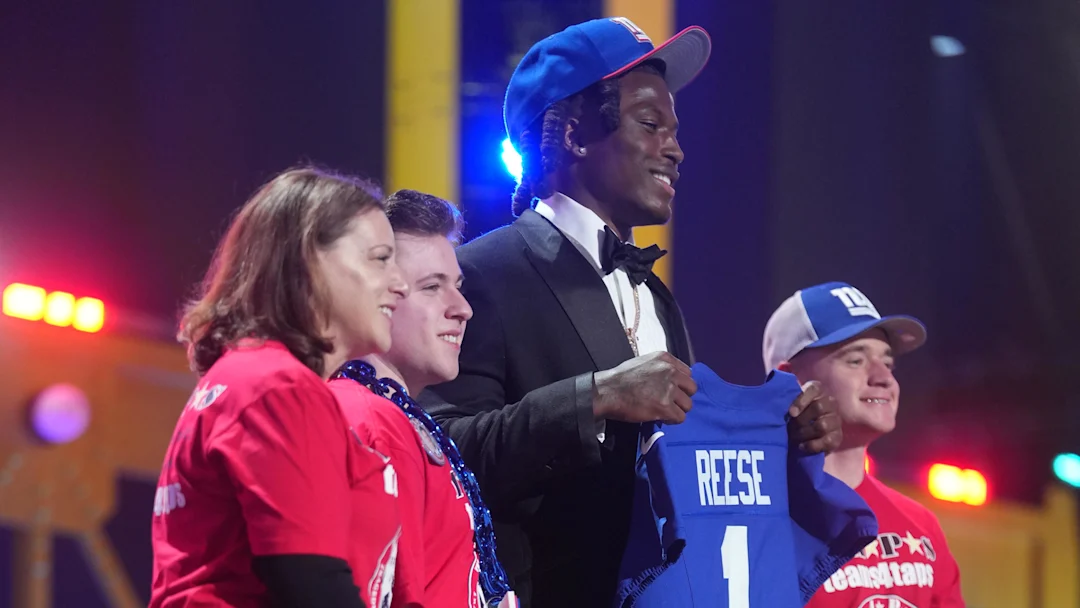
If the Titans’ decision sparked debate, the next Buckeye selection shifted the tone dramatically. Defensive standout Arvell Reese came off the board at No. 5 overall to the New York Giants, a move widely viewed as one of the strongest value picks of the early draft. Reese’s slide into the Giants’ lap was considered by many evaluators as a moment that could reshape the defensive identity of a franchise searching for long-term stability.
Reese’s versatility is what sets him apart. Capable of impacting the game as both an edge rusher and an off-ball linebacker, he brings a rare hybrid skill set that defensive coordinators covet but rarely find in a single prospect. His explosiveness off the line, combined with his fluidity in space, allows him to disrupt passing lanes, pressure quarterbacks, and contribute in coverage without sacrificing physicality.
What makes the selection even more significant is the broader draft context. The New York Jets, selecting earlier at No. 2, opted for Texas Tech’s David Bailey, a more traditional edge rusher viewed as a safer but lower-upside option. That decision effectively opened the door for the Giants to secure a player many evaluators believed had legitimate No. 1 overall potential in certain draft scenarios.
For New York, Reese represents more than just a pass-rush solution. He is a foundational defensive piece who can be molded into multiple roles depending on scheme evolution. While his refinement as a full-time pro may take time, the upside is significant enough to justify the investment at No. 5. The Giants, under a more stable organizational structure and a defense-oriented approach, appear well-positioned to maximize his development.
The pick earned an A grade, reflecting both the value obtained and the strategic alignment between player and franchise trajectory. Reese enters an environment where patience and structure can coexist, a critical factor for a prospect whose ceiling may ultimately define the draft’s defensive narrative.
The Buckeyes’ defensive representation in the top ten continued at No. 7, where linebacker Sonny Styles was selected by the Washington Commanders. Styles’ transition from safety to linebacker during his collegiate career has become one of the more intriguing developmental arcs in recent memory, and Washington’s decision to invest a high first-round pick in him reflects confidence in that evolution.
Styles offers a rare blend of coverage ability and physical presence in the box. His background as a defensive back gives him unusual range for a middle linebacker, allowing him to handle vertical responsibilities that many players at his position struggle with. At the same time, his growth into a more traditional run-defending role has added necessary mass and discipline, making him a complete three-down linebacker prospect.
For Washington, the selection addressed a clear and pressing need. The Commanders’ linebacker unit lacked consistency and impact, particularly in coverage situations against modern spread offenses. Styles provides both immediate rotational value and long-term starting potential, fitting neatly into a defensive rebuild that prioritizes speed and versatility.
The pick was widely praised, earning an A-minus grade. While not without developmental questions—particularly regarding full-time command of the defensive signal system at the NFL level—Styles’ floor is considered high enough to justify the selection, with his ceiling offering legitimate Pro Bowl potential if his transition continues on its current trajectory.
The final Buckeye selection of the night came at No. 11, where safety Caleb Downs was drafted by the Dallas Cowboys. The move immediately stood out as one of the most strategically sound decisions of the opening round, pairing one of the draft’s most instinctive defensive backs with a franchise in need of secondary leadership and structure.
Downs’ appeal lies in his football intelligence, range, and ability to dictate coverage from the back end. He processes plays quickly, closes ground efficiently, and has demonstrated a rare ability to function as both a center-field safety and an aggressive run supporter. That versatility makes him an ideal fit for modern defensive systems that demand adaptability from their secondary anchors.
In Dallas, Downs enters a defensive scheme undergoing recalibration under new coordinator Christian Parker, whose background with the Philadelphia Eagles as a defensive passing game coordinator has shaped a philosophy centered on maximizing player strengths rather than forcing rigid assignments. Parker’s reputation for developing defensive backs aligns closely with Downs’ profile, suggesting a strong developmental partnership from the outset.
The Cowboys view Downs as a foundational piece, not merely a rotational addition. His presence is expected to stabilize a secondary that has struggled with consistency and communication in recent seasons. With his combination of intelligence and physicality, he projects as a long-term starter capable of anchoring the back end of the defense.
The selection earned an A-minus grade, reflecting both the schematic fit and the organizational need. While some evaluators debated whether other defensive positions could have been prioritized, few questioned Downs’ talent or long-term value.
Taken together, the first round represented a defining moment for Ohio State’s 2026 draft class. Four players selected in the top eleven is a testament not only to individual excellence but also to the program’s sustained dominance in developing NFL-ready talent across multiple positions. From wide receiver to linebacker to defensive back, the Buckeyes showcased positional diversity at the highest level of the draft.
Beyond the individual selections, however, the night also highlighted a broader truth about the NFL’s evolving identity. Teams are increasingly willing to project upside over immediate fit, to prioritize versatility over specialization, and to trust developmental timelines that extend beyond rookie contracts. Ohio State’s prospects embodied that shift perfectly, each arriving with unique strengths but also with varying degrees of polish and projection.
The Titans are banking on refinement becoming production sooner rather than later. The Giants are betting on raw disruption turning into defensive dominance. The Commanders are investing in hybrid athleticism translating into leadership at the heart of their defense. The Cowboys are trusting intelligence and range to stabilize a secondary in transition.
Whether all four decisions ultimately prove successful will only be revealed over time. But on draft night in Pittsburgh, Ohio State once again stood at the center of the NFL’s future, shaping narratives, influencing strategies, and reinforcing a pipeline that shows no signs of slowing down.