Todd McShay has never been one to shy away from strong draft evaluations, and his latest comments on Ohio State’s rising wide receiver phenom Jeremiah Smith have once again sent a ripple through the college football and NFL scouting communities. The veteran analyst, known for his long-standing work breaking down prospects years ahead of their draft eligibility, has made it abundantly clear where he stands on the Buckeyes’ star receiver as a projected 2027 NFL Draft prospect: he believes Smith is not just good, but already shaping up as one of the most intriguing long-term evaluations in the sport.
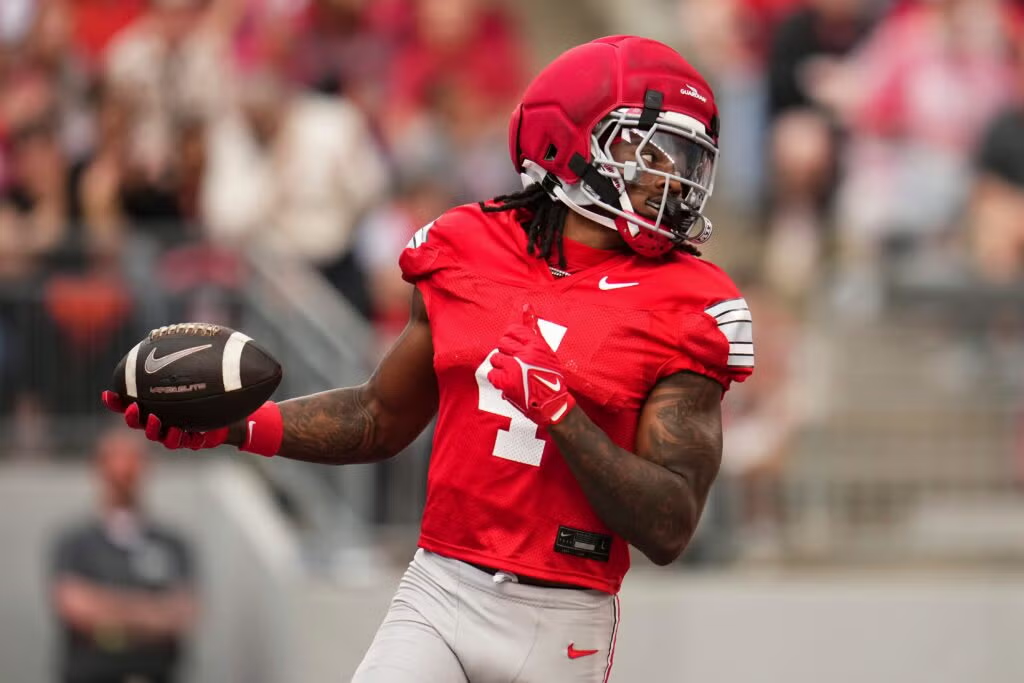
For context, Jeremiah Smith has already become one of the most talked-about young talents in college football despite still being in the early stages of his collegiate career with Ohio State Buckeyes. The combination of his physical dominance, refined route-running ability, and rare composure for his age has created an unusual situation in which draft analysts are already projecting his NFL future years in advance. That level of early attention is typically reserved for once-in-a-generation quarterback prospects or transcendent defensive players, but Smith’s emergence as a wide receiver has forced evaluators like Todd McShay to recalibrate how they discuss long-term projections.
McShay, a respected voice in the draft analysis space, has consistently emphasized that it is still far too early to place firm expectations on any 2027 projections. However, in discussing Smith specifically, he has been unusually candid about the level of excitement the Ohio State receiver generates within scouting circles. According to McShay’s evaluation framework, what separates Smith from the average highly recruited freshman or sophomore is not just production or athleticism, but the way his skill set already mirrors that of established NFL contributors.
In scouting terms, that is a significant distinction. Most elite college wide receivers develop gradually over multiple seasons, refining their release techniques, expanding their route trees, and learning to consistently win against elite defensive backs. Smith, however, has shown flashes of maturity in his game that suggest a much shorter developmental curve. McShay has pointed out that when evaluating wide receiver prospects this far out, the focus is less on statistics and more on traits that translate to the professional level. In Smith’s case, those traits are already standing out.
Physically, Smith checks nearly every box that NFL teams prioritize in modern outside receivers. He possesses the size and length to compete in contested catch situations, the explosive acceleration to separate at the second level, and the body control to adjust mid-air in ways that only a handful of college receivers can replicate. More importantly, McShay and other analysts have highlighted Smith’s natural ability to track the football in flight, a skill that often takes years to master at the collegiate level.
But what has truly elevated Smith in early draft discourse is not just his physical profile, but his mental approach to the game. McShay has noted that wide receivers who project as top-10 NFL Draft picks usually display an early understanding of leverage, timing, and defensive tendencies. Smith, despite his youth, already shows signs of reading coverage rotations and adjusting his routes accordingly. That level of awareness is typically what separates productive college receivers from future NFL stars.
Within the broader scouting community, comparisons have inevitably begun to surface, though McShay has been careful not to overinflate expectations this early in the process. Still, the conversations themselves are telling. When analysts start mentioning a college sophomore in the same breath as established NFL boundary receivers in terms of traits and projection, it signals that the player in question is operating on a different developmental timeline than most of his peers.
Ohio State’s history at the wide receiver position also adds weight to Smith’s growing reputation. The program has long been a pipeline for elite NFL talent at the position, producing first-round selections with regularity. That legacy places added scrutiny on every standout receiver who emerges in Columbus, but it also provides a useful benchmark for evaluation. According to McShay’s long-term outlook, Smith is already tracking alongside some of the program’s most physically gifted wideouts at similar stages of their careers.
What makes McShay’s stance particularly notable is his cautious reputation. While he is known for identifying early risers, he is equally known for tempering hype when it becomes disproportionate. His willingness to engage seriously with Smith’s 2027 projection suggests that the Ohio State receiver is not just generating media buzz, but legitimate scouting intrigue.
From an NFL perspective, the league’s evolution has only increased the value of receivers like Smith. Modern offenses prioritize explosive perimeter threats who can win both vertically and after the catch. The ability to stress defenses horizontally and vertically has become a cornerstone of successful passing attacks, and Smith’s early film suggests he has the versatility to fulfill multiple roles within that structure. McShay has pointed out that receivers who enter the league with that kind of adaptability often become immediate contributors, even if they are not yet fully refined technically.
Of course, projecting a player three years into the future comes with inherent uncertainty. Developmental curves can shift dramatically due to injuries, scheme changes, or competition for targets. McShay himself has acknowledged that the history of draft evaluation is filled with early projections that never fully materialized. For every prospect who maintains trajectory, there are others whose growth stalls or whose roles change in ways that impact their professional outlook.
Still, the early signs surrounding Smith are difficult to ignore. At Ohio State, he is already being integrated into one of the most complex offensive systems in college football, which requires receivers to process information quickly and execute within a high-tempo environment. That exposure is accelerating his development in ways that could prove critical by the time he becomes eligible for the NFL Draft.
Within scouting departments around the league, early watchlists for future draft classes often include names that are tracked more for curiosity than certainty. Smith, however, appears to have moved beyond the curiosity phase. McShay’s commentary suggests that he is already being evaluated as a potential cornerstone receiver prospect in a future draft class that is still largely undefined.
Part of what fuels the excitement is the rarity of true alpha wide receiver prospects at such an early stage. While quarterback evaluations tend to dominate early draft discourse, elite receivers who demonstrate dominance before reaching their junior year often carry similar long-term value. McShay has indicated that when he evaluates players like Smith, he is not simply projecting college production, but envisioning how their skill sets will translate against NFL-caliber defensive backs who are faster, stronger, and more technically advanced.
That projection process is where Smith continues to stand out. His release package at the line of scrimmage already shows diversity, allowing him to beat press coverage with both speed and physicality. His ability to separate in intermediate routes suggests a developing understanding of timing concepts that are essential in professional passing systems. And perhaps most importantly, his competitive demeanor in contested situations reflects the kind of mentality that NFL teams prioritize when investing high draft capital in wide receivers.
Even with all of these positives, McShay has not framed Smith as a finished product. Instead, the emphasis remains on trajectory rather than certainty. The difference, according to draft analysts, is crucial. A finished product implies limited growth potential, while a high-trajectory prospect suggests that the ceiling remains significantly higher than current production indicates.
That distinction is what makes early evaluations like McShay’s so compelling. They are not predictions of immediate dominance, but rather assessments of long-term possibility. In Smith’s case, that possibility is already generating serious attention across both college football and NFL scouting communities.
As the 2027 NFL Draft remains years away, it is unlikely that conversations around Smith will slow down anytime soon. If anything, they will intensify as he continues to develop within Ohio State’s system and take on larger roles in high-stakes games. Each performance will be scrutinized not just in the context of college football success, but through the lens of future professional projection.
For McShay, the early conclusion is clear enough to share publicly, even if cautiously framed. Jeremiah Smith is not just another talented college receiver. He is, at this stage of evaluation, one of the most compelling long-term wide receiver prospects in the country. And while the road to the 2027 NFL Draft is still long, the early narrative has already begun to take shape around a player whose ceiling continues to draw attention from some of the most experienced evaluators in the sport.