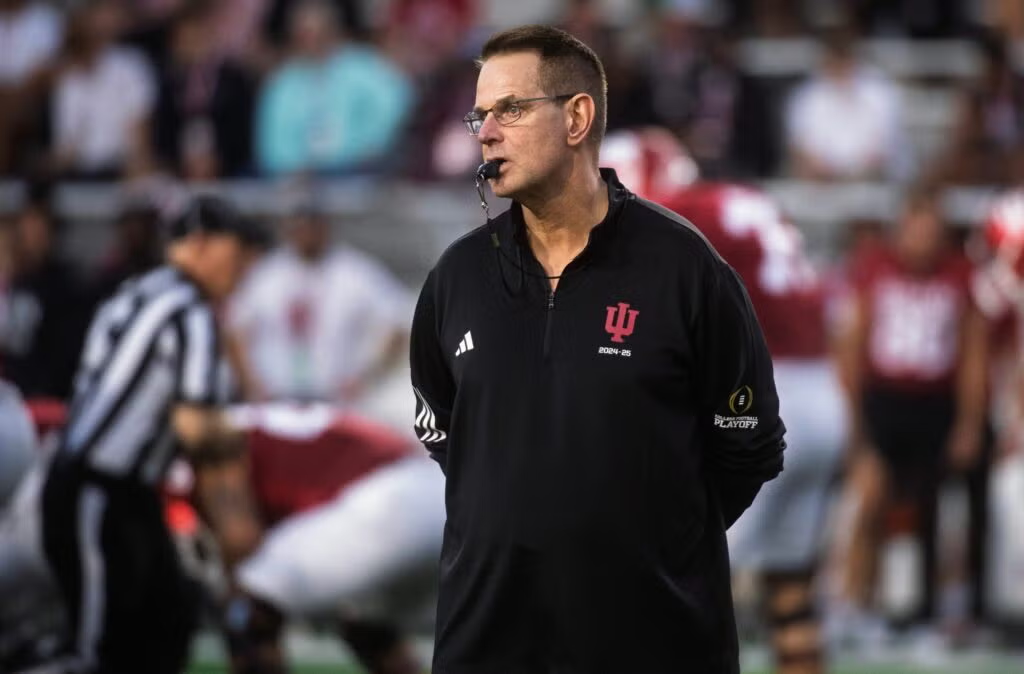
In college football, offseason narratives have a way of circling back at just the right time, especially when they involve elite talent and blunt evaluations from respected coaches. That is exactly what has happened with Indiana head coach Curt Cignetti and his past remarks about Ohio State’s freshman standout wide receiver Jeremiah Smith. As the new season approaches, those comments—originally made in a broader evaluation of the Big Ten landscape—are resurfacing across fan circles and media discussions, not because they were controversial at the time, but because they now feel increasingly prophetic.
Cignetti, known for his straightforward assessments and no-nonsense coaching philosophy, has never been one to overstate praise. So when he spoke about Smith in the context of preparing for Big Ten competition, it carried weight. The Indiana coach essentially acknowledged what many around the sport already suspected: that Ohio State may have landed a once-in-a-generation receiver talent, and that defending him would require more than conventional preparation.
At the time, Cignetti’s comments were treated as part of the usual offseason coach-speak cycle—respectful acknowledgment of an opponent’s talent, paired with a subtle reminder that games are not won on paper. But as spring workouts and preseason projections continue to build momentum, the remarks are being revisited with a different lens. The reason is simple: Smith’s trajectory has only reinforced the idea that he is not just another highly touted recruit, but a potential program-altering presence for the Ohio State Buckeyes.
Smith arrived in Columbus with immense expectations. A five-star recruit and widely regarded as one of the most polished high school receivers in recent memory, he entered a program already known for producing NFL-caliber wideouts. Yet even by Ohio State standards, where elite receiver play is almost a tradition, Smith’s physical profile and early flashes have stood out. At 6-foot-3 with exceptional body control, acceleration off the line, and rare ball-tracking ability, he has been described by analysts as a player who can win in nearly every coverage situation.
That is what makes Cignetti’s earlier evaluation so relevant again. In discussing how defenses in the Big Ten would need to adapt, he emphasized that players like Smith force coordinators into uncomfortable decisions before the ball is even snapped. Whether it is bracket coverage, safety rotation, or altering press technique at the line of scrimmage, the presence of a receiver who can consistently defeat single coverage changes the structure of a defense entirely.
For Indiana, that reality is particularly significant. Cignetti’s program has built its identity on discipline, defensive structure, and limiting explosive plays. But against Ohio State, and specifically against Smith, those principles are tested in real time. The margin for error shrinks dramatically when a receiver can turn a routine throw into a 40-yard gain simply by winning a contested catch or separating late in a route.
What has made the resurfacing of Cignetti’s comments especially compelling is how closely they align with early internal scouting reports that have circulated around the conference. Opposing defensive staffs privately acknowledge that Smith is already being treated as a top priority, even before he has played a full collegiate season. That level of attention is typically reserved for proven veterans, not second-year or freshman players.
Yet Smith is not operating in a vacuum. His emergence is tied directly to the continued evolution of Ohio State’s offensive identity. The Buckeyes have long been one of the most explosive passing teams in college football, but the addition of a receiver with Smith’s ceiling adds another layer of unpredictability. Defenses that already had to account for multiple threats now face the possibility of a true alpha receiver who can dictate coverage adjustments on his own.
That dynamic is what Cignetti was alluding to when he spoke candidly about preparation. His point was not that Smith is unguardable, but that guarding him requires tradeoffs—tradeoffs that often open space elsewhere on the field. For a defensive coach, those are the kinds of dilemmas that shape entire game plans, from weekly practice emphasis to situational play-calling on Saturdays.
It is also why the comments have gained traction again. As preseason film study intensifies across the Big Ten, analysts and coaches are revisiting every available look at Smith, from high school tape to early college snaps. The consensus forming is consistent with Cignetti’s original observation: Smith is already playing at a level that forces opponents to prepare as if he is the primary focal point of the offense.
What makes that even more challenging is the timing. Most freshman wide receivers require adjustment periods, particularly in physical conferences like the Big Ten. Press coverage, complex zone schemes, and the speed of collegiate defenses typically slow development. But Smith’s transition has shown fewer of those growing pains than expected, reinforcing the idea that his skill set translates immediately.
For Indiana, that means defensive planning cannot be generic. It must be specific, layered, and adaptable. Cignetti’s staff is known for its attention to detail, but even the most structured systems can be stressed by a receiver who threatens all three levels of the field. A short slant can become a sprint to the end zone if leverage is lost. A deep route can turn into a broken coverage highlight if safety help arrives a half-second late.
Beyond Indiana, the broader Big Ten landscape is also taking note. Defensive coordinators across the conference are re-evaluating matchups, particularly in games where Ohio State’s offensive scheme allows Smith to isolate against single coverage. The challenge is not just physical—it is psychological. Once a receiver demonstrates the ability to consistently win, defenses begin to hesitate, and hesitation at this level often leads to breakdowns.
That is why Cignetti’s remarks continue to resonate. He framed the challenge in practical terms rather than hype-driven language. His perspective was rooted in coaching reality: elite players force adaptation, and adaptation requires risk. For programs like Indiana, that risk calculus becomes central to how they approach games against top-tier opponents.
At the same time, there is caution in overextending the narrative around Smith too early. College football history is filled with players who flashed elite potential before defenses adjusted. The difference here, however, is the combination of physical traits, opportunity, and system fit. Ohio State has consistently demonstrated an ability to maximize wide receiver talent, and Smith appears to be the latest in that pipeline.
Still, the expectations surrounding him now carry weight that extends beyond highlight plays. He is being discussed not just as a future NFL prospect, but as a current strategic problem for opposing defenses. That distinction matters, because it shifts how teams prepare in August and September, not just November.
For Cignetti, the resurfacing of his comments also underscores his broader coaching philosophy. He has long emphasized honesty in evaluation—acknowledging strengths in opponents without surrendering competitive belief. His assessment of Smith was not an admission of defeat, but rather a recognition of the level required to compete in the upper tier of the Big Ten.
As the season approaches, Indiana’s preparation for Ohio State will likely reflect that mindset. Film sessions will focus on leverage, spacing, and situational containment rather than attempts to completely neutralize Smith—a task few programs believe is realistic. Instead, the objective becomes limiting explosive outcomes and forcing Ohio State’s offense into longer, more methodical drives.
For fans and analysts revisiting Cignetti’s original remarks, the takeaway is not that Indiana fears Ohio State, but that the competitive gap at certain positions can shape game strategy in profound ways. Smith represents one of those positions. His presence alone alters defensive math, and that is precisely what Cignetti identified early on.
Ultimately, the resurfacing of those comments serves as a reminder of how quickly narratives evolve in college football. What was once a passing acknowledgment in the offseason has become a focal point of preseason analysis. And as both Indiana and Ohio State prepare for another chapter in their Big Ten rivalry landscape, the attention surrounding Jeremiah Smith will only intensify.
Whether he fully meets the expectations placed upon him remains to be seen, but the early signals are clear enough that opposing coaches are already treating him as a priority problem. And in a conference defined by physical defenses and tactical adjustments, that alone speaks volumes about where he stands before the season even begins.