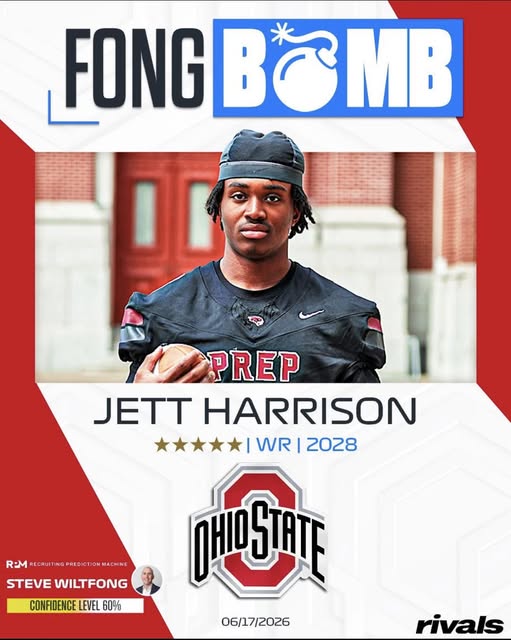
FONG BOMB: Ohio State’s pursuit of another elite wide receiver may have taken its biggest step yet.
Rivals national recruiting insider Steve Wiltfong, one of the most trusted evaluators and predictors in college football recruiting, has logged an expert prediction for the Ohio State Buckeyes to land five-star wide receiver Jett Harrison, the No. 1 overall prospect in the 2028 Rivals300 rankings. The projection immediately reshapes the conversation surrounding the 2028 recruiting cycle, not simply because of Harrison’s elite talent, but because of what his recruitment represents for one of college football’s premier talent factories.
When Wiltfong enters a prediction—widely known throughout recruiting circles as a “Fong Bomb”—the industry pays attention. His projections are built on extensive conversations with prospects, families, coaches and college staffs, making them among the most respected indicators of where a recruitment is trending. While expert predictions are not commitments and recruiting remains fluid, Wiltfong’s latest forecast signals that Ohio State Buckeyes football has established itself as the team to beat for perhaps the most coveted player in high school football.
For Ohio State, the implications extend well beyond adding another five-star receiver. Landing Harrison would further reinforce the Buckeyes’ reputation as college football’s premier destination for elite pass catchers while strengthening their long-term recruiting momentum in an increasingly competitive Big Ten Conference landscape.
The storyline also carries unmistakable family significance.
Harrison is the younger brother of Marvin Harrison Jr., whose decorated career in Columbus culminated with unanimous All-American honors before becoming one of the highest-selected wide receivers in recent NFL Draft history. Their father, Marvin Harrison Sr., built a Hall of Fame career with the Indianapolis Colts, creating one of football’s most accomplished receiver families.
Yet recruiting analysts consistently emphasize that Jett Harrison’s evaluation is built on his own accomplishments rather than his surname.
The Philadelphia native, who stars at St. Joseph’s Preparatory School, has emerged as Rivals’ No. 1 overall prospect in the 2028 class after an extraordinary start to his varsity career. Standing approximately 6-foot-1 and weighing around 175 pounds, Harrison has already demonstrated the polish and technical refinement rarely seen from underclassmen receivers.
His freshman campaign immediately announced his arrival on the national stage.
Harrison earned MaxPreps Freshman All-American recognition after helping lead St. Joseph’s Prep to a Pennsylvania state championship while scoring 10 touchdowns. Instead of plateauing, he elevated his game as a sophomore, producing roughly 50 receptions, 849 receiving yards and 20 touchdown catches against one of the country’s toughest high school schedules.
Production alone, however, tells only part of the story.
Scouts routinely point to Harrison’s advanced route tree, nuanced release package and exceptional understanding of leverage against defensive backs. His ability to create consistent separation before the football arrives distinguishes him from many physically gifted young receivers who rely primarily on athleticism.
Rivals Director of Scouting Charles Power has described Harrison as possessing an elite combination of ball skills and route-running ability, praising his ability to consistently create separation while making difficult catches outside his frame. Power has even suggested Harrison appears more technically advanced at this stage than Marvin Harrison Jr. was during the same point in his development.
Those observations align with evaluations from other national scouting services.
247Sports Director of Scouting Andrew Ivins has highlighted Harrison’s ability to attack defensive cushion, snap off routes with precision and turn routine completions into explosive plays after the catch. The combination of body control, acceleration and football intelligence allows Harrison to threaten defenses at every level of the field, whether attacking vertically, winning on intermediate breaking routes or generating yards after catch through vision and balance.
His catch radius stands out despite not possessing overwhelming size.
Harrison routinely wins contested catches while demonstrating late hands that minimize opportunities for defensive backs to disrupt the football. His spatial awareness near the sideline, timing at the catch point and ability to adjust to off-target throws reflect a receiver who already understands many of the technical demands required at the collegiate level.
Those traits explain why virtually every national power entered the race early.
Programs including University of Oregon football, Penn State Nittany Lions football, Miami Hurricanes football, Notre Dame Fighting Irish football and others have positioned themselves as serious contenders throughout various stages of Harrison’s recruitment.
Still, Ohio State has steadily strengthened its position.
Part of that advantage stems from familiarity.
The Harrison family already understands Ohio State’s infrastructure, player development model and expectations after Marvin Harrison Jr.’s collegiate career. That existing relationship naturally gives the Buckeyes credibility, although recruiting observers have consistently noted that Jett Harrison intends to evaluate programs on their own merits rather than simply following family precedent.
Ohio State’s broader track record at wide receiver may ultimately prove even more persuasive.
Few programs can match what the Buckeyes have accomplished over the past decade at the position. From Michael Thomas to Terry McLaurin, Parris Campbell, Chris Olave, Garrett Wilson, Jaxon Smith-Njigba, Marvin Harrison Jr., Emeka Egbuka and the next generation led by Jeremiah Smith and Carnell Tate, Ohio State has become synonymous with elite receiver development.
That pipeline has consistently translated into first-round NFL Draft selections and productive professional careers.
For prospects evaluating developmental opportunities, that résumé carries significant weight.
Head coach Ryan Day has built offensive systems emphasizing quarterback efficiency, offensive spacing and explosive passing concepts designed to maximize receiver production. Ohio State’s offenses frequently stress defenses vertically while incorporating layered route combinations that create favorable leverage opportunities for elite route runners.
Within that framework, Harrison’s skill set appears particularly compatible.
His ability to vary tempo throughout routes, manipulate defensive backs at the stem and accelerate out of breaks projects naturally into Ohio State’s passing attack. Whether aligned as an X receiver, moved into the slot or utilized in motion packages, Harrison possesses the versatility to threaten defenses from multiple alignments.
He also profiles as an impact player in red-zone efficiency.
His body control, timing and contested-catch ability make him an attractive target on fade routes, back-shoulder throws and play-action concepts near the goal line, while his acceleration enables him to generate explosive plays from underneath route combinations.
Another significant factor has been Ohio State’s recruiting philosophy.
Even amid coaching transitions and evolving recruiting landscapes shaped by NIL and the transfer portal, the Buckeyes have maintained a relentless commitment to acquiring elite high school receiver talent.
For years, wide receivers coach Brian Hartline established himself as arguably the nation’s premier recruiter and developer at the position before moving into a head coaching opportunity elsewhere. Although Hartline’s departure inevitably prompted questions about whether Ohio State could sustain its recruiting dominance, the Buckeyes have continued attracting elite receivers while emphasizing the broader strength of the program’s developmental infrastructure.
Wiltfong’s prediction may represent the strongest indication yet that Ohio State’s recruiting momentum at wide receiver remains firmly intact.
His projections have earned widespread credibility because they typically follow extensive reporting rather than speculation. While recruiting remains unpredictable—particularly with prospects in the 2028 cycle who still have significant time before signing—Wiltfong generally waits until substantial evidence points toward a clear favorite before making public predictions.
That context makes his Ohio State projection especially noteworthy.
The Buckeyes are not simply leading because of family history.
They appear to have assembled a compelling combination of relationships, developmental success, offensive identity and long-term vision that resonates with Harrison and those closest to his recruitment.
National recruiting analysts have likewise praised Harrison’s maturity throughout the process.
Despite carrying enormous expectations attached to both his family name and recruiting ranking, Harrison has consistently emphasized humility while allowing his play to speak louder than external attention.
That approach mirrors many of the characteristics recruiters value beyond measurable athletic traits.
College staffs frequently evaluate competitiveness, coachability, football intelligence and consistency with nearly as much emphasis as speed or size. Harrison’s reputation in those areas has only strengthened his standing as the consensus elite prospect.
Should Ohio State ultimately secure his commitment, the impact would extend well beyond one recruiting class.
Elite quarterback prospects often prefer throwing to elite receivers.
Top offensive linemen want to protect explosive offenses.
Skill-position recruits gravitate toward programs assembling championship-caliber supporting casts.
Recruiting success frequently compounds itself, and adding the nation’s No. 1 overall player could create additional momentum throughout Ohio State’s 2028 class.
The commitment would also reverberate across the Big Ten.
Conference rivals continue investing heavily in recruiting infrastructure following the league’s recent expansion and growing national profile. Programs such as Oregon and Penn State have intensified efforts to challenge Ohio State atop the conference recruiting hierarchy, making every elite commitment increasingly significant.
Nationally, Harrison’s decision could influence future team recruiting rankings across Rivals, On3, 247Sports and composite industry evaluations.
While no single player determines a recruiting class, landing the consensus top overall prospect often serves as a foundational victory capable of attracting additional blue-chip talent.
There remains important work before any commitment becomes official.
Harrison is expected to continue visiting campuses, evaluating coaching staffs and assessing offensive systems before making a final decision. Other national powers continue pursuing him aggressively, and recruiting battles involving elite prospects rarely conclude without multiple twists.
Ohio State’s current advantage should therefore be viewed precisely as Wiltfong presented it: a strong projection rather than a completed recruitment.
That distinction matters.
The modern recruiting landscape evolves rapidly through coaching changes, official visits, NIL developments and personal relationships. Programs trailing today can narrow gaps through sustained recruiting efforts, while early favorites must continue reinforcing their position.
Even so, the Buckeyes appear exceptionally well positioned.
Their combination of receiver development, offensive philosophy, championship aspirations and established relationship with the Harrison family provides a compelling recruiting pitch few programs can replicate.
If the prediction ultimately proves accurate, Ohio State would once again demonstrate why elite receivers continue viewing Columbus as the premier destination for maximizing their collegiate and professional potential.
For the Buckeyes, another Harrison wearing scarlet and gray would symbolize continuity in a program that has transformed wide receiver development into one of college football’s defining competitive advantages.
For the 2028 recruiting cycle, it would represent one of the year’s most consequential commitments, potentially reshaping national recruiting rankings while reinforcing Ohio State’s standing among the sport’s perennial championship contenders.
And for college football recruiting as a whole, Wiltfong’s latest projection serves as another reminder that the race for transformative talent often begins years before signing day—but programs with sustained excellence, proven player development and consistent championship aspirations remain best positioned when the nation’s top prospects ultimately make their decisions.