Fernando Mendoza’s mentorship with Kirk Cousins is anything but typical
HENDERSON, Nev. — The most important relationship in the Las Vegas Raiders’ quarterback room might not look like a traditional mentorship at all.
Kirk Cousins does not consider himself Fernando Mendoza’s mentor. In fact, when the subject was raised during the offseason, the veteran quarterback pushed back firmly, calling the characterization “a bit of a reach” and describing the room instead as a collaborative environment in which every quarterback contributes.
Yet that distinction may be exactly what makes Cousins’ influence on Mendoza so valuable.
The Raiders signed Cousins in April to a five-year, $172 million contract that includes only $20 million guaranteed, according to Reuters, and then selected Mendoza No. 1 overall in the 2026 NFL draft just three weeks later. The juxtaposition created an unusual quarterback structure: a 37-year-old veteran with extensive experience in the offense standing in front of a 22-year-old Heisman Trophy winner viewed as the franchise’s long-term answer.
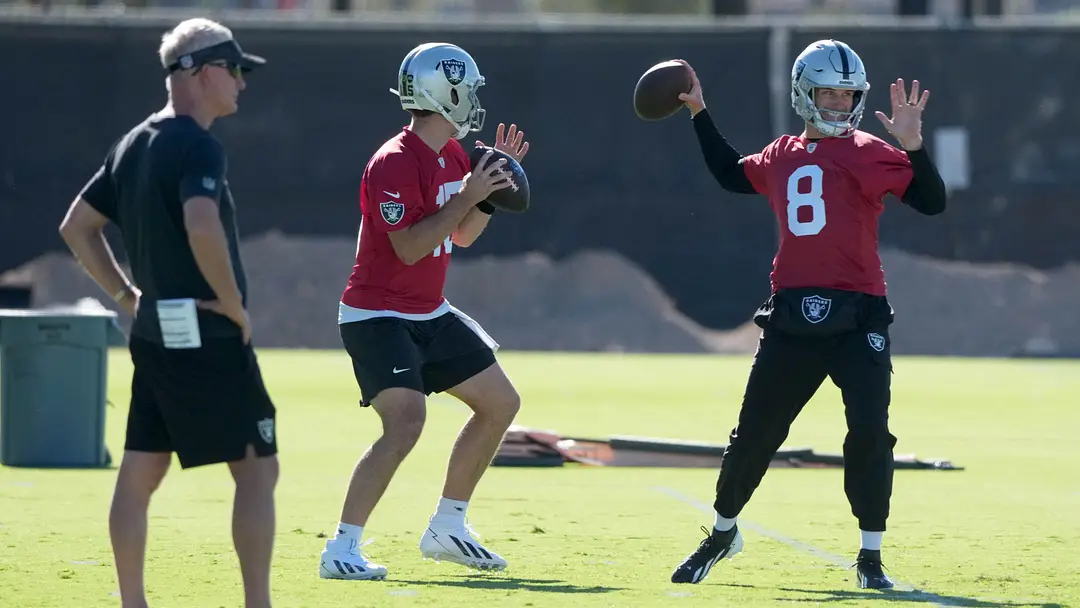
The plan was never necessarily for Cousins to hand the job over immediately. Las Vegas coach Klint Kubiak has repeatedly indicated that he prefers Mendoza to learn behind an established veteran before being asked to carry an NFL offense. Cousins opened training camp as QB1, while Mendoza worked primarily with the second unit.
But the relationship has evolved into something more nuanced than “veteran teaches rookie.”
Mendoza is not simply sitting beside Cousins and absorbing lectures. He is studying him, challenging him, asking questions and using his veteran teammate as a live reference point for an offense he is learning from the ground up.
That matters because the transition facing Mendoza is substantial.
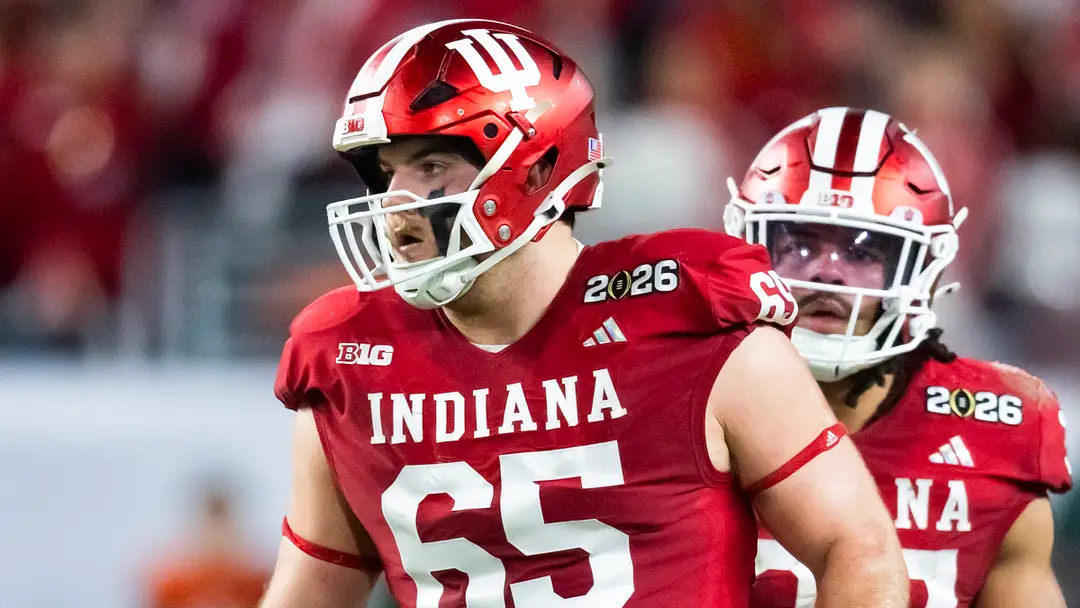
At Indiana in 2025, Mendoza operated primarily from the shotgun. In Kubiak’s offense, the quarterback must be comfortable working under center, selling play-action, managing his footwork and manipulating second-level defenders while maintaining precise timing with the run game. NFL.com noted that Mendoza took more under-center snaps at rookie minicamp than he had during his entire college career, highlighting just how significant the schematic adjustment has been.
Cousins happens to have lived inside that system.
He spent three seasons with Kubiak in Minnesota, giving him firsthand knowledge of the terminology, concepts and quarterback mechanics Kubiak wants from his passer. The Raiders specifically viewed that familiarity as an asset when they brought Cousins aboard.
For Mendoza, that creates an unusually valuable classroom.
“He Kirk [Cousins] is definitely helping me a lot,” Mendoza said during the offseason, explaining that Cousins’ previous experience in the offense gives him an advantage when explaining how certain plays function in actual NFL games.
But Cousins does not appear interested in turning that advantage into authority over the rookie.
That is important.
Quarterback development can become complicated when the veteran is competing with the player the organization drafted to be its future. The natural tension is obvious. Cousins has every reason to protect his starting job, while Mendoza has every reason to eventually claim it.
Instead, the Raiders have attempted to establish a culture in which competition and cooperation coexist.
“Nobody’s leading more than someone else,” Cousins said. “I think we’re all a working force together, helping each other, giving feedback, giving perspective and giving another set of eyes.”
That philosophy has been visible throughout the offseason.
Offensive coordinator Andrew Janocko has praised Mendoza’s appetite for information, describing the rookie as someone who wants to understand not only what the offense is calling but why it is calling it. That curiosity has reportedly forced coaches to reconsider certain assumptions they have made about the system over time.
It also gives Cousins something in return.
The veteran has acknowledged that he learns from Mendoza and Aidan O’Connell, the Raiders’ other quarterback. Cousins has emphasized the value of spending time together in the quarterback room, studying concepts collectively rather than preparing in isolation.
That is why describing Cousins simply as Mendoza’s mentor misses the larger story.
The relationship is closer to an exchange of football information between two quarterbacks separated by more than a decade of NFL experience, but united by the same offensive language.
And Mendoza has plenty to offer.
Before arriving in Las Vegas, he authored one of the most remarkable seasons in Indiana football history. The 6-foot-5 quarterback completed 273 of 379 passes for 3,535 yards, 41 touchdowns and six interceptions in 2025, finishing with a 72% completion rate and a 182.9 passer rating. He also added seven rushing touchdowns.
He won the Heisman Trophy, led Indiana to an undefeated national championship season and became the first player in program history to win college football’s most prestigious individual award.
That résumé explains why expectations in Las Vegas are enormous.
Mendoza is not entering the league as a developmental third-round quarterback who can disappear for two years. He is the No. 1 overall selection, a fully guaranteed four-year, $57.27 million rookie contract and the centerpiece of the Raiders’ attempt to rebuild their offense around a young franchise quarterback.
The financial structure makes the arrangement particularly interesting.
Cousins’ deal provides Las Vegas with veteran insurance while allowing the organization to develop Mendoza without immediately forcing him into the lineup. Reuters reported that Cousins’ 2026 compensation includes $20 million guaranteed, while Atlanta is contributing $8.7 million toward his salary this season.
That is a relatively expensive insurance policy, but it gives the Raiders something rookie quarterback contracts cannot buy: time.
And time may be the most important resource for Mendoza.
The rookie does not have to prove in September that he can immediately replicate what he did at Indiana. He has to demonstrate that he can translate those traits — anticipation, accuracy, decision-making and command — into a professional offense.
His first preseason appearance offered encouraging evidence.
Against Arizona on Aug. 13, Mendoza completed 10 of 16 passes for 97 yards and a touchdown in his NFL debut. The Raiders lost 27-14, and Mendoza was openly critical of his performance afterward, saying he needed to improve his timing and anticipation. Kubiak, however, praised his command of the huddle and called him an ascending player.
That response is revealing.
Mendoza is already demonstrating the self-evaluation that helped separate him from other prospects. His instinct after a first NFL appearance was not to celebrate the touchdown pass but to identify the throws and reads he believed he mishandled.
For a coaching staff trying to accelerate his development, that mindset may be as important as his arm talent.
The competition, meanwhile, remains real.
Cousins is still expected to open the regular season as the starter, and Kubiak has made clear that the veteran deserves those first-team repetitions. But Mendoza’s performance has earned him additional opportunities, and Kubiak has indicated that the rookie will receive more work with the starters.
The Raiders now have an intriguing problem — and potentially a very good one.
If Cousins plays efficiently, protects the football and keeps the offense on schedule, Las Vegas can afford to let Mendoza continue learning. If Mendoza develops faster than expected, the organization can decide whether its future should arrive sooner.
There is also a broader implication for the AFC.
The Raiders are trying to build around a young core that includes tight end Brock Bowers and running back Ashton Jeanty, while adding veterans capable of stabilizing a roster that has endured considerable instability. A functional quarterback succession plan could allow Las Vegas to avoid the familiar NFL cycle of rushing a highly drafted passer into an incomplete roster.
For Mendoza, Cousins represents more than competition.
He is a reference point for what the position demands after the college game ends.
For Cousins, Mendoza is not simply a rookie waiting to replace him. He is another football mind capable of challenging assumptions, asking difficult questions and forcing everyone in the room to sharpen their preparation.
That is why the mentorship between them is anything but typical.
It is not a veteran quarterback telling a rookie how to play football.
It is a former Pro Bowl quarterback teaching a future franchise quarterback how to navigate an offense — while the rookie, in turn, reminds the veteran that development is not a one-way street.
Eventually, Mendoza will have to take the field and prove he can lead the Raiders without Cousins standing beside him.
But if Las Vegas gets the relationship right, by the time that moment arrives, Mendoza may have learned something more valuable than a playbook.
He may have learned how to operate an NFL offense from the quarterback who already knows it.
And that could make the difference between simply becoming the Raiders’ next quarterback and becoming the quarterback who finally changes their trajectory.