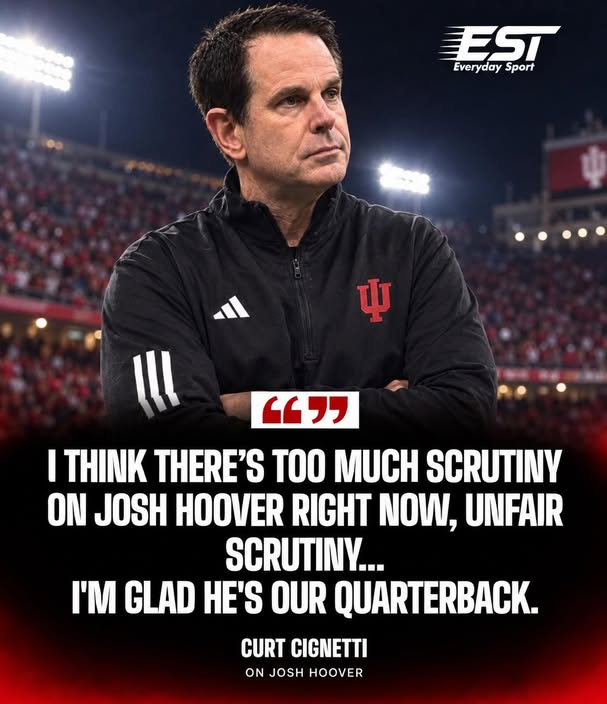
Curt Cignetti’s Most Meaningful Visit Had Nothing to Do With Football
There are moments in sports that cannot be measured by a box score, a win total or a championship banner.
For Curt Cignetti, one of those moments came far away from the noise of Memorial Stadium, away from the pressure of the Indiana Hoosiers’ schedule and the relentless demands that come with coaching at the highest level of college football.
It happened in a hospital room.
A 7-year-old girl battling a serious illness had one simple wish: She wanted to meet Cignetti, the Indiana coach she had come to admire.
She wasn’t asking for a trip to Bloomington. She wasn’t asking for a signed football or an afternoon surrounded by the pageantry of college football. Her wish was considerably smaller — and, in the circumstances, considerably more meaningful.
She wanted to meet her idol.
When Cignetti learned about the girl’s wish, he reportedly chose to make the visit himself. Rather than turning the moment into a public relations opportunity, the coach walked into her hospital room and spent time with her.
For a coach whose professional life is defined by preparation, competition and accountability, there was no game plan for this moment.
There didn’t need to be one.
According to the account of the visit, Cignetti sat beside the young girl, spoke with her, offered encouragement and provided a brief escape from the difficult reality surrounding her.
There was no stadium crowd.
No television audience.
No scoreboard.
Just a coach and a young fan who wanted to meet the person she admired.
And that distinction matters.
Cignetti has built much of his reputation on demanding standards from his players. His Indiana program has become synonymous with physical football, discipline and an insistence that preparation cannot be compromised. But the most revealing moments for a coach aren’t always found on Saturdays.
Sometimes they happen when nobody is keeping score.
Cignetti’s rise at Indiana has been one of the more remarkable coaching stories in recent college football. Hired after establishing a reputation as one of the sport’s most effective program builders, he arrived in Bloomington with a track record of turning overlooked players and programs into legitimate contenders.
His coaching philosophy has always been rooted in competitiveness and accountability. His teams play with an edge. His practices are demanding. His public comments are frequently direct.
But behind that competitive exterior is another dimension of the job — the responsibility coaches carry as figures who can mean far more to young people than their position on the sideline might suggest.
For this 7-year-old girl, Cignetti wasn’t simply a college football coach.
He was her hero.
That can be difficult to comprehend from the perspective of a Saturday afternoon. Coaches often become larger-than-life figures because of the environments surrounding them. Tens of thousands of fans chant their names. Television cameras follow their every move. Every decision can be dissected within seconds.
But for a child facing a serious illness, the meaning of meeting that person can be entirely different.
A few minutes of conversation can become a memory that lasts a lifetime.
That is what makes the story resonate beyond Indiana football.
College athletics has increasingly become defined by enormous television contracts, conference realignment, NIL negotiations, transfer-portal battles and the growing professionalization of the sport. Coaches are evaluated through recruiting rankings, efficiency metrics, win totals and postseason results.
Those measurements matter.
So do offensive success rate, defensive EPA, explosive-play rate and turnover margin. In a sport where small advantages can determine whether a team competes for a conference championship or spends December watching the postseason from home, the analytical details are essential.
But none of those numbers can measure what happened in that hospital room.
There is no statistic for encouragement.
No advanced metric for compassion.
No column in a box score for the comfort provided to a child during an extraordinarily difficult period.
For Indiana, the episode also reflects something important about the relationship between a football program and its community.
The Hoosiers’ football identity has changed dramatically in recent seasons. Indiana has moved from being routinely overlooked nationally to becoming a program capable of commanding attention well beyond Bloomington. That transformation has raised expectations for Cignetti and his staff.
With greater expectations comes greater visibility.
Every recruiting decision matters more. Every transfer-portal addition receives greater scrutiny. Every loss produces a larger reaction.
Yet the foundation of a college football program remains its connection to people.
Players aren’t merely names on depth charts. Coaches aren’t simply play-callers. Fans aren’t simply customers buying tickets.
The strongest programs understand that college football exists within communities, and those communities often give the sport its deepest meaning.
For the young girl at the center of this story, none of Indiana’s recent accomplishments mattered in that moment.
She didn’t need Cignetti to explain a defensive front or talk about offensive line technique.
She didn’t need a recruiting update.
She needed someone she admired to show up.
And he did.
That is particularly significant because a coach’s schedule rarely provides much room for anything that isn’t directly connected to football. The college football calendar has become a year-round operation. Recruiting, roster management, transfer evaluations, NIL discussions, staff meetings, practices, travel and game preparation leave coaches with remarkably little free time.
During the season, the demands become even greater.
A coach can spend an entire week preparing for a single opponent, knowing that one missed assignment or one poor decision can alter the outcome of a game.
Cignetti nevertheless made time for a child whose request had nothing to do with winning.
That choice offers a different perspective on leadership.
The best leaders understand that influence isn’t confined to the workplace. Coaches have an unusual ability to affect young people because of what they represent: discipline, perseverance, teamwork and belief.
Those lessons become especially powerful when they are demonstrated rather than preached.
For Indiana’s players, too, moments like this can reinforce the values that coaches attempt to establish inside a locker room. Football teaches players to understand that their responsibilities extend beyond themselves. They play for teammates, families, universities and communities.
Showing up for someone who needs encouragement is part of that same principle.
The timing of the story also underscores the contrast between the two worlds Cignetti occupies.
On one side is the increasingly unforgiving business of college football, where coaches are expected to recruit at an elite level, manage rapidly changing rosters and compete against programs with enormous financial resources.
On the other is a hospital room where none of those pressures matter.
The coach doesn’t have to win there.
He simply has to be present.
And sometimes presence is enough.
The visit will not appear in Indiana’s season statistics. It won’t improve the Hoosiers’ third-down conversion rate or defensive success rate. It won’t affect the College Football Playoff rankings.
But its significance may ultimately extend further than any Saturday result.
Football is often described as a game of inches. A first down can be decided by inches. A touchdown can be separated from the goal line by inches. Championships can turn on a single play.
Life works differently.
Sometimes the moments people remember most aren’t the dramatic ones.
They’re the quiet ones.
A child looking up and realizing that the person she admired had actually come to see her.
A coach sitting beside a hospital bed.
A few words of encouragement.
A brief moment in which illness, fear and uncertainty were pushed aside.
For Cignetti, it was likely only a small portion of a demanding schedule. For the girl, it could become something much bigger.
That is the part of college football that statistics cannot capture.
Coaches will be judged by wins and losses. Players will be evaluated by production. Programs will be measured by championships.
But long after the final whistle, people often remember something else.
They remember who showed up.
And on this occasion, Curt Cignetti did.