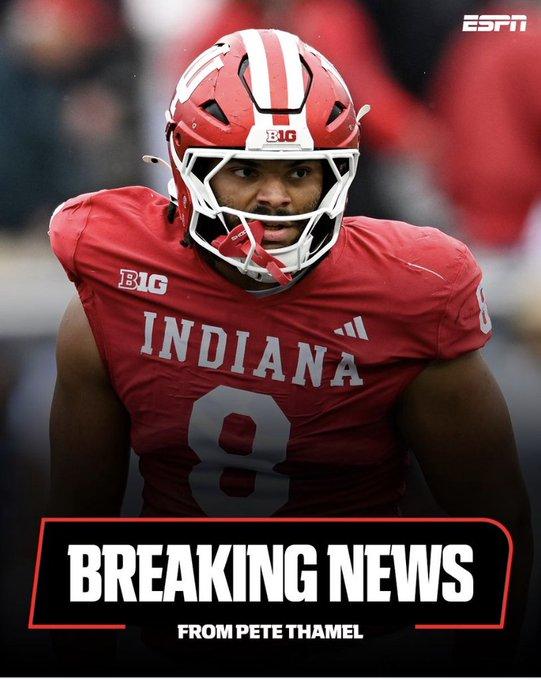
BLOOMINGTON, Ind. — Indiana’s defense received a stunning, last-minute boost from a courtroom Friday, as a Monroe Circuit Court judge issued a temporary restraining order that clears defensive standouts Stephen Daley and Kellan Wyatt to return to competition for the Hoosiers.
The ruling, issued by Judge Kara Krothe, temporarily prevents the NCAA and its conferences from enforcing eligibility restrictions against Daley, Wyatt and other plaintiffs based on their having already completed four seasons of college athletics. The decision restores the players to the competitive position they occupied at the conclusion of their most recent seasons, provided they remain academically and otherwise eligible.
“To be clear, it is the Court’s intention to place Plaintiffs in the position they were in at the end of their last college sports season,” Krothe wrote in the order. “As long as they would have been eligible, academically and otherwise, to continue playing college sports in the following semester if they had a fifth year of eligibility, they are eligible today.”
For No. 6 Indiana, the defending national champion entering the 2026 season, the immediate impact is enormous.
Daley and Wyatt were two of the Hoosiers’ most disruptive front-seven defenders during last season’s unbeaten 16-0 championship run. Their eligibility had been thrown into uncertainty after a separate federal ruling that initially opened the door for athletes from the high school Class of 2022 to receive another year of competition was later stayed by the U.S. Court of Appeals for the 10th Circuit.
That decision left Indiana suddenly facing the possibility of beginning its title defense without two players who had helped define the physical identity of one of college football’s most formidable defenses.
Friday’s ruling changed that — at least temporarily.
Daley, an All-Big Ten honorable mention selection last season, led Indiana with 19 tackles for loss and recorded 5.5 sacks in 13 games. His 19 tackles for loss represented one of the most productive defensive seasons in program history and illustrated the havoc he created as both an edge defender and interior penetrator.
For a defense built around creating negative plays and forcing offenses into uncomfortable down-and-distance situations, Daley was far more than a traditional defensive lineman. His ability to defeat blocks quickly altered protection schemes. Opposing offenses frequently had to account for him with slide protection, tight-end assistance or running back chips, creating opportunities elsewhere along Indiana’s front.
Daley’s season ended under unusual circumstances. After Indiana defeated Ohio State in the Big Ten championship game, he suffered a knee injury during the postgame celebration and missed the Hoosiers’ College Football Playoff run. Indiana ultimately completed a perfect season and won the national championship without him, but his absence underscored his importance to the team’s defensive structure.
Wyatt’s season was also interrupted by injury.
The 6-foot-2 defender started seven games before suffering a knee injury against Michigan State that sidelined him for the remainder of the year. Before his injury, however, Wyatt had established himself as one of Indiana’s most productive and versatile defenders. He finished the season with 27 tackles, eight tackles for loss and 2.5 sacks.
The raw statistics only tell part of the story.
Wyatt’s value was especially evident in Indiana’s ability to move personnel and create matchup advantages along the defensive front. His versatility allowed the Hoosiers to shift between fronts without dramatically changing personnel, an increasingly valuable asset in a Big Ten that continues to feature spread offenses, mobile quarterbacks and physical rushing attacks.
Together, Daley and Wyatt accounted for 27 tackles for loss and eight sacks last season despite both missing significant time. Their return gives Indiana not simply two experienced players, but two defenders who understand the demands of championship football.
That distinction matters as Indiana attempts to navigate one of the most difficult transitions in college football: following a national championship.
The Hoosiers enter 2026 carrying expectations that would have been almost unimaginable only a few years ago. Indiana is no longer attempting to prove it belongs among college football’s elite. After finishing 16-0 and winning the national championship, the challenge is sustaining that position.
Programs that reach the top often discover that staying there requires something different than getting there.
Opponents spend the offseason studying championship film. Coordinators build specific game plans around weaknesses that may have gone unnoticed during a breakthrough season. Every road environment becomes louder. Every opponent views the defending champion as the biggest game on its schedule.
Indiana understands that reality.
And on defense, the return of Daley and Wyatt provides Curt Cignetti and his coaching staff something every championship contender values: proven production.
Indiana can replace talent through recruiting and the transfer portal. It can develop younger players through practice and rotational snaps. What is considerably more difficult to manufacture is postseason experience combined with elite production.
Daley and Wyatt bring both.
The legal fight surrounding their eligibility, however, remains unresolved.
The temporary restraining order does not represent a final judgment on the broader NCAA eligibility dispute. A hearing regarding the plaintiffs’ request for a preliminary injunction is scheduled for Sept. 11. The next phase of the case could determine whether Daley and Wyatt remain eligible throughout the season or whether their status again becomes subject to legal uncertainty.
The case also extends beyond Indiana football.
The plaintiffs include athletes from multiple sports, highlighting the growing legal challenges surrounding the NCAA’s eligibility system. At the center of the broader dispute is the treatment of athletes from the high school Class of 2022.
Those athletes entered college under one eligibility structure and later found themselves excluded from a new framework that expanded opportunities for subsequent classes. A Colorado court ruling initially provided a path toward additional eligibility before the 10th Circuit stayed that decision, once again creating uncertainty for players such as Daley and Wyatt.
The situation has become another example of the increasingly complicated landscape facing the NCAA.
For decades, eligibility rules were largely viewed as matters handled internally through athletic departments, conferences and the NCAA. That framework has changed dramatically. Courts now regularly influence issues involving transfers, compensation, amateurism and eligibility.
The result is a college sports system in which rosters can change not only through recruiting, injuries and the transfer portal, but also through courtroom decisions.
For coaches, that uncertainty presents a unique challenge.
A player who is unavailable one week can become eligible days later. Depth charts must be constructed with contingency plans. Scholarship management becomes more complicated. Coordinators may spend an entire offseason preparing to replace a player only to suddenly have that player restored to the roster before kickoff.
That is precisely the situation Indiana faced with Daley and Wyatt.
Their return could significantly alter the Hoosiers’ defensive rotation immediately.
Without Daley, Indiana would have needed to replace one of its premier backfield disruptors. Without Wyatt, the coaching staff would have lost another experienced defender capable of contributing against both the run and the pass.
With both back, Indiana’s front becomes deeper and more flexible.
That could be particularly significant over the course of a long season.
Championship-caliber defenses rarely rely exclusively on their starting 11. They need rotational depth to maintain pass-rush effectiveness in the fourth quarter. They need fresh bodies against tempo offenses. They need situational specialists for third-and-long and short-yardage packages.
Daley’s return gives Indiana a proven weapon on passing downs. His production in the backfield demonstrates the type of disruption that can transform a third-and-6 into a third-and-12. Wyatt provides another versatile option capable of playing multiple roles within the front.
For Indiana’s secondary, the impact could be equally important.
Pass coverage and pass rush remain connected. The faster a defense can pressure the quarterback, the less time defensive backs must remain in coverage. Daley and Wyatt can help compress the pocket, force quicker decisions and create turnover opportunities.
That formula was central to Indiana’s championship success.
The Hoosiers were among the nation’s most opportunistic defensive teams last season, combining disciplined coverage with an aggressive front that consistently created negative plays. Restoring two experienced disruptors strengthens the possibility that Indiana can maintain that identity despite the inevitable roster turnover that follows a championship season.
There is also an NFL dimension to the story.
Neither Daley nor Wyatt signed NFL contracts, largely because injuries affected their situations following the 2025 season. Their additional college season now presents an opportunity that could significantly influence their professional evaluations if the court ultimately allows them to remain eligible.
For Daley, another healthy season could provide NFL scouts with additional film demonstrating whether his 2025 production can be sustained. His combination of tackles for loss and sack production already illustrates an ability to penetrate and finish plays behind the line of scrimmage.
For Wyatt, the season could offer an opportunity to demonstrate durability and regain momentum after his injury-shortened campaign.
NFL teams routinely evaluate prospects through the lens of production, athletic traits, medical information and positional projection. Another full season could reshape either player’s draft profile. A strong campaign against Big Ten competition would provide additional evidence for scouts studying their ability to translate to the professional game.
Unlike the NFL, however, there are no salary-cap implications attached to Indiana’s decision to welcome them back.
The value is competitive rather than financial.
In the modern college football landscape, roster construction has become increasingly influenced by NIL resources, revenue-sharing structures and transfer portal movement. Indiana’s situation with Daley and Wyatt is different. The program did not acquire two veterans through a late transfer window or free-agent-style pursuit.
Instead, it regained two players through a legal ruling.
That makes Friday’s development one of the most unusual roster moves of the college football season.
It also comes at an ideal time for the Hoosiers.
Indiana opens its season against North Texas with a championship target already on its back. The Hoosiers will face every opponent with the knowledge that their 2025 accomplishments have fundamentally changed expectations surrounding the program.
The question is no longer whether Indiana can beat elite competition.
It has already done that.
The question now is whether the Hoosiers can build a program capable of sustaining championship expectations, surviving roster turnover and responding to the pressure that accompanies national success.
The return of Daley and Wyatt does not answer every question.
Indiana still must replace departed stars. It must navigate another demanding Big Ten schedule. It must maintain the hunger that fueled its rise. And, most immediately, it must monitor a legal situation that remains unresolved.
But Friday’s court ruling gives the Hoosiers something every defending champion wants entering a new season: more options.
More experience.
More depth.
And two defensive players who have already proven they can make championship-level plays.
For Daley and Wyatt, the ruling represents another opportunity.
For Indiana, it could be a season-changing development.
And for college football, it is another reminder that in the modern era, the path to the playoff can run through recruiting offices, transfer portals, conference headquarters — and increasingly, the courtroom.