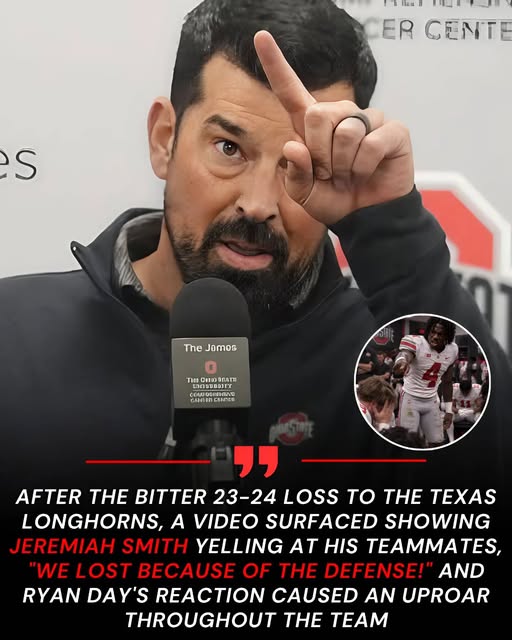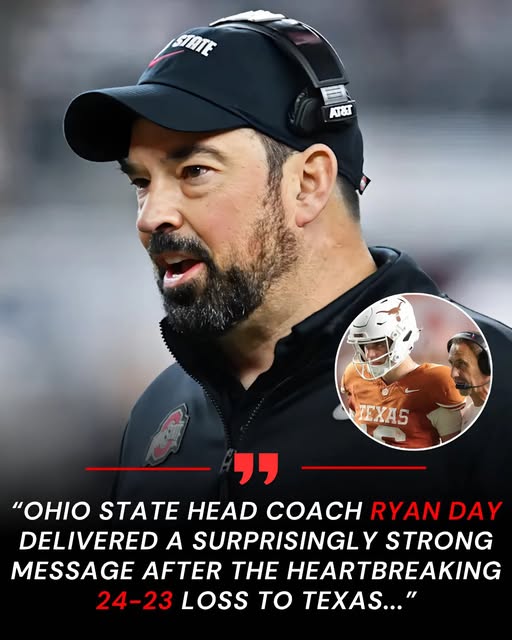
Ryan Day did not need to raise his voice to make the message clear.
Following Ohio State’s heartbreaking 24-23 loss to Texas, the Buckeyes’ head coach delivered a pointed response that reflected both the frustration of falling one possession short and the expectations surrounding a program that enters every season believing it can compete for championships.
For Ohio State, the defeat was more than another loss on the schedule. It was the kind of game that can linger because the Buckeyes were within striking distance of one of the nation’s premier programs before Texas made enough plays to escape with a one-point victory.
And in the aftermath, Day made it clear that Ohio State could not afford to treat the result as simply another entry in the win-loss column.
The margin between winning and losing at the highest level of college football is often razor thin. Against Texas, that margin was essentially one point.
That reality is what makes Day’s response so significant.
Ohio State entered the matchup carrying enormous expectations, as it has throughout Day’s tenure. The Buckeyes are expected to contend for the Big Ten championship, qualify for the College Football Playoff and ultimately challenge for the national title.
A narrow loss does not erase those ambitions.
But it does expose areas that need to be corrected.
The 24-23 final score illustrated just how competitive the matchup was. Ohio State had opportunities, Texas had opportunities and neither team was able to completely separate itself. Ultimately, the Longhorns made enough winning plays to leave with the result.
For Day, the challenge now is turning the disappointment into something useful.
That process begins with accountability.
Coaches can point to individual plays, missed opportunities, execution problems or situational football after a close loss. But championship teams cannot spend an entire season looking backward. The response has to happen on the practice field and, eventually, on Saturday afternoons.
That is particularly true for Ohio State.
The Buckeyes do not have the luxury of allowing one difficult result to define their season. Their schedule provides little room for complacency, and the expectations inside the program remain championship-level.
Day’s message following the loss therefore carried a larger meaning.
The standard does not change because the opponent was Texas.
It does not change because the game was decided by a single point.
And it certainly does not change because Ohio State played well enough in stretches to believe it could have won.
That standard is one of the defining characteristics of the program.
Ohio State has built its identity around depth, elite recruiting, physical play and the expectation that its roster should be capable of competing with the best teams in the country. Losing a close game to a national contender can be frustrating, but the bigger concern is whether the Buckeyes learn from the moments that decided it.
The Texas game offered plenty of those moments.
In a one-point contest, every possession matters. A missed opportunity early can become significant late. A defensive stop that does not come can change the complexion of an entire game. A third-down conversion, a red-zone possession or a single explosive play can ultimately determine the outcome.
That is the brutal arithmetic of elite college football.
There is no guarantee that playing well for most of a game will be enough.
Ohio State learned that lesson against Texas.
Now Day and his coaching staff must make sure the players learn it, too.
The emotional challenge may be just as important as the tactical one. Players who put months of preparation into a marquee matchup naturally feel the sting of a loss like this. The temptation is to focus on what went wrong rather than what can be improved.
Day’s responsibility is to redirect that emotion.
The message is not that the Buckeyes should forget the defeat. It is that they should use it.
There is a difference.
Forgetfulness produces repetition. Accountability produces adjustment.
For Ohio State, the latter is the only acceptable path.
The Buckeyes have too much talent and too much at stake to allow a close loss to become a turning point in the wrong direction. If anything, the defeat should sharpen the team’s focus.
That starts with the players who carry the most responsibility.
Ohio State’s veterans will be expected to set the tone in the locker room. Leadership becomes particularly important after adversity because it reveals which teams can maintain their identity when circumstances turn against them.
Young players will also have to learn from the experience.
A game against Texas provides a different kind of pressure than a routine regular-season matchup. The environment, expectations and quality of the opponent create a test that cannot be replicated during practice.
For some players, the Texas game may ultimately become one of the most valuable experiences of the season.
But only if they respond.
That is where Day’s message matters most.
The Buckeyes cannot control the final score anymore. They cannot replay the decisive moments or manufacture a different outcome. What they can control is how they prepare for the next opponent.
That is the mentality Day will need from his team.
Ohio State’s season will not be defined solely by what happened against Texas. The schedule ahead provides opportunities to build another résumé, compete for conference championships and position the program for another postseason run.
However, the loss does raise questions that Ohio State must answer.
Can the offense become more consistent in critical situations?
Can the defense deliver when one stop is needed?
Can the team execute under pressure against another elite opponent?
And perhaps most importantly, can Ohio State develop the mental toughness required to turn a painful loss into fuel?
Those questions cannot be answered in a press conference.
They will be answered through preparation and performance.
Day understands that better than anyone.
The head coach has spent years navigating the pressure that comes with leading Ohio State. Every close game is scrutinized. Every recruiting class is evaluated. Every decision is examined through the lens of national championship expectations.
That reality makes the response to Texas particularly important.
A 24-23 loss can either become a scar or a lesson.
Ohio State’s next few weeks will reveal which one it becomes.
There is no reason for the Buckeyes to panic. A one-point defeat against a high-level opponent does not automatically eliminate a team from championship contention. But there is also no reason to dismiss it.
The best programs treat narrow losses as opportunities for honest evaluation.
That appears to be the direction Day is pushing his team.
The message is straightforward: the standard remains intact.
Ohio State expects to win.
It expects to compete for championships.
And when the Buckeyes fall short, especially by the smallest possible margin, the answer cannot simply be disappointment.
It has to be improvement.
That is what makes the aftermath of the Texas game potentially more important than the final score itself.
The loss is now part of Ohio State’s record.
The response will become part of its identity.
For Day, the objective is no longer to explain why the Buckeyes lost 24-23.
It is to make sure the next time Ohio State finds itself in a game decided by one possession, it is the team celebrating when the clock reaches zero.