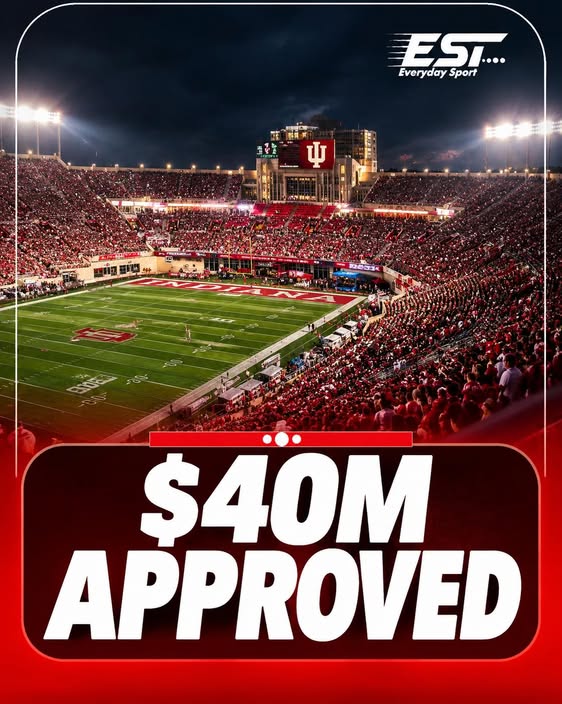
Bloomington, Ind. — Indiana University is moving forward with a $40 million renovation of Memorial Stadium’s west bowl, a project that will address decades-old infrastructure, expand restroom capacity and modernize concessions as the Hoosiers enter a new era of national prominence.
The Indiana University Board of Trustees Executive Committee unanimously approved the renovation plan Sept. 10, clearing a significant administrative hurdle for work that university officials hope to complete by fall 2027. The project is aimed less at creating another flashy premium seating development than at rebuilding some of the basic infrastructure that supports tens of thousands of fans on football Saturdays.
The west bowl dates to 1962 and, according to IU Vice President for Capital Planning and Facilities John D’Angelo, has not undergone a major renovation since it was constructed. The plan calls for 225 new restrooms in the west bowl while renovating the existing 166, bringing those facilities into compliance with the Americans with Disabilities Act. IU says the work will increase restroom capacity by 136%.
The project also includes expanded concession space and additional points of sale, changes designed to improve traffic flow and reduce bottlenecks during games. D’Angelo described the investment as an effort to address critical infrastructure needs, bring plumbing up to current code and correct longstanding accessibility deficiencies.
The timing is significant for an Indiana program that has undergone a remarkable transformation on the field.
Just months removed from the most successful football season in school history, the Hoosiers are entering 2026 with a national championship banner, heightened expectations and a rapidly changing game-day environment. Curt Cignetti’s team went 16-0 last season, won the Big Ten championship and defeated Miami 27-21 in the College Football Playoff National Championship Game on Jan. 19. It was the first football national championship in program history.
Cignetti’s first two seasons have fundamentally altered the profile of Indiana football. The Hoosiers went 11-2 in his first season and followed it with the perfect championship campaign, giving Indiana 27 victories across his first two seasons in Bloomington — the most by an FBS coach through his first two seasons at a school, according to IU Athletics.
That success has changed what Memorial Stadium represents.
For much of its history, Indiana’s football infrastructure operated in the shadow of the Big Ten’s traditional powers. The stadium opened in 1960 and has been the home of Hoosier football ever since. Its current configuration includes the west stands, east stands and the north end zone complex, which houses football offices, meeting rooms, athletic administration and player-development facilities. IU lists the stadium’s current capacity at 53,524.
The west bowl is particularly important because it contains one of the largest concentrations of seating in the stadium. IU’s historical stadium breakdown lists 28,327 seats in the west stands alone. That makes the condition and efficiency of those facilities directly relevant to the experience of a substantial portion of the crowd.
And the demand surrounding those seats has changed.
Indiana entered the 2026 season with a level of attention that would have been difficult to project before Cignetti’s arrival. In 2024, home games began attracting larger crowds and heightened national interest. The program’s 2024 Homecoming game against Nebraska was sold out at the time, with additional games against Michigan and other opponents approaching or reaching sellout status.
The championship season accelerated that momentum.
Indiana’s 16-0 run included a perfect regular season, a Big Ten championship and College Football Playoff victories before the Miami finale. The Hoosiers’ postseason success also produced a wave of national awards for the program, including recognition for Cignetti and former quarterback Fernando Mendoza.
The renovation therefore arrives at a point when Indiana is attempting to make its football operation sustainable rather than simply celebrate a breakthrough.
That distinction matters.
In the current college football economy, facilities have become part of the infrastructure of roster construction, recruiting and revenue generation. Programs competing for elite prospects increasingly sell an entire ecosystem — training resources, player development, academic support, sports science, nutrition, recovery, fan environment and institutional commitment.
The $40 million west-bowl project does not directly change Indiana’s salary structure or its ability to compensate athletes under the modern revenue-sharing model. It also is not a football roster expenditure in the traditional sense. But it represents another category of investment that can influence the broader economics of a major college football program.
Indiana already has been making changes to the fan experience.
Ahead of the 2026 season, IU Athletics announced additional food and beverage options, 42 new points of sale throughout the stadium, new concession locations and other game-day enhancements. Two new grab-and-go locations and an ice cream vendor were added to the upper west stands, while additional food offerings were introduced on the west side.
The permanent west-bowl renovation goes considerably deeper than those seasonal improvements.
The focus on restrooms, plumbing, accessibility and concessions is essentially an investment in throughput. A stadium can have modern video boards and premium suites, but if thousands of fans are fighting for limited restroom capacity or waiting too long for food, the game-day experience still breaks down.
For Indiana, that problem becomes more consequential as the program attempts to maintain the attendance and atmosphere generated by its championship breakthrough.
There is also a broader institutional context.
In August, the Board of Trustees approved $50 million in financing for Memorial Stadium renovations and authorized a $150 million capital project request to the state for additional stadium improvements. University officials characterized the immediate spending as necessary to address deferred maintenance while indicating that larger investments could follow.
The newly approved $40 million west-bowl project fits into that larger effort.
According to the Indiana Daily Student, the approval allows the university to submit the project for state approval before the board’s scheduled October meeting, preserving IU’s target of completing the renovations by fall 2027.
For the football program, the construction timeline creates an interesting intersection with Cignetti’s competitive window.
Indiana is attempting to establish itself as a permanent factor in the Big Ten rather than a one-season surprise. The conference now includes some of the sport’s most powerful programs, and the Hoosiers’ championship has raised the standard inside Bloomington. Maintaining that level requires resources that extend beyond the depth chart.
Cignetti’s teams have already demonstrated that Indiana can win at the highest level. The next challenge is making that success repeatable.
A modernized stadium does not guarantee victories, recruiting wins or another playoff appearance. It cannot create an offensive line, develop a quarterback or manufacture defensive pressure. Those outcomes remain dependent on coaching, personnel development, roster management and execution.
But facilities can support the larger operation.
For fans, the changes should be more immediately tangible. More restrooms, improved accessibility and expanded concessions address the basic mechanics of attending a game. For the university, they also help preserve one of its most visible public venues.
Memorial Stadium is more than a football facility. It hosts major university events and traditions, including commencement, making its long-term condition relevant well beyond the fall schedule. Trustee Steve Henke said the investment was intended to preserve the stadium as an important university asset for decades to come.
The significance of the project is therefore not measured solely by the $40 million price tag.
Indiana is effectively upgrading the physical infrastructure around a football program that has already undergone a much more dramatic transformation on the field.
Two years ago, the Hoosiers were trying to prove they belonged in the Big Ten’s upper tier. Now they are defending a national championship while preparing a stadium built in another era for the demands of a modern college football audience.
The west bowl will not determine whether Indiana repeats as Big Ten champion or returns to the College Football Playoff. But by 2027, the goal is for the stadium around the team to look increasingly consistent with the program that now occupies it.
The renovation is scheduled to bring the west bowl’s basic infrastructure into the present.
Indiana’s football program, meanwhile, is trying to remain in the future.