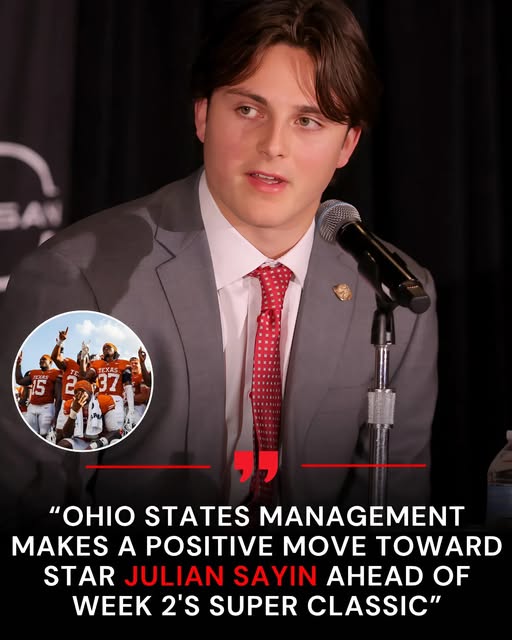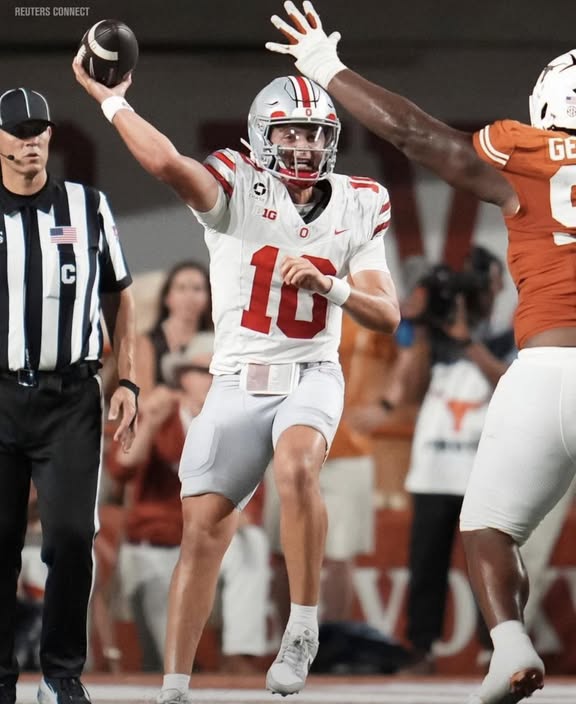
Julian Sayin did not try to hide from the moment.
After Ohio State watched a 20-point fourth-quarter lead disappear in Austin, the Buckeyes’ second-year starting quarterback put the responsibility on himself, specifically acknowledging the missed opportunity that could have changed the direction of a game that ultimately ended with No. 4 Texas stunning No. 1 Ohio State 24-23.
“I want that one back for sure.”
The play Sayin was referring to was an open touchdown opportunity to Devin McCuin early in the third quarter. Ohio State had just moved the ball into Texas territory, and moments earlier Sayin had connected with Jeremiah Smith for 43 yards to put the Buckeyes at the Texas 30-yard line. With Ohio State still holding a 20-point advantage, the opportunity was there to deliver what could have been a decisive blow.
Instead, Sayin’s throw to McCuin fell incomplete.
Two plays later, Ohio State settled for a field goal and extended its advantage to 23-3. The Buckeyes would not score again.
Texas, meanwhile, eventually found the cracks.
The Longhorns scored 21 unanswered points in the fourth quarter, completing the largest fourth-quarter comeback against an AP No. 1 team in college football history. Hollywood Smothers’ 1-yard touchdown run with 25 seconds remaining capped the rally, and Texas converted the ensuing extra point to take its first lead of the night.
Ohio State never recovered.
For Sayin, the loss represented a complicated night. His final numbers — 17 completions on 32 attempts for 278 yards, one touchdown and one interception — were productive in the aggregate, but they masked a dramatic split between the first and second halves. He completed only five of 16 passes after halftime for 86 yards, with no touchdowns and an interception on the final play.
That distinction matters because Ohio State was not simply beaten from the opening whistle.
For three quarters, the Buckeyes controlled the game.
They entered halftime with a 20-3 advantage and extended that lead to 23-3 with 8:14 remaining in the third quarter. Sayin was particularly effective during the opening half, distributing the football while repeatedly creating opportunities for Ohio State’s explosive receiving corps.
Smith was the centerpiece.
The junior wide receiver finished with eight catches for 164 yards and a touchdown, including the 43-yard reception that moved Ohio State deep into Texas territory immediately before Sayin’s missed opportunity to McCuin.
But Texas eventually adjusted, and Ohio State’s offense stopped sustaining drives.
The missed throw to McCuin became one of the game’s most significant “what if” moments because of what happened afterward. Ohio State’s next possession lasted only three plays and gained one yard. The Buckeyes punted, and Texas responded with a 15-play, 91-yard touchdown drive that consumed 6:28.
The sequence flipped the game’s momentum.
Ohio State’s defense had spent most of the evening controlling Arch Manning and the Texas offense. Manning threw for 195 yards, one touchdown and one interception, while Texas managed only 195 passing yards. But the Longhorns repeatedly extended possessions late, converting nine of 16 third downs and two of three fourth downs. Texas also finished with 141 rushing yards.
The Buckeyes, by contrast, converted only six of 14 third downs and failed on their lone fourth-down attempt.
Those numbers illustrate why placing the entire defeat on Sayin would be misleading.
The quarterback’s missed touchdown was real. So was the late interception. But Ohio State’s collapse involved every phase of the team.
Special teams became part of the equation when Connor Hawkins missed a 45-yard field goal with roughly four minutes remaining. The defense surrendered three consecutive fourth-quarter touchdowns after allowing only three points through the first three quarters. And the offense managed only three points after halftime despite entering the fourth quarter with a 23-3 cushion.
Still, quarterback play carries disproportionate weight in games of this magnitude, particularly when a team has a chance to turn a three-score advantage into an insurmountable margin.
Sayin’s missed throw was therefore impossible to ignore.
According to the official play-by-play, the incompletion to McCuin came on second-and-10 from the Texas 30 with 8:25 remaining in the third quarter. Sayin followed it with another incompletion, this one intended for Smith on third down. Ohio State kicked a 48-yard field goal on the ensuing fourth down.
From a quarterback-evaluation standpoint, the sequence illustrates the difference between accumulating statistics and executing high-leverage throws.
Sayin finished with 278 passing yards, but Ohio State’s passing attack became increasingly concentrated on Smith. Smith received 15 of Sayin’s 31 targets, according to postgame analysis, while McCuin received only three targets.
That concentration is understandable when an offense has a receiver capable of producing eight catches for 164 yards against one of the country’s best teams. But it also allowed Texas to anticipate where the football was going as the game progressed.
McCuin’s presence was supposed to help prevent precisely that problem.
The former UTSA receiver arrived at Ohio State with established production and immediately demonstrated his potential in the season opener. Against Ball State, McCuin caught six passes for 97 yards and a touchdown. Through two games, he has seven receptions for 102 yards and one touchdown.
His Texas performance, however, was largely quiet: one reception for five yards on three targets.
That does not make the loss his fault. In fact, the missed third-quarter opportunity demonstrates the opposite. McCuin was open; Sayin simply failed to connect.
For a young quarterback, acknowledging that distinction publicly matters.
Sayin’s response places the focus on execution rather than excuses. The quarterback also has to understand that Ohio State cannot afford to leave points on the field against elite opponents and expect to survive every late-game swing.
That lesson becomes particularly important because the Texas game was not merely a nonconference loss. It was a direct collision between two teams with legitimate national championship ambitions.
Ohio State entered Austin ranked No. 1 nationally. Texas entered ranked No. 4. The result immediately reshaped the national picture, with Texas moving to 2-0 while Ohio State dropped to 1-1.
The loss does not eliminate Ohio State from the College Football Playoff conversation. The Buckeyes still have a full Big Ten schedule ahead, and the expanded playoff format provides more room for elite teams to recover from a single defeat.
But the margin for error has changed.
More importantly, Ohio State now has to prove that the Texas collapse was an isolated failure rather than evidence of a deeper problem in late-game execution.
That starts with Sayin.
The quarterback will have another opportunity to respond when Ohio State returns home to face Kent State on Sept. 19. The matchup will not provide the same level of resistance as Texas, but it will give coach Ryan Day and the offensive staff a chance to evaluate how Sayin responds after his first major setback of the season.
The most revealing part may not be his statistics.
It will be whether he plays with the same decisiveness that helped Ohio State build its 20-point advantage in Austin — while eliminating the hesitation and missed opportunities that allowed Texas back into the game.
Sayin has already accepted responsibility for one of those moments.
The next step is turning that accountability into execution.
Because against teams capable of competing for championships, an open receiver in the red zone or deep in opposing territory is more than another play.
It can be the difference between controlling the game and watching it disappear.
Ohio State learned that lesson the hard way in Austin.