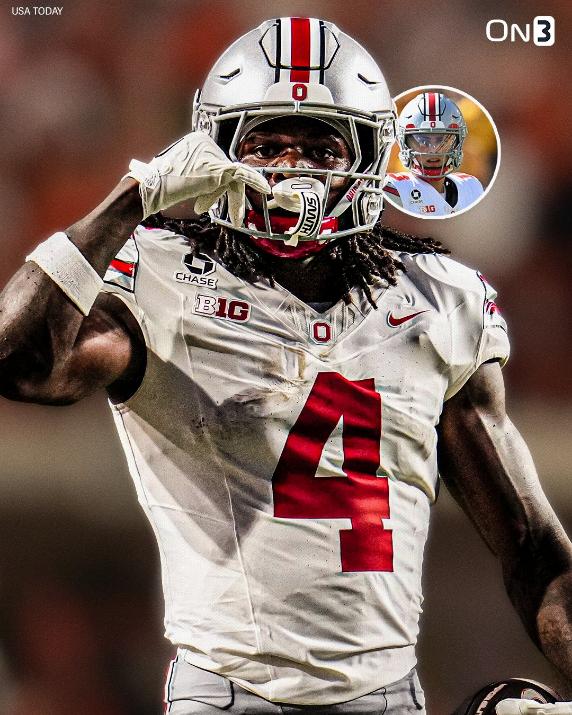
Ohio State coach Ryan Day has delivered a simple but significant message to quarterback Julian Sayin: Jeremiah Smith may be one of the most dangerous players on the field, but that does not mean the ball should be forced his way on every passing opportunity.
Day’s point was less about limiting Smith’s role than emphasizing the importance of quarterback discipline within an offense loaded with playmakers.
“If he’s single-covered, he’s open. If he’s double-covered, he’s sort of open. If he’s triple-covered, he’s covered,” Day said, explaining the standard Sayin should apply when deciding whether to target Ohio State’s star wide receiver. “Somebody’s gotta be open somewhere else.”
It is the kind of message that can define a quarterback’s development. For Sayin, the challenge is not simply finding Smith. It is recognizing what the defense is giving him before the snap, understanding how coverage changes after the play begins and having enough confidence to move to the next option when opponents devote multiple defenders to Ohio State’s premier receiving threat.
Smith has become the kind of player who changes defensive game plans before the ball is even snapped. His presence can dictate coverage, safety alignment and personnel decisions, creating opportunities for teammates even when he never touches the football.
That reality is at the center of Day’s message to Sayin.
The temptation is obvious. When a quarterback has a receiver capable of turning a routine completion into a touchdown, there is an understandable desire to give that player as many chances as possible. Smith’s combination of size, speed, ball skills and ability to create separation makes him one of the most difficult matchups in college football.
But there is a difference between trusting a star receiver and ignoring defensive structure.
Day wants Sayin to understand that distinction.
If Smith is isolated against one defender, Ohio State expects its quarterback to recognize the favorable matchup and take advantage of it. If the defense sends a second defender into the equation, the matchup becomes more complicated, but Smith can still remain a viable option because of his ability to win contested situations.
Once a defense commits three defenders to Smith, however, the equation changes dramatically.
At that point, the Buckeyes should be looking elsewhere.
That does not necessarily mean Smith is removed from the play. His presence can be the reason another receiver becomes wide open. A defense that commits significant resources to stopping one player inevitably creates opportunities elsewhere, and Day wants Sayin to be comfortable exploiting those openings.
For a young quarterback, that can be easier said than done.
Quarterbacks often develop strong chemistry with their top receivers, particularly when that receiver has repeatedly demonstrated an ability to make difficult plays. But high-level quarterback play requires more than trust. It requires anticipation, progression reads and the willingness to make the correct decision even when the most talented player on the offense is demanding defensive attention.
Sayin’s development will therefore be closely connected to how effectively he balances aggression with patience.
Ohio State does not need its quarterback to avoid Smith. It needs him to understand when Smith is the best answer and when Smith’s presence has created a better answer somewhere else.
That distinction could become one of the defining characteristics of the Buckeyes’ offense.
Smith’s reputation makes defensive attention inevitable. Opposing coordinators know the consequences of allowing him to operate one-on-one. Leaving him isolated can produce explosive plays, while giving him too much space can allow Ohio State to dictate the matchup.
The natural response is to provide help.
That is where Ohio State’s offensive depth becomes important.
When defenses tilt coverage toward Smith, the Buckeyes have opportunities to attack the vacated areas of the field. A safety who shades toward Smith may leave space in the middle. A cornerback playing with outside leverage can create an inside throwing window. A defense that brings an extra defender toward Smith can potentially expose another receiver, the tight end or the running game.
For Sayin, the objective is to identify those reactions and punish them.
That is a major part of what makes Day’s message more than a comment about one receiver. It reflects the broader philosophy Ohio State wants from its quarterback.
The best offenses are not necessarily the ones that feature one superstar on every possession. They are the offenses that force defenses to account for everyone.
If opponents believe Ohio State will force the ball to Smith regardless of coverage, they can build their game plan around stopping him. If Sayin demonstrates that he will immediately attack the open player when defenses overcommit to Smith, the Buckeyes become far more difficult to defend.
That puts pressure on opposing coordinators to make difficult choices.
Cover Smith with one defender and risk giving up an explosive play.
Double him and potentially open another part of the field.
Triple him and effectively concede that another Ohio State playmaker may have an advantageous matchup.
That is the chess match Day wants Sayin to understand.
The quarterback’s job is not to determine who should receive the ball before the snap. His job is to process the defense and distribute the football based on what happens after the play begins.
That is particularly important for Sayin as he continues to establish himself as Ohio State’s quarterback.
The expectations surrounding the position are enormous. Ohio State enters every season with championship aspirations, and the quarterback is expected to operate an offense featuring elite talent at virtually every position.
Sayin does not have to carry that burden by himself.
In fact, Day’s comments suggest the opposite.
The Buckeyes want Sayin to trust the entire offense.
Smith may be the most recognizable piece of the passing game, but he is also a tool that can be used to manipulate defenses. His value extends beyond receptions and statistics. Simply lining up Smith on one side of the formation can alter how the defense distributes its personnel.
That creates opportunities for everyone else.
And if Sayin can consistently recognize those opportunities, Ohio State’s offense becomes considerably more unpredictable.
There will still be moments when the quarterback has to take a chance. Elite receivers are often asked to win difficult matchups, and Smith’s ability to make contested catches means Ohio State will not hesitate to give him opportunities when the situation warrants it.
But Day’s message establishes a clear boundary.
Single coverage is an invitation.
Double coverage is a decision.
Triple coverage is a warning.
The smartest response is often to look elsewhere.
For Sayin, learning that distinction could be just as important as developing his arm strength, footwork or chemistry with his receivers. Quarterback development is ultimately about processing information quickly and making sound decisions under pressure.
Ohio State has enough offensive talent to punish defenses that become too focused on one player.
Now, Sayin has to prove he can identify those opportunities.
The message from Day is straightforward: Jeremiah Smith does not need to be force-fed the football to remain the centerpiece of Ohio State’s offense.
Sometimes the best way to get Smith involved is to let the defense worry about him.
And when three defenders follow him, the quarterback should already know what comes next.
Find the open man.