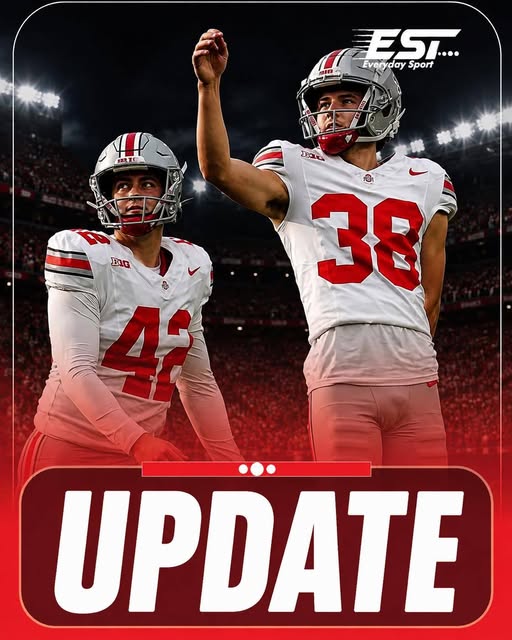
Former Ohio State Kicker Jayden Fielding Sues NCAA, Seeks Fifth Season of Eligibility
Former Ohio State kicker Jayden Fielding has taken his fight for another season of college football to court, suing the NCAA in Illinois and seeking the right to transfer and compete for a fifth season, his attorney told CBS Sports.
The lawsuit adds another high-profile football player to a rapidly expanding legal battle over the NCAA’s evolving eligibility rules, one that has already created uncertainty across college athletics as players challenge restrictions that could otherwise end their careers.
Fielding, who graduated from Ohio State in December with a degree in sport industry, is seeking an opportunity to continue playing despite having exhausted his traditional eligibility. He enters the legal fight with a résumé that includes four seasons at one of the country’s highest-profile programs and a productive final campaign in 2025.
The Texas native converted 16 of 20 field-goal attempts last season, an 80% success rate, while remaining a dependable option in Ohio State’s kicking operation. He also maintained an extraordinary run on extra points, converting 156 consecutive attempts before his streak ended with a miss against Purdue in 2023.
Fielding was recognized as an honorable mention All-Big Ten selection by conference coaches following the 2025 season. The honor was part of a deep Ohio State postseason haul, although he did not make one of the conference’s three primary special-teams teams.
Now, however, the question surrounding Fielding is no longer simply whether he can make a 45-yard field goal under pressure. It is whether he will be allowed to take another kick at the college level at all.
The timing of the lawsuit is significant.
The NCAA approved a sweeping overhaul of Division I eligibility rules in June, moving toward an age-based system that generally permits athletes to have up to five years of eligibility if they enroll in college no later than the academic year after turning 19. The new system eliminates the traditional distinction between seasons of competition and redshirt seasons and is designed to create a more uniform eligibility framework.
But the transition provisions have created the very dispute Fielding is now attempting to exploit.
Under the NCAA’s transition rules, athletes who used their final season of competition during the 2025-26 academic year do not receive another season. Current athletes who still had eligibility remaining after 2025-26 can benefit from whichever system is more favorable, but athletes who had already exhausted their previous eligibility are generally outside the new framework.
That distinction has triggered a wave of litigation.
In July, 11 college athletes filed a federal lawsuit challenging the NCAA’s implementation of the new eligibility system, arguing that athletes who exhausted their eligibility during the 2025-26 academic year were unfairly excluded from the new five-year model. The plaintiffs argued that the restriction affects not only their ability to compete but also their access to scholarships, NIL opportunities and professional development.
Other court decisions have further complicated the landscape. A federal judge in Colorado granted a temporary restraining order involving athletes seeking another season, while separate legal actions have produced additional uncertainty over who can enter the transfer portal and compete during the 2026 season.
Fielding’s case therefore arrives at a moment when eligibility has become one of the most consequential competitive issues in college football.
For Ohio State, the immediate football implications are limited because Fielding is no longer on the Buckeyes’ roster. But his potential return to college football could affect the broader transfer market, particularly at a position where experience, consistency and pressure performance carry enormous value.
Kickers operate differently from most positions. A quarterback or wide receiver can accumulate significant value through volume statistics, while a kicker’s worth is often concentrated into a handful of high-leverage snaps. Fielding’s 2025 numbers illustrate that dynamic. He converted 80% of his field-goal attempts, including seven of eight from 30 to 39 yards and three of four from 40 to 49 yards. He also made six of seven attempts from 20 to 29 yards.
His lone miss from beyond 50 yards came on his only attempt from that range.
Those numbers do not make Fielding an automatic NFL prospect, but they demonstrate why another college season could be valuable. A fifth year would give him additional game tape, another opportunity to improve his consistency from distance and another chance to perform in pressure situations.
It also could provide a financial opportunity in the new era of college athletics.
Unlike NFL players, college athletes do not operate under an NFL salary-cap structure, and Fielding does not have an NFL contract or an NFL salary-cap figure attached to this dispute. Instead, the economic stakes center on scholarships, NIL agreements and, increasingly, direct institutional compensation available under the changing college sports model. Courts examining eligibility cases have specifically recognized the financial consequences of being denied another season.
For a veteran kicker, that distinction matters. A fifth college season could serve simultaneously as another year of development and another opportunity to increase his professional marketability.
Fielding’s career at Ohio State also gives him a stronger résumé than many players seeking eligibility relief.
He arrived in Columbus as a walk-on in 2022 after being rated the No. 7 kicker in his recruiting class by Chris Sailer Kicking. At IMG Academy, he made all of his field-goal attempts as a high school senior, with a long of 50 yards.
His Ohio State career included several significant moments.
In 2023, Fielding made 16 of 20 field-goal attempts and delivered a 31-yard field goal in the first half of Ohio State’s 17-14 victory over Notre Dame in South Bend. In 2024, he connected on 13 of 17 attempts, including a 33-yarder late in Ohio State’s national championship victory over Notre Dame.
Across his career, Fielding finished 45 of 57 on field-goal attempts, according to Ohio State’s official records.
That history could become important if the court grants him relief. A kicker with four years of Power Four experience is not entering the transfer market as an unknown commodity. He has performed in hostile environments, championship games and rivalry contests, and he has already demonstrated that he can handle the pressure that accompanies Ohio State’s special teams.
The legal question, however, is larger than Fielding.
The NCAA’s decision to replace its traditional eligibility system with an age-based model was intended to simplify the rules. Instead, the transition has exposed a fault line between athletes who exhausted their eligibility under the old system and those who remain eligible under the new one.
That tension has become particularly pronounced as college football enters an era in which roster construction can change almost overnight.
Coaches build teams months in advance. They allocate scholarship resources, evaluate transfer options and develop contingency plans at every position. Court orders and eligibility lawsuits can disrupt those plans after rosters have already been constructed.
The result is a difficult balance between competitive stability and athletes’ arguments that they should not lose opportunities because they happened to graduate or exhaust eligibility immediately before a new rule took effect.
Fielding’s case could become another test of that balance.
For Ohio State, the Buckeyes have already moved forward without him. For Fielding, though, the next chapter remains unwritten.
If he prevails, the former Buckeye could re-enter the transfer market as an experienced kicker with Power Four credentials and a proven record in pressure situations. If he loses, his college career will effectively remain where it ended — after the 2025 season, with four years of competition and an honorable mention All-Big Ten distinction.
Either way, the lawsuit underscores a reality that has become increasingly difficult for college football to ignore: eligibility is no longer merely an NCAA administrative issue. It is now a legal, financial and competitive battleground.
And for players such as Fielding, the difference between one final season and the end of a career may ultimately be decided in a courtroom rather than on the field.