INDIANA SURVIVES MICHIGAN IN OVERTIME, ENDS 59-YEAR WAIT AT THE BIG HOUSE
College Football | October 24, 2026
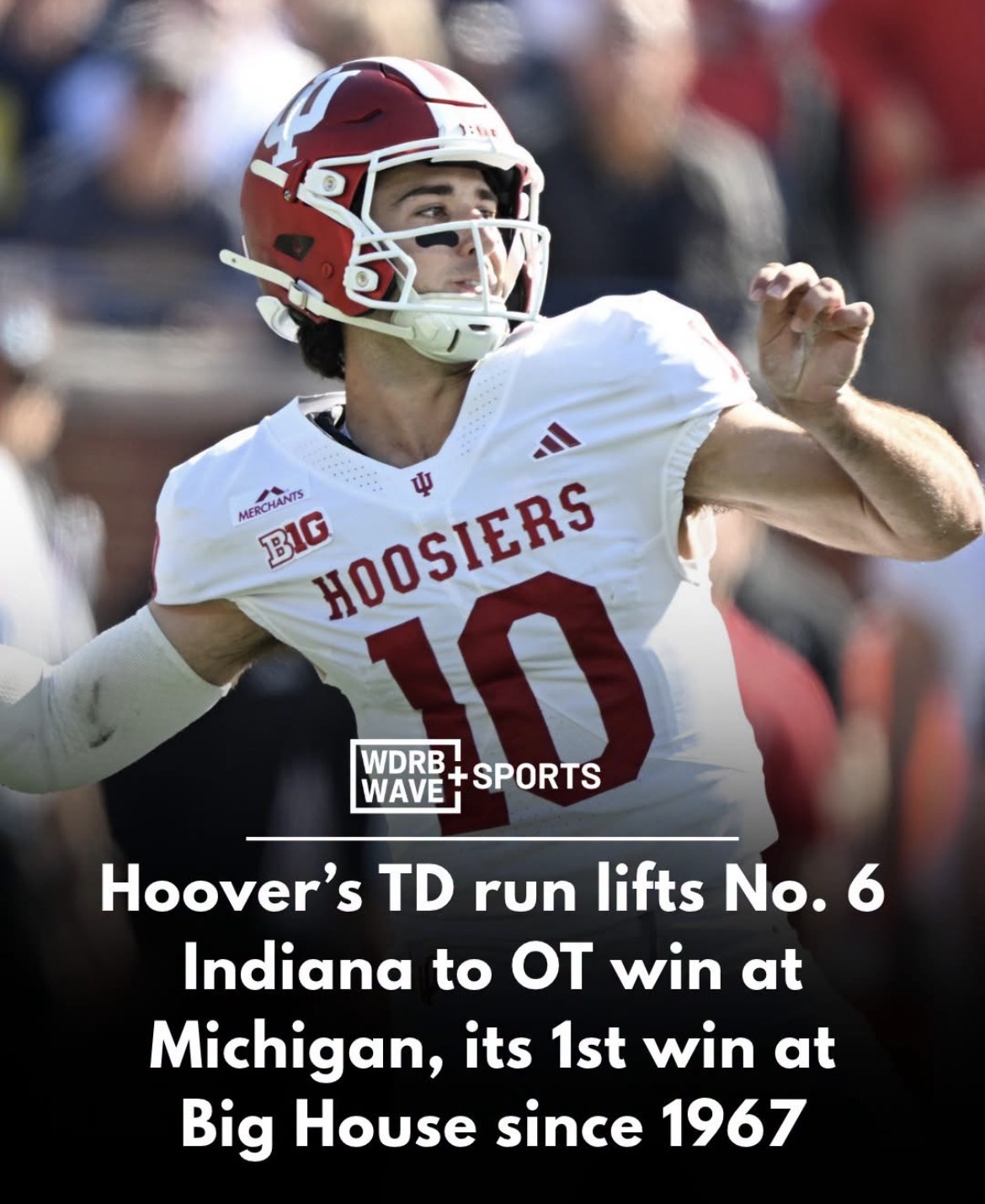
The defending national champion Indiana Hoosiers found a way to overcome adversity, snap a difficult stretch and make history Saturday, defeating Michigan 13-6 in overtime at Michigan Stadium.
Head coach Curt Cignetti’s team entered the matchup looking to respond after a narrow 19-15 loss to Ohio State the previous week. Instead of allowing that defeat to turn into a losing streak, Indiana delivered a resilient defensive performance and secured its first victory at the Big House since 1967.
The victory improved Indiana’s record to 7-1 overall and 4-1 in Big Ten play. More importantly, it preserved a remarkable trend under Cignetti: the Hoosiers avoided consecutive losses for the first time in three years under their head coach.
Indiana’s latest triumph was not an offensive masterpiece. The Hoosiers struggled to establish their passing game, encountered difficulties moving the football consistently and spent much of the afternoon relying on their defense to keep Michigan from taking control.
But championship teams are often judged by their ability to win when circumstances become uncomfortable. In Ann Arbor, Indiana demonstrated precisely that quality.
Indiana’s defense delivers when the offense struggles
The biggest difference in Saturday’s contest was Indiana’s ability to control the game defensively, even when its offense struggled to produce points.
The Hoosiers entered the matchup ranked No. 6 nationally, but their offensive performance against Michigan fell well below expectations. Indiana finished with 212 total yards, including just 81 passing yards, as quarterback Josh Hoover struggled while playing through an injury.
Hoover completed eight of 18 passes and threw an interception that helped Michigan get on the scoreboard. His limited second-half passing production forced Indiana to rely more heavily on its ground game and defense.
The Hoosiers managed 131 rushing yards, with Turbo Richard leading the way with 68 yards on 19 carries. Lee Beebe Jr. added 56 yards on 12 attempts as Indiana attempted to maintain possession and avoid costly mistakes.
Despite the offensive limitations, the defense consistently prevented Michigan from turning promising possessions into touchdowns.
Indiana recorded four sacks and 10 tackles for loss while holding the Wolverines to 224 total yards. Linebacker Rolijah Hardy delivered two sacks, while defensive lineman Tobi Osunsanmi also recorded two.
Those defensive plays proved crucial in a game where neither team could establish consistent offensive momentum.
Josh Hoover makes the decisive play in overtime
After four quarters of defensive football, Indiana finally found the breakthrough it needed in overtime.
Hoover, who had struggled to complete passes throughout the afternoon, connected with tight end Brock Schott for a 21-yard gain on the opening play of the extra period. The completion immediately placed the Hoosiers in a favorable scoring position and gave their offense the opportunity to finish the game.
Indiana capitalized on that opportunity.
Hoover carried the ball four yards into the end zone for the game’s only touchdown, giving the Hoosiers a 13-6 advantage. The score was particularly significant because the quarterback had been dealing with an injury that nearly led the coaching staff to replace him with backup Grant Wilson.
Cignetti later explained that the staff discussed the possibility of a quarterback change but ultimately decided to stick with Hoover.
The decision proved decisive. Hoover had not delivered his best passing performance, but he made the plays that mattered most when the game was on the line.
Michigan received an opportunity to respond in overtime, but Indiana’s defense once again came through. The Wolverines advanced into scoring territory but failed to reach the end zone, with Tommy Carr’s fourth-down pass falling incomplete.
The stop secured the victory and sent Indiana players and coaches into celebration after one of the program’s most memorable regular-season road wins in recent history.
A historic victory at Michigan Stadium
The significance of the result extended far beyond the final score.
Indiana had not won at Michigan Stadium since 1967, making Saturday’s triumph a milestone for a program that has spent decades trying to establish itself among college football’s elite.
The Hoosiers entered the 2026 season as defending national champions after their breakthrough campaign the previous year. Maintaining that level of success has brought a different set of challenges, including increased expectations and opponents eager to challenge the defending titleholders.
The loss to Ohio State had placed additional pressure on Indiana to respond. A second consecutive defeat could have raised concerns about the team’s momentum and its ability to remain in contention for another College Football Playoff appearance.
Instead, Indiana demonstrated resilience in a hostile environment.
The 13-6 victory improved the Hoosiers to 7-1 overall and 4-1 in Big Ten play. It also extended their road winning streak to eight games, according to Indiana’s official postgame notes.
For Cignetti, the result reinforced the mentality he has worked to establish since arriving in Bloomington: find a way to win, regardless of the circumstances.
Indiana did not dominate Michigan offensively, and the game was far from aesthetically pleasing. But the Hoosiers protected their lead, overcame a difficult quarterback situation and executed when the opportunity finally arrived.
Michigan’s offensive problems continue
While Indiana celebrated a historic win, Michigan was left searching for answers after another frustrating offensive performance.
The Wolverines entered the game with quarterback Tommy Carr making his first career start, while Bryce Underwood was held out of the starting lineup. Carr finished with 167 passing yards on 20-of-32 passing, along with an interception and a fumble.
Michigan struggled to convert its opportunities into touchdowns, settling for two field goals after trailing for most of the afternoon.
The Wolverines also had difficulty protecting Carr, as Indiana’s pass rush repeatedly disrupted their offensive rhythm. A late sack in regulation forced Michigan to settle for a field goal that tied the game at 6-6 and sent the contest into overtime.
Michigan’s inability to find the end zone ultimately proved costly. The Wolverines finished with only 57 rushing yards and were unable to produce the decisive play needed to extend the game after Hoover’s touchdown.
The defeat dropped Michigan to 4-3 overall and 1-3 in conference play, adding further pressure as the team looks to recover during the second half of the season.
What the win means for Indiana’s season
Indiana’s victory provides an important reminder that defending a national championship requires more than explosive offensive performances.
The Hoosiers have experienced the pressure of being one of the teams everyone wants to beat, and their narrow loss to Ohio State demonstrated how small the margins can be against elite competition.
Saturday’s performance showed another side of the defending champions. When the offense struggled, the defense kept the game within reach. When the quarterback’s health became a concern, the coaching staff trusted him to finish the job. And when overtime presented an opportunity, Indiana converted it into a winning touchdown.
The Hoosiers will next host Minnesota as they attempt to build momentum heading into the final stretch of the regular season. With their College Football Playoff ambitions still alive, the focus will be on improving offensive consistency while maintaining the defensive intensity that carried them through the Michigan game.
For now, Indiana can celebrate a victory that ended a 59-year wait at the Big House and prevented the program’s first consecutive losses under Cignetti in three years.
The bottom line: Indiana did not need a perfect performance to make history. The Hoosiers needed resilience, timely defense and one decisive play from Josh Hoover. They delivered all three, leaving Ann Arbor with a 13-6 overtime win and keeping their championship ambitions firmly on track.