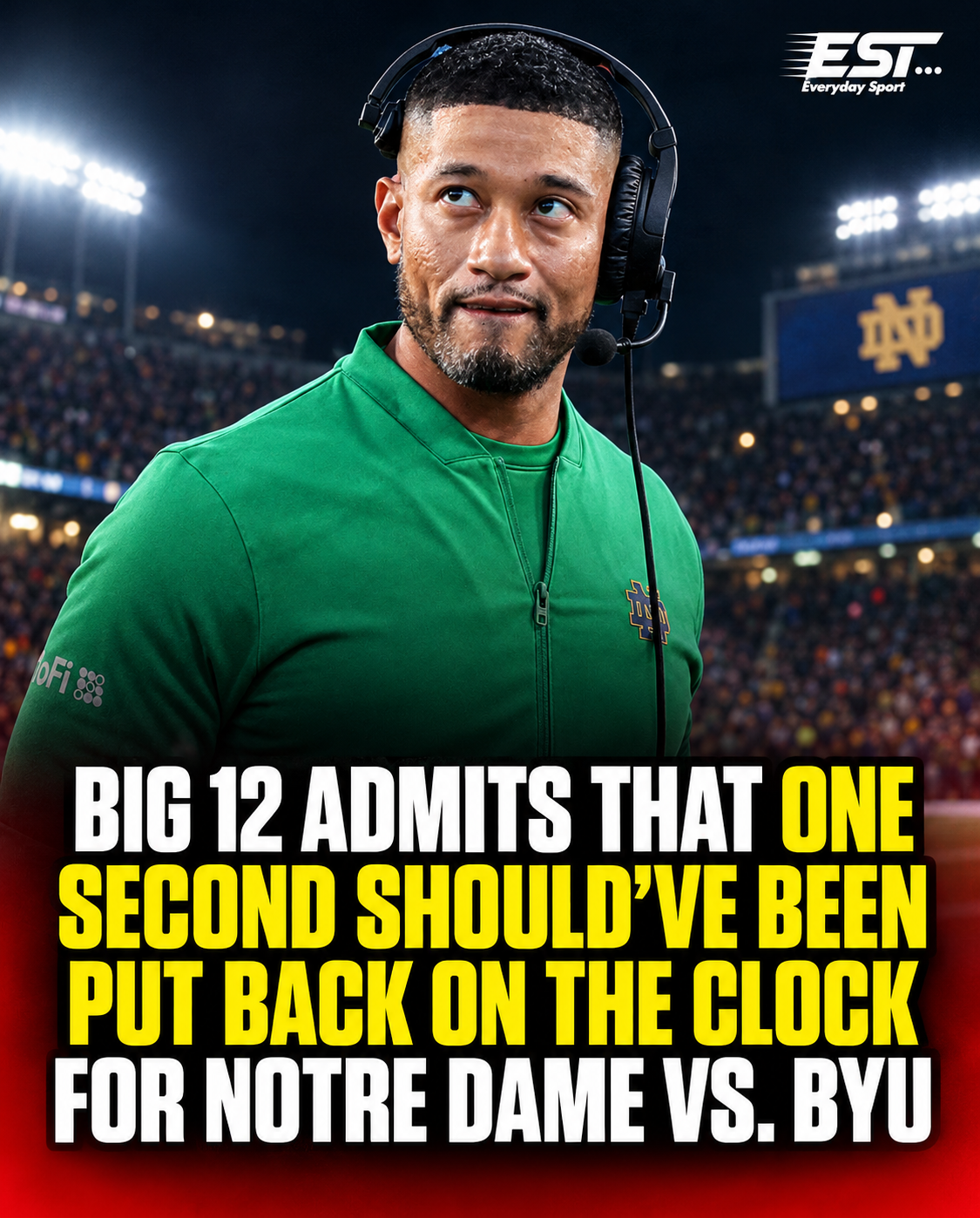
Big 12 Admits Clock Error in BYU-Notre Dame Finish, Raising Questions About Officials’ Handling of Crucial Final Play
The Big 12 Conference has reportedly acknowledged that time remained on the clock during the closing moments of the matchup between Notre Dame and BYU, raising serious questions about how the officials handled the decisive sequence. The error could have cost the Fighting Irish one final opportunity to pursue a late comeback and potentially change the outcome of the game.
The disputed finish has become a major talking point because every second matters in college football, particularly when a team is attempting to mount a comeback in the closing moments. For Notre Dame, the possibility of having another opportunity to win makes the situation especially frustrating. For BYU, the controversy has placed renewed attention on the final moments of a game that should ultimately be decided by what happens on the field.
When a game reaches its final seconds, officials must make quick decisions while ensuring that the clock, the down, the spot of the ball and the status of the play are handled correctly. Any mistake in that process can have consequences far beyond a single snap. In this case, the reported acknowledgment that time remained has intensified the debate over whether Notre Dame was denied a legitimate chance to continue its final possession.
Big 12 Admits Officiating Error in Notre Dame-BYU Finish, Says Irish Deserved One More Play
College Football | Game Recap and Analysis
The controversy surrounding Notre Dame’s 28-24 loss to BYU has taken a significant turn after the Big 12 Conference acknowledged that officials incorrectly ended the game while one second remained on the clock. The admission confirms that the Fighting Irish should have received another opportunity to extend their final possession, creating a major talking point following one of the weekend’s most dramatic college football finishes.
For Notre Dame, the revelation adds frustration to a defeat that ended its 16-game winning streak. For BYU, the result remains a major victory, but the final moments will now be remembered alongside questions about the officiating crew’s handling of the clock and replay review.
The Big 12 acknowledged the mistake in a statement released after reviewing the final play. The conference determined that time remained when the football hit the ground and that the replay officiating crew incorrectly cleared the play, allowing the game to end prematurely. The conference also announced plans to conduct a comprehensive review of its end-of-game officiating procedures before the following week’s games.
How the Controversial Finish Unfolded
Notre Dame entered the final moments of Saturday’s matchup needing a touchdown to overcome BYU. The Fighting Irish had battled back from a halftime deficit and briefly taken the lead in the fourth quarter, only for the Cougars to respond and regain control.
BYU ultimately moved ahead 28-24, leaving Notre Dame with one last opportunity to produce a late comeback.
Quarterback CJ Carr led the final sequence, with the Fighting Irish pushing toward the end zone as the clock continued to run down. On the final play, Carr threw a pass intended for wide receiver Jaden Greathouse in the end zone.
The pass fell incomplete, and officials subsequently ruled that the game was over. BYU celebrated a hard-fought victory, while Notre Dame was left to absorb its first defeat of the season.
However, replays showed that the ball had hit the ground with one second still remaining. That detail proved crucial because Notre Dame should have been permitted to run another play rather than have the contest declared finished.
The conference’s postgame review confirmed what the replay footage appeared to show. The error was not simply a matter of whether a final pass was completed. It concerned whether the officials correctly applied the game-ending procedure and allowed the clock to be handled according to the rules.
Big 12 Acknowledges the Mistake
The conference’s statement brought clarity to the clock controversy while raising additional questions about how the error occurred.
According to the Big 12, the replay officiating crew incorrectly cleared the final play despite time remaining when the pass hit the turf. The conference said it would review its procedures to help prevent a similar situation in future games.
That admission is significant because replay review is designed to help officials correct mistakes and ensure that crucial decisions are made accurately. In a close game, a single second can determine whether a team gets another snap or whether its season-defining opportunity disappears.
The situation also highlights the importance of communication between the officials on the field and the replay crew. Although the game clock is only one component of a football contest, its proper management is essential, particularly when a team is attempting a final scoring drive.
For Notre Dame, the conference’s acknowledgment confirms that the ending was not handled correctly. However, it does not establish that the Fighting Irish would have scored on the additional play or changed the final result.
That distinction matters. The officials’ error denied Notre Dame an opportunity, but the outcome of a hypothetical final snap remains unknown.
Notre Dame Had Another Chance to Win
The missed second is especially significant because Notre Dame was still within striking distance of the end zone.
With another play available, the Fighting Irish could have attempted another pass, used a different offensive formation or looked for an alternative route into the end zone. The coaching staff would have had one final opportunity to make a decision that could potentially have changed the outcome.
Carr and the Notre Dame offense had already faced considerable pressure during the closing sequence. An additional snap would not have guaranteed a touchdown, but it would have allowed the team to determine its fate on the field rather than see the game end before the clock had expired.
That is the central issue surrounding the controversy: Notre Dame did not need officials to guarantee a victory. It needed the opportunity that the rules should have provided.
The disputed ending also featured questions about possible defensive pass interference involving BYU cornerback Evan Johnson and Greathouse. That separate debate added to the scrutiny of the final play, with broadcast rules analysts questioning whether the contact warranted a penalty.
The clock error, however, stands apart from the pass-interference discussion. Even without a defensive penalty, the Big 12’s review established that the game should not have been declared over at that moment.
What the Error Means for BYU
Despite the controversy, BYU’s performance throughout the game should not be overlooked. The Cougars secured a 28-24 victory over a highly ranked Notre Dame team, delivering a significant result in front of their home crowd at LaVell Edwards Stadium.
The win showcased BYU’s ability to respond when Notre Dame threatened to take control. The Cougars made the plays necessary to move ahead late in the contest and appeared to have secured the result when Carr’s final pass fell incomplete.
Nevertheless, the postgame admission has changed the conversation surrounding the finish.
Instead of focusing exclusively on BYU’s victory, attention has shifted toward the officiating process and the failure to recognize the remaining second. The Cougars earned the lead on the scoreboard, but the game’s conclusion should have included one additional Notre Dame play.
The distinction is important for both programs. BYU can point to its performance across the game, while Notre Dame can reasonably question why its final opportunity was taken away before time had fully expired.
Questions Remain About Officiating Accountability
The Big 12’s commitment to reviewing its procedures is an important first step, but the situation also raises broader questions about officiating accountability in college football.
Teams invest months preparing for games that can influence rankings, postseason opportunities and the direction of an entire season. Coaches and players are expected to execute under pressure, and officials must meet the same standard of accuracy when enforcing the rules.
Clock management becomes particularly important during the final seconds because there is little time available to correct an error once a game has been declared over.
The Big 12 now faces the task of examining how the replay crew reached its decision and determining what procedural changes may be necessary. Its review could help identify whether communication, replay protocols or other aspects of the end-of-game process require improvement.
For Notre Dame, the admission offers confirmation that the final sequence was mishandled, but it cannot restore the lost opportunity.
The Final Word
The Big 12’s acknowledgment has placed the ending of Notre Dame’s 28-24 loss to BYU under renewed scrutiny. One second remained when Carr’s pass fell incomplete, yet officials cleared the play and ended the game without allowing the Fighting Irish another snap.
Notre Dame might have scored on the final play, or BYU might have held on to win. There is no way to know what would have happened.
What is clear is that the Fighting Irish should have been given the opportunity to find out.
As the Big 12 reviews its officiating procedures, the controversy serves as a reminder that every second matters in college football. In a game decided by four points, the difference between a proper ending and an officiating error can be the difference between a team getting one final chance and watching that chance disappear.