BOOM! Indiana Hoosiers Football Recruiting Is on Fire, and the Hoosiers Have Just Landed Another BIG Commitment
BLOOMINGTON, Ind. — Indiana football has reached a point where recruiting victories no longer feel like isolated surprises. They are beginning to look like the foundation of something much bigger.
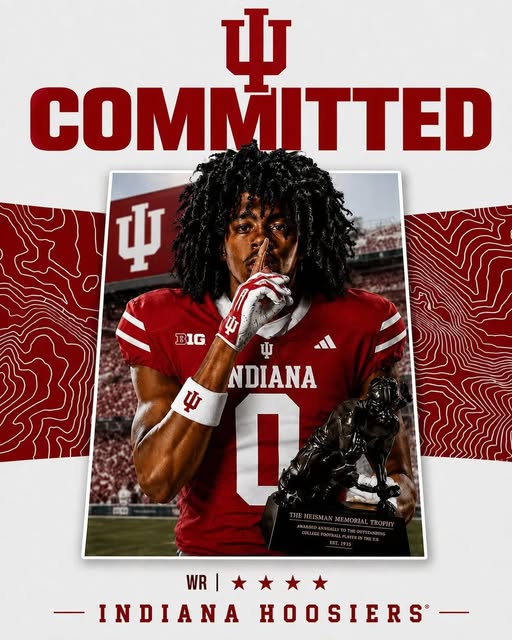
The latest evidence is a commitment that would have been difficult to imagine only a few years ago: five-star wide receiver Monshun Sales, an Indianapolis native and one of the nation’s premier prospects in the 2027 recruiting class, chose the Hoosiers over a heavyweight group that included Ohio State, Alabama, Texas and LSU.
For Indiana coach Curt Cignetti, this was more than another name on a recruiting board. It was a statement.
Sales is ranked among the top prospects in the country and was rated No. 8 overall and No. 2 at wide receiver in the 247Sports Composite at the time of his commitment. On3/Rivals likewise identified him as a national-level five-star prospect. His decision made him the highest-rated recruit to commit to Indiana in the modern recruiting era, surpassing former Hoosiers standout Dasan McCullough.
And perhaps most importantly for Indiana, Sales did not simply select the Hoosiers because they were the hometown option.
He chose them while programs with decades of recruiting dominance were sitting at the table.
That distinction matters.
Indiana’s recruiting transformation under Cignetti has been gradual, but the trajectory has changed dramatically since his arrival in Bloomington. The Hoosiers were long viewed as a program that had to identify undervalued prospects, develop them and maximize every available advantage. Cignetti’s early success has not eliminated that philosophy. Instead, it has added another dimension: Indiana can now compete for prospects who previously might not have considered Bloomington a realistic destination.
Sales is the clearest example yet.
Before Cignetti arrived, Indiana had never signed a five-star recruit. The program then won at a level that changed the perception of what was possible in Bloomington, culminating in the Hoosiers’ historic 2025 season and national championship. That success has begun to carry directly onto the recruiting trail.
The 2027 class illustrates the change.
Indiana entered the summer building momentum with a wave of commitments, including four-star linebacker Jalaythan Mayfield, four-star defensive lineman Reinaldo Perez, four-star edge rusher Myles Smith and four-star offensive tackle Mason McDermott. The Hoosiers also added several three-star prospects at positions of need, creating a class built across the roster rather than around a handful of marquee names.
Sales changes the ceiling of that group.
At approximately 6-foot-5 and around 205 pounds, Sales brings the profile of a modern boundary receiver: size, catch radius and the ability to create matchup problems on the perimeter. His presence gives Indiana another potential vertical weapon in an offense that has increasingly become attractive to skill-position recruits.
That offensive identity is central to the story.
Recruiting is rarely about one player. Elite prospects want to know who will develop them, how they will be used and whether the program can put them in position to reach the next level. Indiana’s recent offensive production and its ability to showcase receivers have therefore become part of the pitch.
The Hoosiers’ 2027 receiver group already included in-state prospect Branden Sharpe and Jordan Carrasquillo before Sales arrived. Carrasquillo, a three-star receiver from Georgia, had previously explained that Indiana’s ability to move the football and create favorable matchups stood out during his recruitment. He finished his junior season with 33 receptions for 586 yards and seven touchdowns, averaging 17.75 yards per catch.
Now add Sales to that equation, and Indiana has a receiving room in the making that looks considerably different from the one the program might have expected to assemble several years ago.
The implications extend beyond the 2027 class.
When an elite local prospect chooses Indiana over Ohio State, Alabama, Texas and LSU, other recruits notice. Recruiting is relational. One commitment can influence another, particularly when the player is nationally recognizable and remains connected to the state’s high school football community.
That is why Sales’ decision could become a recruiting multiplier.
Indiana already has one commitment in the 2028 class, quarterback Lukas Prock, a highly regarded young signal caller from Massachusetts. The Hoosiers also have continued to pursue additional national prospects as they attempt to build consecutive classes capable of sustaining the program’s rise.
The timing is particularly important.
The modern college football calendar has made roster construction an almost year-round operation. The transfer portal, NIL opportunities and expanded playoff have fundamentally changed how programs evaluate talent. Coaches are no longer recruiting simply for the next season. They are attempting to build multi-year pipelines capable of surviving roster turnover and NFL departures.
Indiana’s 2025 championship accelerated that process.
The program’s recent NFL development provides another recruiting asset. Eight Indiana players were selected in the 2026 NFL draft, and 18 former Hoosiers ultimately made 53-man NFL rosters for the 2026 season, according to reporting tracking the program’s professional pipeline.
That is an important selling point.
A high school prospect considering Indiana is no longer being asked to believe only in potential. The program can point toward recent evidence that players developed in Bloomington can reach the NFL.
There is, however, an important distinction between recruiting momentum and guaranteed success.
A commitment is not a signed professional contract. There is no NFL salary-cap consequence attached to a high school pledge, and college NIL arrangements are not equivalent to NFL contracts. Financial details surrounding individual recruits should therefore be treated cautiously unless they are publicly confirmed by the school, the athlete or credible reporting.
What Indiana is building is more significant than any single reported figure.
It is building credibility.
Cignetti has repeatedly demonstrated that he is comfortable constructing teams through evaluation, development, transfers and strategic recruiting. The national championship proved that formula could produce an elite team. The next challenge is proving that Indiana can sustain it.
That is where Sales becomes especially important.
One five-star receiver does not suddenly turn Indiana into Ohio State or Alabama. But landing one of the country’s best players while competing directly against those programs changes the conversation.
It tells other elite recruits that Indiana can win those battles.
It tells Indiana high school prospects that staying home can mean playing for a national contender rather than simply playing for the state’s flagship program.
And it gives Cignetti another piece around which to build the next phase of the Hoosiers’ roster.
The Big Ten, meanwhile, is becoming increasingly unforgiving. Ohio State, Oregon, Penn State, Michigan and other national powers continue to operate with enormous recruiting and financial resources. Indiana’s path to sustained contention therefore cannot depend on one historic season. It needs depth, development and a consistent flow of high-end talent.
Sales represents the kind of commitment that can help create that ecosystem.
The Hoosiers have already shown they can win on Saturdays.
Now they are beginning to win the recruiting battles that determine what happens years later.
That may ultimately be the most important development of all.
For decades, Indiana football operated from the outside of the national recruiting conversation. Cignetti has spent the past several seasons changing that perception through results. The 2027 class is now becoming evidence that those results are influencing the players who will determine the program’s future.
Sales is the headline name.
But the larger story is the direction of the program.
Indiana is no longer simply asking whether it can compete with the Big Ten’s elite.
It is beginning to recruit like it expects to stay there.