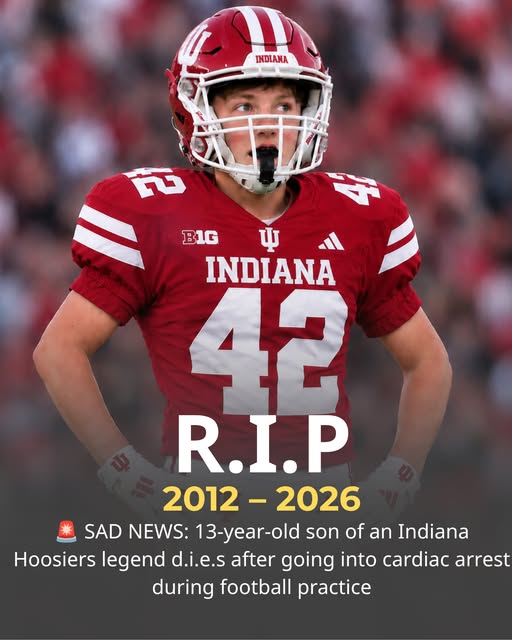
🚨 SAD NEWS: 13-Year-Old Son of Indiana Hoosiers Legend Dies After Suffering Cardiac Arrest During Football Practice….
The football community is mourning an unimaginable tragedy after 13-year-old Caden Sorrell, the son of an Indiana Hoosiers football legend, died days after suffering sudden cardiac arrest during a youth football practice in North Carolina. The heartbreaking loss has sent shockwaves far beyond his hometown, resonating throughout college football and reminding everyone connected to the sport that some battles transcend wins, losses, and championships.
Caden, an eighth-grade football player at Northwest Guilford Middle School in Greensboro, collapsed during the opening moments of practice after completing a routine warm-up lap. Coaches and medical personnel immediately began life-saving measures before he was transported to Cone Hospital, where doctors employed advanced cardiac support, including extracorporeal membrane oxygenation (ECMO), in an effort to save his life. Despite days of intensive treatment, his family announced that the neurological damage caused by the cardiac arrest was irreversible, and Caden passed away surrounded by loved ones.
For a family already deeply rooted in football, the loss is particularly devastating. Caden grew up immersed in the culture of the game through his father’s legacy as a celebrated Indiana Hoosiers player, developing the same passion, competitive spirit, and love for football that had defined generations before him. Friends and teammates remembered him not simply as a gifted young athlete, but as a joyful teammate whose infectious personality made every practice and every locker room brighter.
The tragedy unfolded with frightening speed.
According to accounts provided by the family, Caden showed no signs of distress before practice began. He completed the team’s initial conditioning run when he suddenly collapsed on the field. Emergency responders arrived quickly, and CPR was administered almost immediately while an automated external defibrillator was deployed in an effort to restore his heartbeat. He was rushed to the hospital, where specialists worked tirelessly over the following days using multiple forms of advanced cardiovascular support.
His parents later revealed that physicians believe an undiagnosed genetic heart condition may have contributed to the cardiac arrest. As a result, Caden’s four siblings are expected to undergo comprehensive genetic and cardiac screening, even though there had been no previous indication that the family carried such a condition.
That revelation has transformed an already heartbreaking story into an urgent conversation about youth athlete safety.
Sudden cardiac arrest remains the leading cause of death among student-athletes during school-sponsored athletic activities. Unlike heart attacks, which are typically caused by blocked arteries, sudden cardiac arrest often stems from electrical abnormalities within the heart and can strike seemingly healthy young athletes without warning. Rapid CPR and immediate access to an AED dramatically improve survival odds, making emergency preparedness one of the most critical components of modern athletic programs.
Indiana has been at the forefront of strengthening those protections.
In recent years, state lawmakers expanded legislation requiring schools to establish sudden cardiac emergency response plans and ensure that AEDs are readily accessible during athletic events and extracurricular activities. The legislation was inspired in part by previous tragedies involving Indiana student-athletes, including the death of LaPorte linebacker Jake West during football practice in 2013. His family’s advocacy helped reshape statewide emergency protocols and heightened awareness of cardiac screening for young competitors.
While Caden’s passing occurred outside Indiana, the connection to one of the Hoosiers’ most respected football families has united communities across state lines.
Messages of support poured in from former Indiana players, coaches, Big Ten programs, and youth football organizations throughout the country. Many described the loss as a reminder that football’s greatest strength has always been its sense of family—a bond that extends well beyond Saturdays in Bloomington or Friday nights under stadium lights.
The Indiana program has long prided itself on cultivating relationships that last far beyond graduation. Whether during the transformative years under the late Terry Hoeppner, the resurgence led by Tom Allen, or the championship ambitions that have defined recent seasons under Curt Cignetti, the Hoosiers have consistently emphasized character alongside competition. This tragedy places those values into painful perspective, as the football community rallies around one of its own during its darkest moment.
For coaches across America, Caden’s death will inevitably renew discussions surrounding preseason practice protocols.
Modern football has already undergone significant evolution in response to player safety. Heat acclimatization guidelines have become standard. Contact periods have been reduced. Independent athletic trainers are now common across many high school and collegiate programs. Yet cardiac emergencies remain uniquely difficult because they often arrive without obvious warning signs.
Sports cardiologists have increasingly advocated for broader access to electrocardiogram screening and expanded family history evaluations, particularly for athletes participating in competitive football. While universal ECG screening remains debated due to cost and the possibility of false positives, tragedies like Caden’s inevitably reignite conversations about whether additional preventative measures could identify hidden conditions before they become catastrophic.
The emotional impact extends beyond medicine and policy.
Teammates gathered for a candlelight vigil just days after Caden’s passing, filling the stadium with jerseys, footballs, flowers, and handwritten messages celebrating his life. Coaches encouraged players to lean on one another and reminded them that grief, like football, is never meant to be carried alone. School officials established counseling services while the local football community organized memorial tributes in Caden’s honor.
His family has also begun channeling unimaginable grief into advocacy.
Rather than focusing solely on their own heartbreak, Caden’s parents have urged other families to consider cardiac evaluations for young athletes—even in the absence of symptoms or known family history. Their message has resonated nationally, particularly among parents preparing children for fall football seasons, as awareness campaigns surrounding sudden cardiac arrest continue to gain momentum.
Within the broader football landscape, moments like these momentarily silence every debate that typically dominates headlines.
Recruiting rankings lose significance. Transfer portal speculation fades. Playoff projections become irrelevant. The sport’s relentless news cycle pauses to acknowledge a painful truth: behind every helmet is a child, a teammate, and a family whose life extends far beyond the game itself.
For Indiana’s football community, that reality hits especially hard. The Hoosiers have celebrated remarkable progress in recent years, emerging as one of the Big Ten’s premier programs through elite recruiting, disciplined development, and championship aspirations. Yet the foundation of any successful program has always rested on the people who build it. This week, victories will be measured not in touchdowns or defensive stops, but in compassion, unity, and support for a grieving family whose connection to Indiana football runs generations deep.
Caden Sorrell’s story is not ultimately about statistics or potential. It is about a 13-year-old who loved football, cherished his teammates, dreamed of following the path carved by his father’s Hoosiers legacy, and inspired countless people through the joy he brought to the field every day.
As stadiums across the country observe moments of silence and communities wear his number in tribute, football once again demonstrates its most enduring quality: the ability to come together when one of its own needs it most. Caden’s life ended far too soon, but his memory will continue to echo through every practice, every kickoff, and every young athlete whose safety becomes stronger because of the conversations his story has inspired.