BLOOMINGTON, Ind. — Josh Hoover’s first start for Indiana was supposed to be about proving he could handle the enormous responsibility of replacing a Heisman Trophy winner and leading the defending national champions.
Instead, it became a test of something more basic.
Could he take a brutal shot, bleed through his helmet and uniform, and keep running the offense?
The answer came quickly.
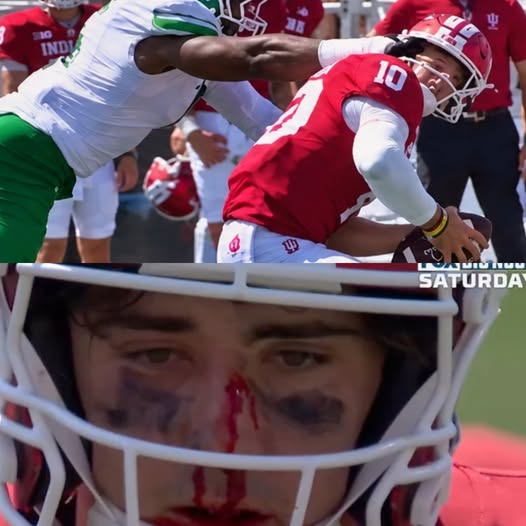
During the second quarter of Indiana’s season opener against North Texas on Saturday, a Mean Green defender grabbed Hoover’s facemask and violently twisted his helmet nearly all the way around his head. The play drew an immediate 15-yard penalty, but the visual was far more jarring than the flag: Hoover’s helmet had been turned backward and blood began pouring from his nose.
The hit immediately raised concern for the fifth-year quarterback, particularly because of the violent torque created when his facemask was pulled. But Hoover stayed in the game.
And rather than simply surviving the sequence, he finished the drive by throwing a touchdown.
Three plays after the penalty moved Indiana into scoring territory, Hoover found Charlie Becker for a 9-yard touchdown pass, extending the Hoosiers’ lead and turning an alarming moment into one of the defining images of Indiana’s 52-16 victory.
The FOX College Football broadcast captured the scene, with blood visible on Hoover’s face and chinstrap as he continued operating the offense.
For a quarterback entering perhaps the most scrutinized season of his career, it was an unforgettable introduction.
Hoover did not simply make his Indiana debut. He made it with blood on his face.
The larger significance, however, extends beyond one violent play.
Indiana entered 2026 carrying expectations unlike anything the program had experienced before. Curt Cignetti’s team finished 2025 with a perfect 16-0 record, won the national championship and watched quarterback Fernando Mendoza capture the Heisman Trophy before becoming the No. 1 overall pick in the 2026 NFL draft.
That made Hoover’s transition one of the central questions surrounding the Hoosiers.
Replacing Mendoza was never going to be a routine quarterback change. Mendoza became one of the most accomplished players in program history during Indiana’s championship run, and the NFL rewarded his performance by making him the first player selected in the draft.
Hoover arrived from TCU with considerably less fanfare but an extensive résumé of his own.
According to Indiana’s official roster, Hoover appeared in 35 games and made 31 starts during his four seasons at TCU. He entered the season with 9,629 career passing yards and 79 total touchdowns, according to USA Today Network’s report on Saturday’s game. He also had 16 career games with at least 300 passing yards and had thrown four or more touchdown passes eight times.
That experience was a major reason Cignetti believed Hoover could handle the transition.
“He’s played a lot of football,” Cignetti said during Indiana’s offseason preparation. “I’m confident he’ll come out of camp ready to play well and build off his successes.”
Saturday offered the first meaningful evidence that the coach’s confidence was justified.
Hoover completed 13 of 16 passes for 231 yards and four touchdowns, producing an efficient 81.3% completion rate while avoiding an interception. Indiana’s offense eventually pulled away from North Texas for a 52-16 victory, extending Cignetti’s winning streak to 17 games.
The efficiency mattered.
For a quarterback inheriting a championship roster, the first objective isn’t necessarily to replicate every statistic Mendoza produced. It is to keep the offense on schedule, protect possessions and distribute the football to the talent surrounding him.
Hoover accomplished that.
His first touchdown as a Hoosier came on a back-shoulder throw to Michigan State transfer Nick Marsh, who made a spectacular one-handed catch for the score. Later came the touchdown to Becker after Hoover absorbed the facemask hit.
By halftime, Hoover had completed seven of eight passes for two touchdowns and had not thrown an interception.
The bloodied face became the headline, but the efficiency may ultimately be more important to Indiana’s championship defense.
Cignetti’s team doesn’t need Hoover to win games by himself. The Hoosiers have built a roster designed to complement their quarterback, with an experienced coaching staff, a talented receiving corps and a defense expected to remain among the team’s defining strengths.
That formula gives Hoover room to operate.
It also means Indiana can afford to be selective about how aggressively it asks its quarterback to attack downfield. Turnover avoidance will be particularly important as the schedule becomes more demanding and the margin for error narrows inside the Big Ten.
Hoover’s history provides reason for optimism, but also a reminder of what Indiana must manage.
At TCU, he demonstrated the ability to produce explosive passing numbers but also experienced stretches of turnover trouble. Indiana’s system, however, is designed to put its quarterback in favorable situations rather than force him into constant high-volume, high-risk passing.
Saturday was an encouraging first step.
There was another encouraging element: Hoover’s response to adversity.
Nobody should mistake playing through a bloody nose for evidence that an injury is insignificant. Football’s culture of toughness can sometimes blur the line between resilience and unnecessary risk. The important fact from Saturday is that Hoover remained on the field and, based on the reports available after the game, there was no indication of a major injury from the facemask incident.
He later returned with a bandage over his nose.
That image will likely follow him throughout the season.
Indiana’s players and fans will remember the quarterback who arrived to replace the No. 1 overall pick and immediately showed that he was willing to absorb the physical cost of the job.
But the real test begins now.
North Texas was an important opening assignment, but Indiana’s championship ambitions will ultimately be measured against Big Ten competition and the College Football Playoff field.
The Hoosiers entered the season ranked No. 6 nationally, a reflection of both last year’s championship and the amount of talent Cignetti retained and added through the transfer portal. Their 52-point performance did little to weaken those expectations.
The question is whether Hoover can sustain that level of efficiency when defenses become more sophisticated.
Saturday suggested he has the arm talent and experience.
The facemask sequence suggested something else: he isn’t going to be intimidated by the physical demands of the position.
There is no salary-cap calculation attached to Hoover’s performance because Indiana is operating in college football, not the NFL. His value instead exists within the modern college roster economy, where transfer recruiting, NIL resources and eligibility decisions increasingly shape a team’s ability to maintain championship-level depth.
Indiana’s decision to bring in an experienced transfer quarterback was therefore about more than replacing Mendoza statistically. It was about protecting the program’s competitive window.
So far, Hoover looks capable of doing that.
He finished the afternoon with four touchdown passes, no turnovers and an efficiency that allowed Indiana to pull away despite stretches in which North Texas moved the football effectively. The Hoosiers were not perfect, but their new quarterback gave them exactly what a championship contender needs from its starter in an opener: production without unnecessary mistakes.
And he did it after a play that briefly made the entire stadium hold its breath.
The image of Hoover standing in the pocket with blood streaming from his nose will circulate long after the box score is forgotten. It was violent, unsettling and, in the context of the game, strangely symbolic.
Indiana lost the quarterback who delivered its greatest season ever.
Hoover arrived with the pressure of replacing him.
On his first Saturday as the Hoosiers’ starter, he got knocked around, got bloodied and kept throwing.
Then he threw four touchdown passes.
For Indiana, that may have been the most important message of all.
The Hoosiers are not asking Hoover to be Mendoza.
They are asking him to be himself.
And in his first opportunity, bloodied but unbowed, Hoover looked very much like a quarterback ready for the challenge.