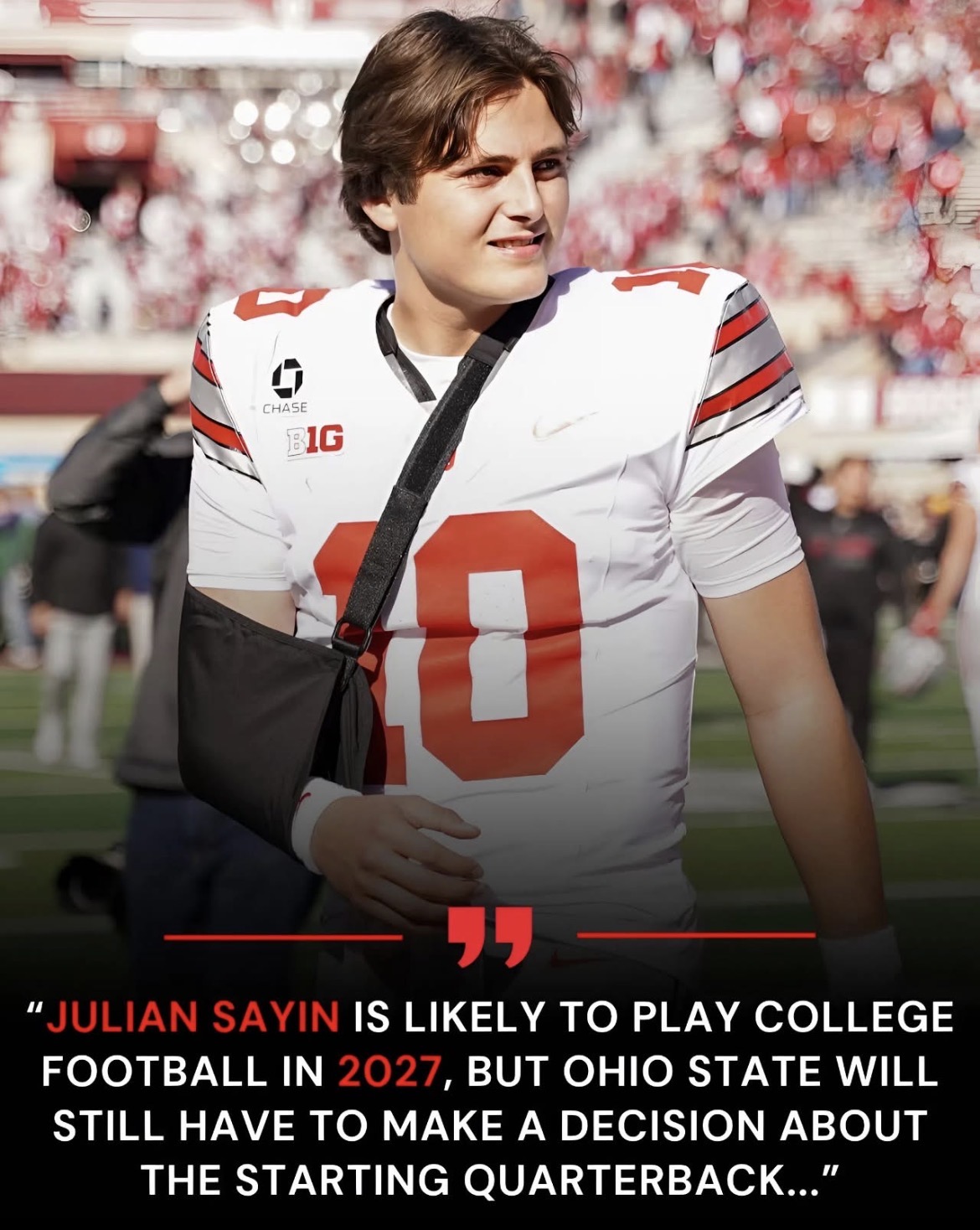
Julian Sayin Likely to Return in 2027 as Ohio State Faces Major Quarterback Decision
Ohio State’s quarterback situation has taken an unexpected turn following Julian Sayin’s throwing-arm injury, and the consequences could extend well beyond the 2026 season. With the Buckeyes preparing for life without their starting quarterback, head coach Ryan Day must evaluate not only who will lead the offense for the remainder of this season but also who deserves the starting job in 2027.
According to a report from Eleven Warriors, Sayin is now more likely to return to college football next season rather than enter the 2027 NFL Draft. However, his expected return does not automatically guarantee that he will reclaim Ohio State’s starting position.
The injury has introduced uncertainty into a quarterback room that appeared to have a clear leader entering the season. With freshman Luke Fahey and former five-star recruit Tavien St. Clair potentially competing for opportunities, Ohio State could face one of its most important personnel decisions heading into 2027.
Sayin’s Injury Could Change His NFL Draft Plans
Before the injury, Sayin had established himself as one of the most productive quarterbacks in college football. His performances during the 2025 season placed him among the sport’s top young passers and helped strengthen expectations surrounding Ohio State’s championship ambitions.
In 2025, Sayin completed 301 of 391 passes for 3,610 yards, 32 touchdowns and eight interceptions. His completion percentage of approximately 77% led the nation, and he finished fourth in Heisman Trophy voting.
Those numbers demonstrated his ability to operate Ohio State’s offense efficiently while delivering consistent production through the air.
Sayin continued that form during the opening seven games of the 2026 campaign. Before suffering his injury against Indiana, he had completed 131 of 192 passes for 2,007 yards, 19 touchdowns and four interceptions.
However, his season changed dramatically during Ohio State’s 19–15 victory over Indiana on October 17. Sayin left the game after injuring his throwing arm and did not return.
Head coach Ryan Day subsequently confirmed that the quarterback would be out indefinitely. The coaching staff began preparing for the possibility that Sayin could miss both the remainder of the regular season and the postseason.
According to reporting from Reuters, the Buckeyes were not providing a definitive recovery timeline, leaving considerable uncertainty about when Sayin could return to action.
That uncertainty is central to Ohio State’s planning for 2027.
If Sayin cannot return to full football activity until late in the offseason, the coaching staff could face difficult decisions about preparation, competition and continuity. Even if he recovers successfully, the program must determine whether he should immediately regain the starting position or compete with other quarterbacks.
For Sayin, returning to college could provide an opportunity to rebuild his momentum, demonstrate that he has recovered and strengthen his professional prospects.
For Ohio State, the challenge will be balancing confidence in an established starter with the need to prepare for every possible scenario.
Luke Fahey Has an Opportunity to Change the Conversation
Luke Fahey: The next man up
Freshman quarterback Luke Fahey is expected to receive an expanded opportunity following Sayin’s injury. His performance during the remainder of the season could influence Ohio State’s plans for 2027.
With Sayin sidelined, Fahey has an opportunity to demonstrate that he can become more than a temporary replacement.
The freshman won the backup role during preseason preparations, finishing ahead of St. Clair on the depth chart. That decision gives Fahey an important advantage as the coaching staff evaluates its available options.
However, replacing a productive starter at a championship-contending program is a significant responsibility. Ohio State needs a quarterback capable of handling pressure, protecting possession, making accurate throws and maintaining communication with the offense.
Fahey’s next opportunity will offer a more meaningful evaluation of his readiness. His limited appearances before Sayin’s injury provided some experience, but extended playing time will test his decision-making and ability to manage the offense against stronger opposition.
A successful finish to the season could strengthen his case for a larger role in 2027.
If Fahey delivers consistent performances, protects the football and helps Ohio State remain competitive in the Big Ten and College Football Playoff race, the coaching staff will have legitimate reasons to consider him for the starting job.
Nevertheless, a few successful performances would not automatically settle the competition. Ohio State must assess the entire body of work, including practice performance, leadership, consistency and how well each quarterback executes the offensive system.
The remainder of the season could therefore become an extended audition for Fahey.
Tavien St. Clair Remains a Factor
Fahey is not the only quarterback with an opportunity to influence the situation.
St. Clair, a former five-star prospect, also remains part of Ohio State’s long-term plans. Although Fahey entered the season ahead of him on the depth chart, Sayin’s injury has created an opportunity for the coaching staff to reassess its options.
Day indicated that both quarterbacks would receive additional first-team repetitions as Ohio State evaluated how to move forward.
That approach makes sense for a program that cannot afford uncertainty at its most important offensive position.
St. Clair has the recruiting pedigree to attract attention, but his ultimate standing will depend on what he demonstrates on the practice field and, if given the opportunity, during games.
If he performs well enough to challenge Fahey, Ohio State could enter the offseason with a genuine competition rather than an obvious successor.
That possibility also creates a roster-management challenge. Both young quarterbacks will want a clear pathway to playing time, and uncertainty surrounding the starting position could influence their decisions about their futures.
The Buckeyes must therefore consider not only which quarterback gives them the best chance to win but also how to maintain sufficient depth at the position.
Could Ohio State Enter the Transfer Portal?
Another possibility is that Ohio State pursues an experienced quarterback through the transfer portal.
The program has previously demonstrated a willingness to strengthen its roster through transfers, and the success of Will Howard during Ohio State’s 2024 national championship season provides a recent example of that approach.
A transfer could offer the Buckeyes additional experience and insurance if Sayin’s recovery affects his offseason preparation.
However, bringing in an established quarterback would not be a straightforward decision. A high-profile transfer would likely expect a legitimate opportunity to compete for the starting position, potentially complicating the futures of Fahey and St. Clair.
Ohio State would need to determine whether adding an experienced passer improves the roster enough to justify the potential disruption to its existing quarterback group.
Recruiting and development also remain important considerations. The Buckeyes have a commitment from 2027 quarterback prospect Brady Edmunds, while Justyn Martin is another potential depth option discussed in recent reporting.
The program must balance immediate championship ambitions with its responsibility to develop quarterbacks who could contribute over multiple seasons.
A transfer would make the most sense if the coaching staff believed the move addressed a significant need without unnecessarily weakening its existing depth.
For now, the possibility remains a strategic option rather than a confirmed decision.
Ryan Day Faces a Defining Decision for 2027
Ultimately, Day must decide whether Sayin remains the best option to lead Ohio State into the 2027 season.
Sayin’s previous production gives him a strong argument. He has already demonstrated that he can operate the offense at a high level, and his experience could prove valuable to a team with championship expectations.
At the same time, the coaching staff cannot ignore the uncertainty surrounding his recovery or the opportunities available to other quarterbacks.
If Fahey performs exceptionally well, St. Clair makes significant progress or an attractive transfer becomes available, Ohio State could have several legitimate options to evaluate.
The decision will involve more than statistics. The coaching staff must consider medical assessments, readiness for competition, leadership, offensive chemistry and the ability to execute under pressure.
It is also important to distinguish between Sayin returning to college and Sayin being guaranteed the starting job. Those are two separate questions, and neither should be treated as officially settled.
The most sensible approach may be to allow the recovery process to progress while evaluating the other quarterbacks throughout the remainder of the season and offseason.
That would give Ohio State a clearer understanding of its options before making a long-term commitment.
The Bottom Line
Julian Sayin’s injury has transformed Ohio State’s quarterback outlook. A player who entered the season with major expectations could now return in 2027 facing competition for the job he previously held.
His production makes him a compelling candidate to remain the Buckeyes’ starter, but Fahey and St. Clair have opportunities to change the conversation. A transfer quarterback could also enter the picture if the coaching staff believes additional experience is necessary.
For now, Sayin’s potential return to college football appears increasingly likely, while the starting position remains uncertain.
Ohio State’s next moves will depend on Sayin’s recovery, the performances of his replacements and the roster decisions made during the offseason.
One thing is clear: Sayin could be back in Columbus in 2027, but he may still have to win the starting job all over again.